Compound batch card captured with one photo
In a radial tire plant every compound skid leaves mixing with a paper card: compound code, batch, mix time, lab result and shelf life. That card travels with the material and decides whether it can go to extrusion or calendering. With iLEAN Connect the operator takes one photo and the batch exists in the central system at second zero, with its shelf-life clock running.
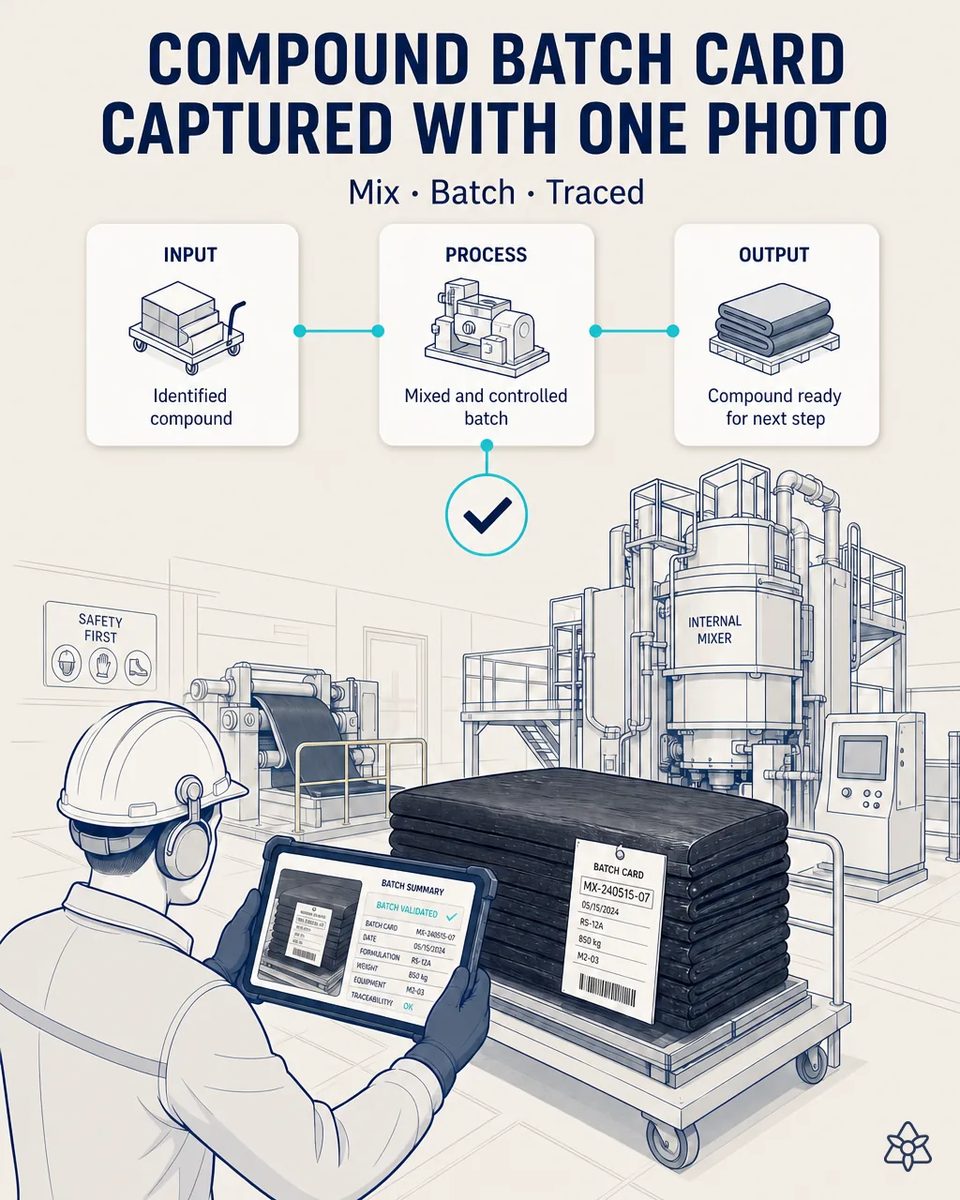
The card that releases a compound to the tread line only exists on paper.
In a tire plant, every compound skid leaves the mixing area with a paper card: compound code, batch, mix time, lab result and shelf life. That card decides whether that rubber can go into a tread or a sidewall. The problem is that the data only lives on paper. When quality asks which compound batches went into a lot of tires, someone rebuilds cards, shift sheets and logs by hand. Hours of work, and traceability gaps exactly when a carmaker opens a claim.
- Every skid leaving the Banbury carries a card with compound code, batch, mix time, rheometer result and shelf life. That card is what lets the rubber go to the tread extruder or the calender.
- Nobody types it at the moment it matters. The data lives on the skid, in shift sheets and in the mixing log, and reaches a system a shift or more later, if it reaches one at all.
- When quality asks which masterbatch and final batches went into a lot of tires, someone rebuilds cards, shift sheets and logs by hand. Hours of work for a single answer.
- The gaps appear exactly when a carmaker opens a claim, and an out-of-life compound that slips into extrusion is discovered at the tire, not at the store. By then it may already be inside a batch of finished tires.
Connect in photo mode — the card stays on the skid, the batch enters the system.
With iLEAN Connect, the operator takes a photo of the card when the skid reaches the intermediate store. iLEAN recognizes the layout, extracts code, batch, time and shelf life, and stores it in central memory. The operator keeps working exactly as before: one extra photo. Before: a shift or more of latency and traceability rebuilt by hand. After: every skid traced at second zero, with its shelf life running, searchable by batch, by compound or by tire.
The operator keeps doing exactly what they did: the card is still written and still travels with the skid. The only new gesture is one photo at the intermediate store, and from that second the batch is searchable and its shelf-life clock is visible to everyone downstream.
Batch cards on paper versus batch cards captured
| Aspect | Today, on paper | With iLEAN Connect |
|---|---|---|
| When the compound batch exists in a system | A shift or more later | Second zero, at the intermediate store |
| Shelf-life clock of each skid | Written on the card, checked by eye | Running and visible to extrusion and calendering |
| Which batches went into a tire lot | Cards and logs rebuilt by hand | One query by tire, batch or compound |
| Out-of-life compound at the extruder | Found later, if at all | Flagged before it is used |
| Masterbatch to final batch link | On two separate cards | Tied in the batch history |
| Mixer operator's routine | — | Unchanged: one extra photo |
A shift or more of latency and hand-rebuilt traceability → every skid traced at second zero and searchable by batch, compound or tire.
Impact estimate — to be validated with your numbers.
The block below is an estimate to be validated against your plant's actual data. We put it forward so the committee has an order of magnitude; we refine it during the assessment.
- Estimated payback 4-9 months, depending on the number of batches per shift and the number of mixing lines.
- Transcription time recovered in mixing, quality and the compound store, without adding a data entry station. The people who rebuild cards today go back to quality work.
- Lower risk of out-of-life compound reaching treads, sidewalls or inner liners, because the shelf-life clock starts at second zero.
- Claim traceability that starts from a query instead of a search through skid cards and shift sheets.
Payback 4-9 months · compound batch traced at second zero (estimate to be validated). We estimate a payback of 4 to 9 months depending on batches per shift, by recovering transcription time and reducing the risk of using out-of-life compound. This is an estimate to be validated with your data.
And the fair question from the production manager
“What if it misreads a batch number on a greasy, handwritten card?” — reading fields from a card with a known layout is an anchored task, where the best models drop below 1.5% error [1]. Low-confidence fields are not guessed: they are flagged, and the batch code is cross-checked against the open mixing order. A person confirms anything doubtful before the batch is used for a release. Every correction is kept, so the reading of that card layout keeps improving.
[1] OpenAI paper "Why Language Models Hallucinate", 2025 — on the reliability of AI in anchored tasks.
What people ask about capturing compound batch cards
Do we have to redesign the compound batch card?
No. iLEAN learns the layout you already use, including handwritten fields and lab stamps. If you change the card later, the new layout is learned from a few examples. Nobody in mixing has to fill in a different form.
Does it link the masterbatch with the final batch?
Yes. When both cards are photographed, the system ties the final batch to the masterbatch skids it consumed, which is the link that is hardest to rebuild by hand during a claim. It is also what lets you see which final batches share a suspect masterbatch.
Can extrusion see the remaining shelf life before loading a skid?
Yes. The shelf-life clock starts with the photo, so the tread extruder or calender operator sees how much life the compound has left and whether it has passed its limit. Out-of-life skids can be blocked before they reach the extruder feed.
What happens if a compound skid reaches the store without a photo?
It shows as a gap in the batch sequence for that shift. The store lead sees which skid is missing and captures it before it goes to extrusion or calendering. Missing photos stop being invisible and become a short list per shift.
Do we need MES integration before the first compound card is read?
No. The case runs against iLEAN's central memory from the first shift, and the push to MES or ERP is connected afterwards, once the value is proven. The first weeks already give you searchable batch history by compound and by tire lot.
More cases from this series
- Synchronized compound flow: zero expired materialConnect, Edge and Agents coordinate mixing, components, building and curing so no compound expires and…
- Human check of every component before buildingEverything iLEAN captures goes through a tablet at the building machine: the operator confirms each…
- The legacy curing press that now talksA camera reads the panel of legacy tire curing presses and digitizes every cure cycle curve without…
- The curing supervisor talks to the AI on the moveBuilding and curing supervisors dictate issues on the move; iLEAN structures them, links them to press…
- From the compound lab Excel to SAPiLEAN reads the rheometer and Mooney results Excel in the shared folder and, after human validation,…
- Mixer weighing system wired to the ERPiLEAN wires the mixer weighing and dosing system to the ERP: recipes flow down automatically and actual…
Tell us how long it takes today to know which compound batches went into a tire lot.
We work on your plant's real data, not ours. Assessment with no commitment.
Request estimated ROI within 48h ‹ See all cases of radial tires See automotive