Human check of every component before building
What sets iLEAN apart from an autonomous agent is that nothing it captures enters the central system without a human seeing it first. In a tire plant that means a tablet at the building machine: when a tread, sidewall or ply roll is loaded, the operator sees the summary — code, batch, remaining shelf life, tire size — and confirms with two taps.
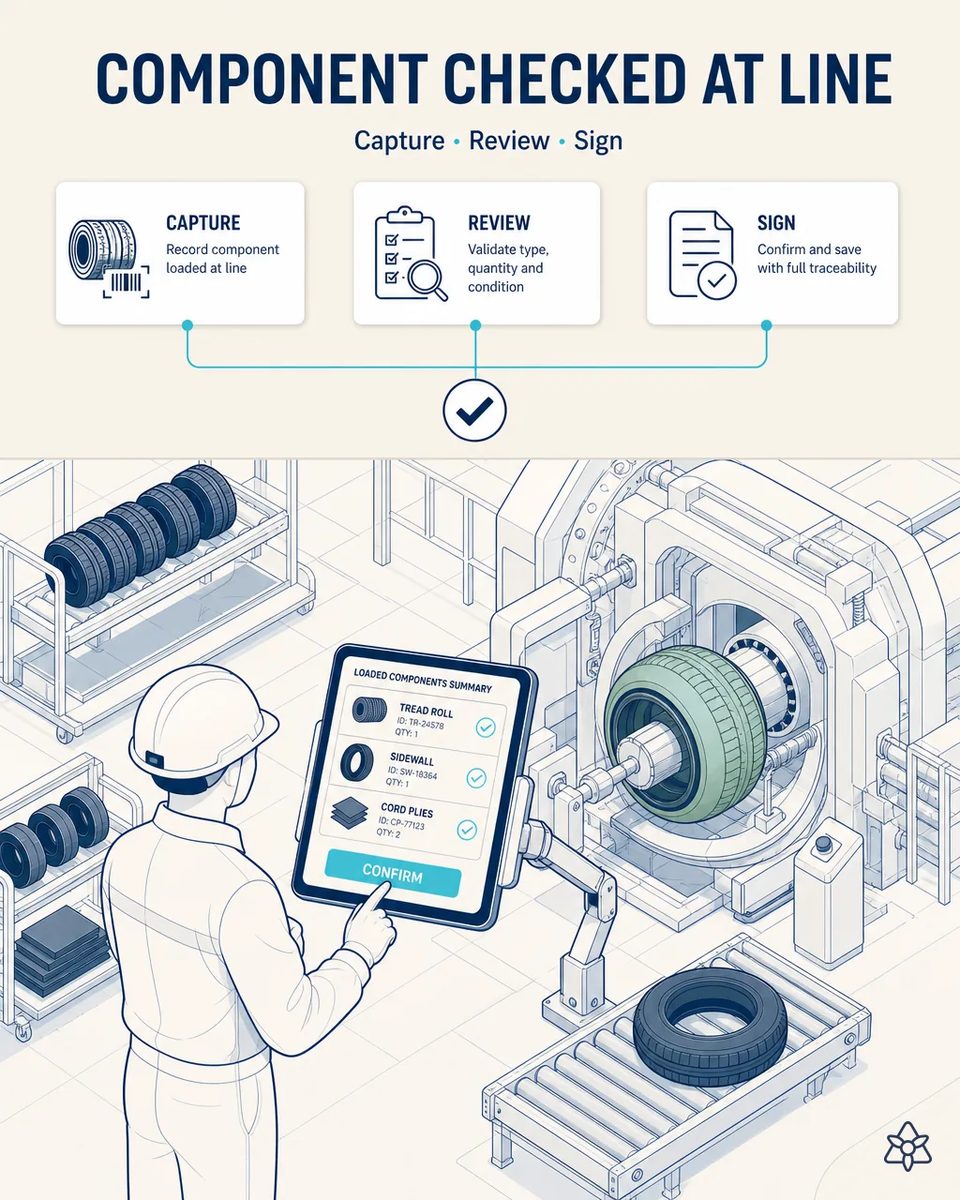
A wrong component in the green tire is found two stages too late.
The main barrier to AI on the shop floor is the fear that it enters unsigned data and pollutes the ERP master. In tire building that is critical: a wrong or expired component in the green tire ends up as scrap or as a claim. But the building machine operator cannot stop to type. Today the component check is visual or on paper, and the mistake shows up in curing or final inspection.
- The main barrier to AI on the shop floor is the fear that it writes unsigned data into the ERP master. In tire building that fear is justified.
- A wrong or expired tread, sidewall, ply or bead roll on the building machine ends up in the green tire and comes out as scrap or as a claim. The cost grows with every stage the mistake travels through.
- The building machine operator cannot stop to type. Today the component check is visual or on paper, against a size card. Under pressure at size changes, that check is the first thing to be skipped.
- The mistake surfaces in curing or at final inspection, hours later, when several green tires have already been built with the same roll. By then the only options left are scrap, rework or a hold.
Connect with a human check at the building machine — two taps, then the ERP.
With iLEAN, each time a roll is loaded the tablet shows a visual summary captured by photo or scan: component code, batch, remaining shelf life and tire size. The operator confirms or corrects with two taps. Only then does the data cross into SAP. Before: component errors found hours later. After: component confirmed in seconds, clean data in the ERP, and an alert if the roll is out of life or does not match the size.
This is the piece that makes the rest acceptable: nothing iLEAN captures reaches the ERP without a person seeing it first. At the building machine that person is the operator, and it costs them two taps per roll. Quality and IT get the guarantee they need; the operator barely notices the extra step.
Component check by eye versus component confirmed on the tablet
| Aspect | Today | With iLEAN Connect |
|---|---|---|
| How a component roll is checked | Visual, against a paper size card | Code, batch and life shown on screen |
| Roll past its shelf life | Found in curing or not at all | Alert before it goes on the server |
| Roll for the wrong tire size | Built into several green tires | Mismatch flagged before building |
| Component data reaching SAP | Typed later, unsigned | Only after the operator confirms |
| Operator time per roll | — | Two taps |
| Who signs for the component | Nobody, in practice | The operator, with a record of the tap |
Component errors found in curing or inspection → component confirmed in seconds at the building machine and clean data in the ERP.
Impact estimate — to be validated with your numbers.
The block below is an estimate to be validated against your plant's actual data. We put it forward so the committee has an order of magnitude; we refine it during the assessment.
- No standalone payback: it is an enabling piece, and we do not give it its own payback range because its value is strategic.
- Without early human verification none of the other cases gets signed off by quality or IT: this is what keeps unsigned data out of the central system.
- It also cuts green tire scrap from wrong or out-of-life components, caught at loading instead of at curing. Every roll stopped at the server is several green tires that do not have to be scrapped.
- We estimate that part of the impact with your building and curing reject data. With a few weeks of confirmed components, the scrap avoided can be measured instead of estimated.
Enabling piece · zero unsigned data in the central system (estimate to be validated). Its value is strategic: without early human verification none of the other pieces gets signed off. It also cuts green tire scrap from wrong components. Impact to be estimated with the plant's reject data.
And the fair question from the production manager
“What if the tablet shows the wrong batch and the operator just taps confirm?” — reading code, batch and remaining life from a roll label or scan is an anchored task, where the best models drop below 1.5% error [1]. On top of that, the system checks the roll against the size on the machine and against its shelf life, and highlights any mismatch so the confirmation is never blind. The operator confirms a summary that has already been checked, not a raw reading.
[1] OpenAI paper "Why Language Models Hallucinate", 2025 — on the reliability of AI in anchored tasks.
What people ask about confirming components at the building machine
Does the operator have to type anything at the building machine?
No. The summary arrives already filled from a photo or scan of the roll label, and the operator confirms or corrects with two taps. The building cycle is not slowed down by the check.
Which tire components does it cover?
Treads, sidewalls, inner liner, body and belt plies, beads with apex and cap plies: any roll or festoon loaded on the servers of the building machine. Bead and apex assemblies are covered in the same way when they are loaded at the machine.
What happens if a roll is out of life or meant for another size?
The tablet shows an alert before the roll is used. The operator decides whether to swap it, and the decision is recorded. The roll can then be returned to the store with its status updated.
Why does the component check have no payback figure?
Because its main value is that it lets the other cases be approved: it guarantees that a person signs every data point. The scrap it avoids is estimated separately with your reject data. We would rather say that than invent a figure.
Do the operator's corrections improve the label reading?
Yes. Every correction is stored and used to improve the reading of that label type, so confirmations get faster over time. Labels from new suppliers or new printers are learned in the same way.
More cases from this series
- Synchronized compound flow: zero expired materialConnect, Edge and Agents coordinate mixing, components, building and curing so no compound expires and…
- Compound batch card captured with one photoHow one photo of the compound batch card traces every rubber skid from mixing onwards, with no typing…
- The legacy curing press that now talksA camera reads the panel of legacy tire curing presses and digitizes every cure cycle curve without…
- The curing supervisor talks to the AI on the moveBuilding and curing supervisors dictate issues on the move; iLEAN structures them, links them to press…
- From the compound lab Excel to SAPiLEAN reads the rheometer and Mooney results Excel in the shared folder and, after human validation,…
- Mixer weighing system wired to the ERPiLEAN wires the mixer weighing and dosing system to the ERP: recipes flow down automatically and actual…
Tell us how component checks are done at your building machines today.
We work on your plant's real data, not ours. Assessment with no commitment.
Request estimated ROI within 48h ‹ See all cases of radial tires See automotive