Synchronized compound flow: zero expired material
The core pain of a radial tire plant is synchronization: compounds and components with limited shelf life, several lines and many sizes. If mixing runs ahead, material expires and is scrapped; if it runs behind, a press waits. iLEAN Agents coordinates the eleven previous pieces with a planning agent that sees live inventory and proposes, every shift, what to mix and build first.
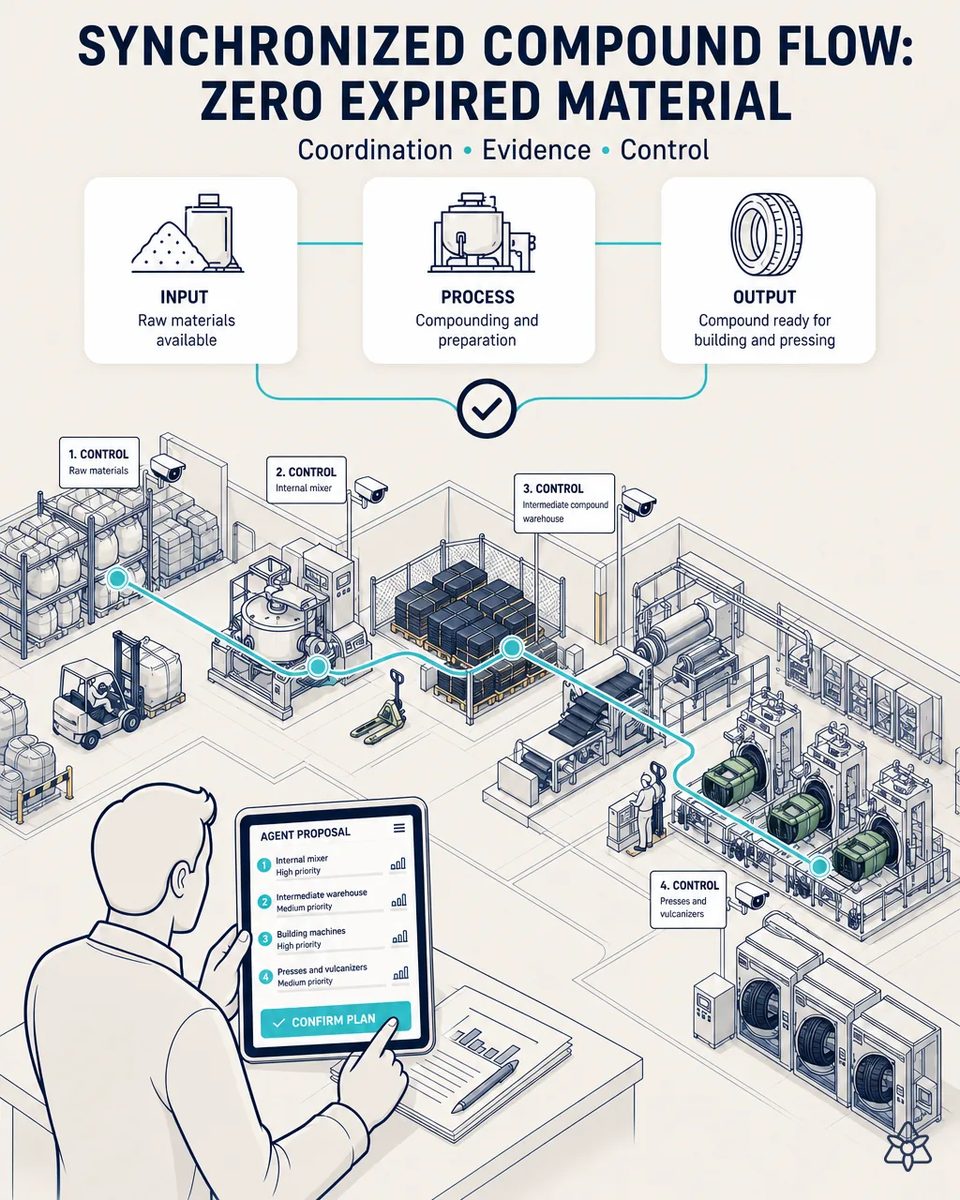
Shelf life and many sizes make synchronization the most expensive problem in the plant.
In a radial tire plant, compounds and components have a shelf life and controlled storage conditions. With several lines and many sizes, keeping mixing, components, building and curing in sync is the problem that moves the most money. If mixing runs ahead, compound expires in the intermediate store and is scrapped or reworked. If it runs behind, a building machine or a press waits for a component. And the safety stock that compensates ties up capital.
- In a radial tire plant, compounds and components have a shelf life and controlled storage conditions, and each size needs its own set of them. The clock starts the moment a compound leaves the mixer.
- With several lines and many sizes, keeping mixing, extrusion and calendering, building and curing in step is the problem that moves the most money. Every stage has its own constraints and its own planner.
- If mixing runs ahead, compound expires in the intermediate store and is scrapped or reworked. If it runs behind, a building machine or a curing press waits for a component.
- The safety stock that compensates for both ties up capital and floor space, and still does not prevent the next expiry. The plant pays twice: once for the stock and once for the scrap.
Agents on top of Connect and Edge — a planning agent proposes, the planner confirms.
Connect provides a live, real inventory: batch card at second zero, traced receiving, dosing consumption and components validated at the machine. Every skid and every roll with its remaining shelf life. Edge makes sure what enters each stage is right: the mixer charge against the recipe, tire inspection and every press curve. JIDOKA AI stops the flow on an anomaly before it spreads. A planning agent cross-checks inventory, shelf lives, the curing plan and supplier alerts, and proposes every shift what to mix and build first. SMED AI prepares size changeovers. The planner confirms: humans in command.
The flagship is the eleven previous cases working together. Connect gives a live inventory with shelf lives, Edge makes sure what enters each stage is right, and the planning agent turns both into a proposal per shift that the planner accepts or changes. It is the case that gives the most money back, and the one that needs the others to exist first.
Compound flow by spreadsheet versus flow coordinated by iLEAN
| Aspect | Today | With iLEAN Agents |
|---|---|---|
| Compound inventory with shelf life | Partial, a shift behind | Live, skid by skid and roll by roll |
| What the mixers run first | Decided from experience | Proposed each shift by the planning agent |
| Compound expiring in the intermediate store | Scrapped or reworked | Used before its limit |
| Curing press waiting for a green tire | Found when it stops | Anticipated in the shift plan |
| Tire size changeovers | Prepared at the last minute | Prepared ahead with SMED AI |
| Compound and component safety stock | Inflated to cover uncertainty | Sized to the real flow |
Expiring compound, waiting presses and inflated safety stock → flow synchronized per shift, shelf lives in plain sight and decisions confirmed by the planner.
Impact estimate — to be validated with your numbers.
The block below is an estimate to be validated against your plant's actual data. We put it forward so the committee has an order of magnitude; we refine it during the assessment.
- Estimated payback 6-12 months, with a pilot scoped to one family of sizes. We calculate it with your expiry scrap and press stops from the last months.
- Less scrap and rework from compound that expires in the intermediate store. Each skid used before its limit is compound that does not have to be mixed again.
- Fewer stoppages of building machines and curing presses from component shortages.
- Less safety stock of compound and components tied up, freeing capital and floor space. The stock left is sized to the real flow, not to fear of a shortage.
Payback 6-12 months · less expiry scrap and fewer component shortages (estimate to be validated). Less scrap from expired compound, fewer stoppages from component shortages and less safety stock tied up. We estimate a payback of 6 to 12 months, with a pilot scoped to one family of sizes. This is an estimate to be validated.
And the fair question from the production manager
“Is an agent going to decide what my mixers run?” — no. The planning agent cross-checks live inventory, shelf lives, the curing plan and supplier alerts and proposes; the planner confirms or changes it. Its inputs come from anchored tasks such as batch cards and validated components, where the best models drop below 1.5% error [1], and JIDOKA AI stops the flow on a verifiable anomaly, not on model uncertainty. The proposal can be rejected at any time, and the plan stays in human hands.
[1] OpenAI paper "Why Language Models Hallucinate", 2025 — on the reliability of AI in anchored tasks.
What people ask about synchronizing compound flow in a tire plant
Where does a tire plant start before reaching the full synchronized flow?
With the cases that build the live inventory: compound batch card, raw material receiving and component check. Each one pays or enables on its own, and the planning agent comes when the data is there. The order depends on where your plant loses most today.
Does the planning agent replace our scheduling system?
No. It works with the curing plan and the ERP you already have and proposes the mixing and building sequence on top of them. The planner keeps the last word on every shift plan.
How does it handle compounds with different shelf lives?
Each skid and roll carries its remaining life from the moment it is captured, and the proposal prioritizes what is closest to its limit without starving the presses. Storage conditions and maximum ages per compound are part of the rules it applies.
What is a sensible pilot scope for compound flow?
One family of sizes, with its compounds and components, across mixing, building and curing. That is enough to measure expiry scrap and shortages before and after. The pilot results decide how far and how fast to extend it.
What happens when the planner disagrees with the agent's proposal?
The planner changes it, and the change is recorded with its reason. The agent learns the plant's real constraints from those corrections. Corrections that repeat become rules the planner can review.
More cases from this series
- Human check of every component before buildingEverything iLEAN captures goes through a tablet at the building machine: the operator confirms each…
- Compound batch card captured with one photoHow one photo of the compound batch card traces every rubber skid from mixing onwards, with no typing…
- The legacy curing press that now talksA camera reads the panel of legacy tire curing presses and digitizes every cure cycle curve without…
- The curing supervisor talks to the AI on the moveBuilding and curing supervisors dictate issues on the move; iLEAN structures them, links them to press…
- From the compound lab Excel to SAPiLEAN reads the rheometer and Mooney results Excel in the shared folder and, after human validation,…
- Mixer weighing system wired to the ERPiLEAN wires the mixer weighing and dosing system to the ERP: recipes flow down automatically and actual…
Tell us how much compound you scrapped last month for expiry.
We work on your plant's real data, not ours. Assessment with no commitment.
Request estimated ROI within 48h ‹ See all cases of radial tires See automotive