Mixer weighing system wired to the ERP
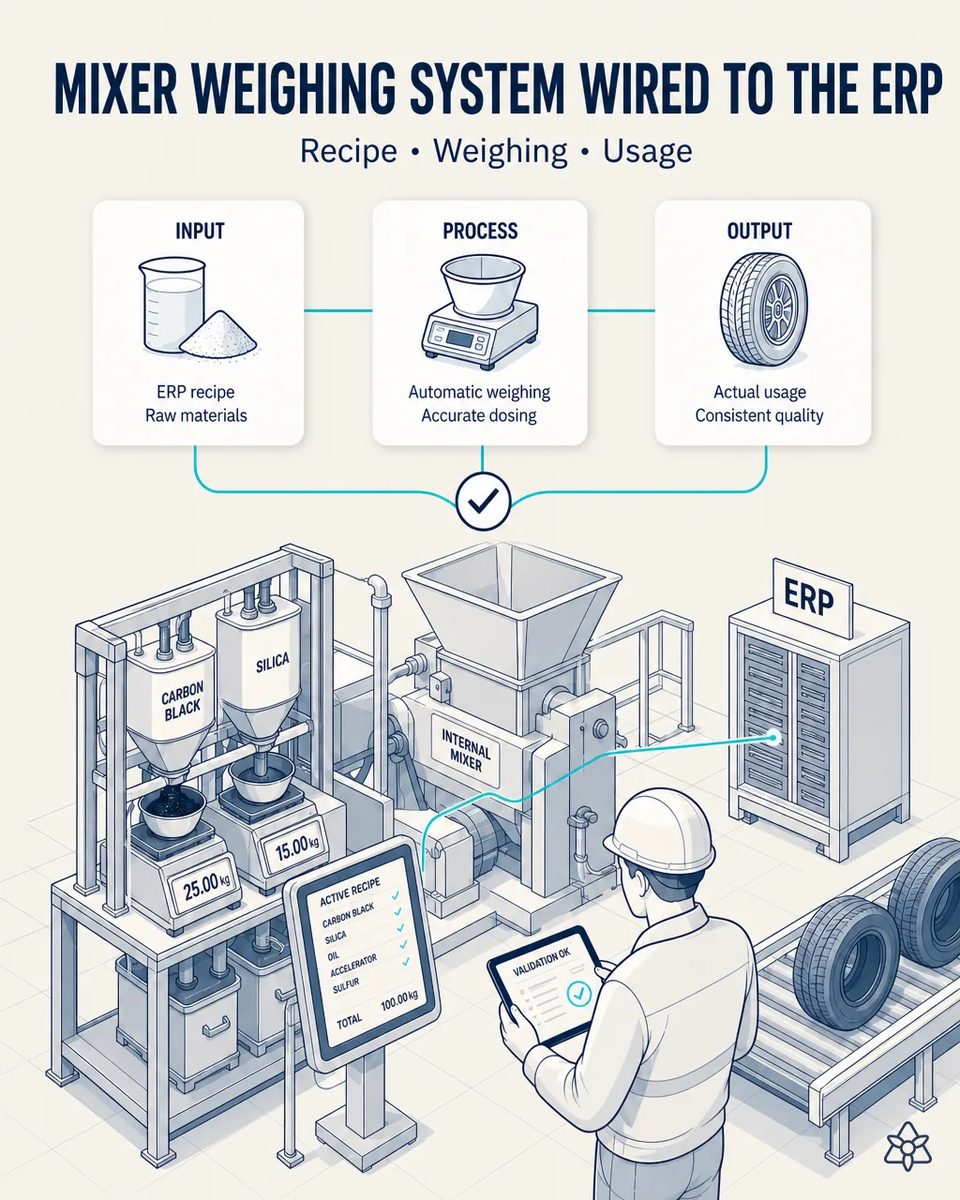
The mixer weighing and dosing system is fairly modern and has an interface, but it is isolated from the ERP: recipes are loaded by hand and actual consumption is typed again into SAP at shift end. iLEAN Connect wires both systems through APIs: the recipe flows down from the order and actual consumption flows up per batch, without replacing either system.
The weighing system is digital; the link to the ERP is a person typing.
The mixer weighing and dosing system is already digital and has an interface. But it is isolated from the ERP: the recipe is loaded by hand at the station and the actual consumption is typed again into SAP. Every recipe change and every shift end means double entry. One mistake in the recipe version or in declared consumption throws off the chemical and carbon black inventory, and nobody sees it until the physical count.
- The weighing and dosing system of the mixer is fairly modern and has an interface. But it is isolated from the ERP.
- The recipe is loaded by hand at the station when the mixing order starts, and the actual weighed consumption is typed again into SAP at shift end. The same numbers are entered twice by two different people.
- Every recipe change and every shift end means double entry. One mistake in the recipe version means a batch mixed to an obsolete formula.
- One mistake in declared consumption throws off the carbon black, silica and chemical inventory, and nobody sees it until the physical count. Then the adjustment is made, but the cause is never found.
Connect between weighing system and ERP — two systems, no double entry.
iLEAN Connect integrates both through APIs without replacing either: when the mixing order starts, the current recipe version flows down to the station; when each batch closes, the actual weighed consumption flows up to SAP. Before: chemical inventory that does not reconcile and recipe versions loaded by hand. After: the right recipe at the source and actual consumption per batch, with inventory always reconciled.
Neither system is replaced and nobody learns a new screen. The order brings its recipe version down, each closed batch sends its weighed consumption up, and the inventory reconciles by itself. It is a quiet integration: nobody notices it, except at the physical count.
Recipes and consumption by hand versus wired through APIs
| Aspect | Today | With iLEAN Connect |
|---|---|---|
| Recipe version at the weighing station | Loaded by hand | Sent from the mixing order |
| Batch mixed to an obsolete formula | Possible after every change | Blocked at the source |
| Actual weighed consumption per batch | Retyped at shift end | Posted when the batch closes |
| Carbon black and chemical inventory | Adjusted at the physical count | Reconciled continuously |
| Weighing system and ERP | — | Both kept, connected by API |
| Double entry of recipes and consumption | Every shift | None |
Recipes loaded by hand and consumption typed twice → recipe flowing down automatically, actual consumption per batch in the ERP and reconciled inventory.
Impact estimate — to be validated with your numbers.
The block below is an estimate to be validated against your plant's actual data. We put it forward so the committee has an order of magnitude; we refine it during the assessment.
- Estimated payback 3-6 months, one of the fastest in this series, from removing double entry. We calculate it with your recipe changes per week and your last inventory adjustments. The integration itself needs no new hardware at the mixer.
- Fewer inventory adjustments for carbon black, silica, oils and curatives, because actual consumption arrives per batch. The physical count stops being the moment when the surprises appear.
- Fewer batches mixed with the wrong recipe version after a formula change. The new version reaches the station only through the mixing order. Nobody has to remember to load it by hand after an engineering change. Each batch avoided is compound that is not held, retested or scrapped.
- Actual compound cost per batch available in SAP, instead of a standard cost corrected at month end. Purchasing sees the real consumption of carbon black and chemicals without waiting for the count. Reorder points can be set on real usage, not on standard formulas.
Payback 3-6 months · zero double entry of recipes and consumption (estimate to be validated). Fast payback, an estimated 3 to 6 months, from removing double entry, fewer inventory adjustments and fewer batches mixed with the wrong version. This is an estimate to be validated.
And the fair question from the production manager
“What if the integration sends a wrong recipe version to the mixer?” — the version comes from the mixing order and is checked against the active recipe master before it is sent; matching structured fields is an anchored task, where the best models drop below 1.5% error [1] even in the parts that need interpretation. And the weighing station keeps its own tolerances: if a weight falls outside them, the batch stops just as it does today. The integration adds a check on the recipe version without removing any of the controls the station already has.
[1] OpenAI paper "Why Language Models Hallucinate", 2025 — on the reliability of AI in anchored tasks.
What people ask about wiring mixer weighing to the ERP
Do we have to replace the mixer weighing and dosing system?
No. iLEAN connects to its existing interface and to the ERP through APIs, without replacing either system. The weighing vendor keeps supporting its system as it does today.
What happens to batches already running when the compound recipe changes?
They finish with the version they started with. The new version reaches the station with the next mixing order, so there is no switch mid-batch. The change of version is recorded with the order that introduced it.
Is consumption posted per batch or per shift?
Per batch, when each one closes. That is what lets the inventory reconcile and the actual cost per compound batch be known. Inventory differences can be traced to the batch where they appeared.
Can it handle manual additions of small chemicals?
Yes, if they are weighed on a scale connected to the system or confirmed at the station. Manual additions without a weight are flagged as declared, not measured. That keeps the difference between weighed and declared consumption visible.
Does the mixing operator see anything different at the station?
Only that the recipe is already loaded when the order starts. The rest of the routine stays the same. There is no new screen to learn and no extra step at the end of the shift.
More cases from this series
- Synchronized compound flow: zero expired materialConnect, Edge and Agents coordinate mixing, components, building and curing so no compound expires and…
- Human check of every component before buildingEverything iLEAN captures goes through a tablet at the building machine: the operator confirms each…
- Compound batch card captured with one photoHow one photo of the compound batch card traces every rubber skid from mixing onwards, with no typing…
- The legacy curing press that now talksA camera reads the panel of legacy tire curing presses and digitizes every cure cycle curve without…
- The curing supervisor talks to the AI on the moveBuilding and curing supervisors dictate issues on the move; iLEAN structures them, links them to press…
- From the compound lab Excel to SAPiLEAN reads the rheometer and Mooney results Excel in the shared folder and, after human validation,…
Tell us how many times a week your mixer recipes and consumption are typed twice.
We work on your plant's real data, not ours. Assessment with no commitment.
Request estimated ROI within 48h ‹ See all cases of radial tires See automotive