The legacy curing press that now talks
Many tire plants run curing presses from several generations. The oldest have controllers with no network, yet their screen shows what matters: bladder pressure, platen temperature and cycle time. Replacing the control is expensive and stops the press. With iLEAN Connect a camera reads the panel and every cure curve is linked to its tire, without touching the machine.
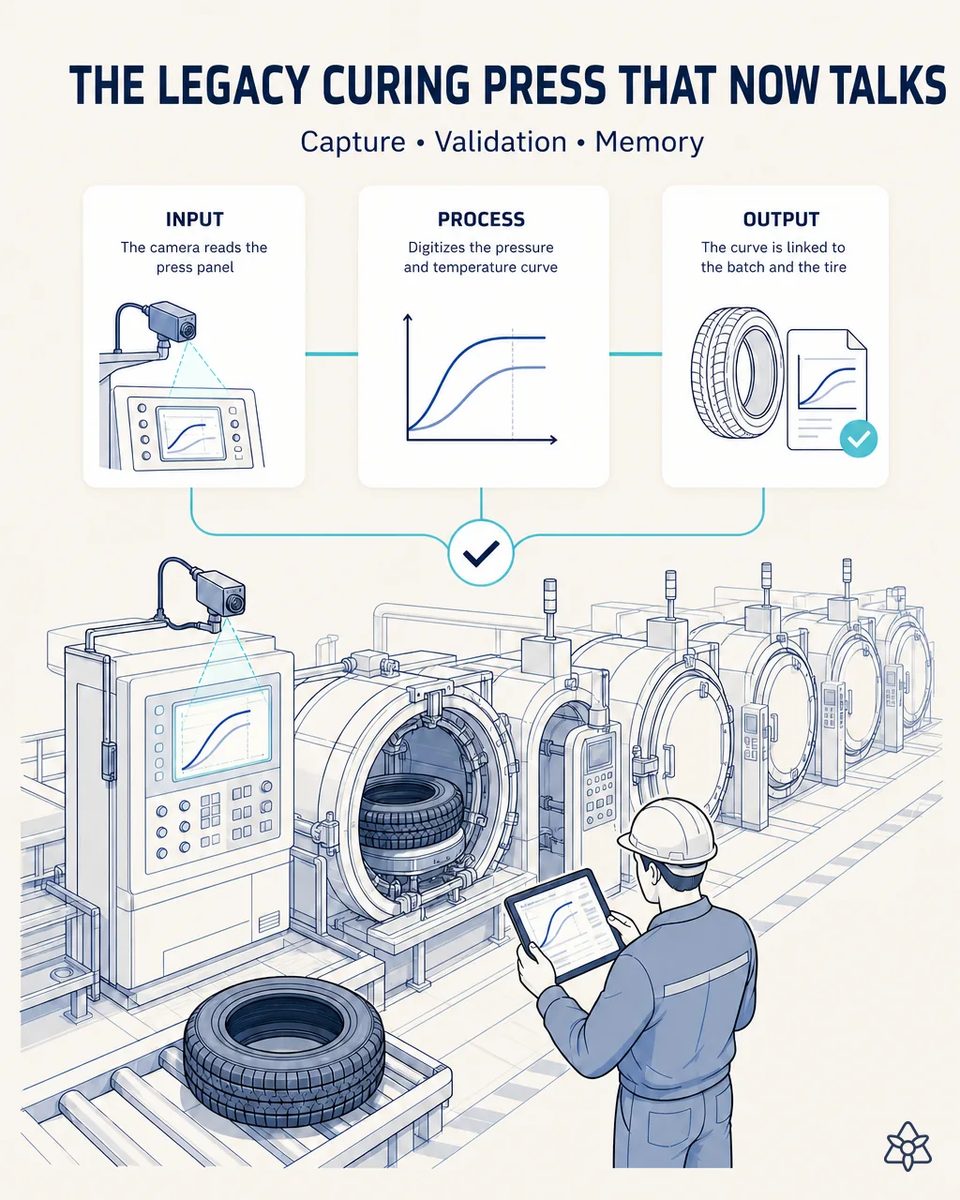
The press shows the cure curve on its screen and then forgets it.
A tire plant runs curing presses from several generations. The oldest work perfectly, but their controller has no network: the pressure, temperature and time curve of each cycle shows on screen and is lost. When a tire shows under-cure, blisters or a molding defect, nobody can correlate it with its press cycle. Retrofitting the control is a significant CAPEX project and requires stopping the press.
- A radial tire plant runs curing presses from several generations. The oldest ones work well, but their controller has no network connection at all.
- Bladder pressure, platen and steam temperature and cycle time appear on screen during each cure and disappear when the next green tire goes in. Nothing is kept beyond what the operator happens to remember.
- When a tire shows under-cure, blisters, backrinding or a molding defect at final inspection, nobody can go back to the cycle that cured it. The analysis ends in an opinion about the press, not in a fact.
- Retrofitting the controller is a significant CAPEX project per press and requires stopping it, so the decision keeps being postponed without data to prioritize it. Meanwhile, good presses and drifting presses are treated the same way.
Connect in camera mode — the press stays as it is, but now it reports every cycle.
iLEAN Connect places an industrial camera in front of the panel. It reads the screen every cycle, turns it into structured data and links it to the tire and the batch. No change to the control or the PLC: the press is still itself, but now it talks. Before: unrecorded cycles and blind defect analysis. After: a curve per tire, an alert when a cycle goes out of window, and root cause in minutes.
No PLC is opened, no controller is replaced and the press does not stop for installation. The camera reads what the operator already sees, and that is enough to give every tire its cure curve and to decide which retrofit really pays. It is usually the case with the clearest story for maintenance and engineering.
The silent curing press versus the press being read
| Aspect | Today | With iLEAN Connect |
|---|---|---|
| Cure curve of each tire | Lost at the end of each cycle | Stored and linked to tire and batch |
| Out-of-window cure cycle | Noticed only if someone is at the panel | Alert as soon as the curve deviates |
| Blister or under-cure analysis | Blind, by guesswork | Traced back to the press cycle |
| Bladder pressure trend | Unknown until a bladder fails | Visible cycle after cycle |
| Press controller retrofit plan | Decided by the age of the press | Prioritized by recorded behavior |
| Press controls and PLC | — | Untouched, no stop to install |
Unrecorded cycles and blind defect analysis → cure curve per tire, alert on out-of-window cycles and retrofit prioritized by data.
Impact estimate — to be validated with your numbers.
The block below is an estimate to be validated against your plant's actual data. We put it forward so the committee has an order of magnitude; we refine it during the assessment.
- Estimated payback 5-10 months, from scrap and rework traced back to their cure cycle.
- A CAPEX angle on top: controller retrofits prioritized by data, or deferred on presses whose curves show they run well.
- Root cause of under-cure or blisters found in minutes instead of being argued over press by press. The curve of the suspect cycle is on screen next to the defect photo.
- An alert on out-of-window cycles while the next tires are still curing, not when they reach final inspection. The process engineer can act on the press before more tires are affected.
Payback 5-10 months · defers press-control retrofit CAPEX (estimate to be validated). We estimate a payback of 5 to 10 months, plus a CAPEX angle: control retrofits can be prioritized by data or deferred on presses that run well. This is an estimate to be validated.
And the fair question from the production manager
“Is a camera on a press panel reliable enough to base quality decisions on?” — the screen is fixed, the fields sit in known positions and pressure and temperature have physical ranges, so the task is anchored: there the best models drop below 1.5% error [1]. Any reading outside the possible range for that press is discarded and flagged instead of being stored as a real value. The series that reaches quality only contains readings the press could actually have produced.
[1] OpenAI paper "Why Language Models Hallucinate", 2025 — on the reliability of AI in anchored tasks.
What people ask about reading legacy curing press panels
Does the camera survive the heat and steam around the curing presses?
It is an industrial camera with a housing rated for that environment, mounted at a distance from the platens. Installation takes minutes per press and needs no stop. The press keeps curing while the camera is fixed and aligned.
Can it read presses from different builders and generations?
Yes. Each panel layout is learned separately, so a mix of mechanical and hydraulic presses with different screens is the normal case, not an exception. A new press model is added by showing the system its panel for a few cycles.
How is the cure curve linked to the right tire?
By crossing the cycle timestamp with the press, the mold and the green tire loaded, which the plant already records. If the green tire barcode is read at loading, the link is direct. Either way, every tire ends up with the cycle that cured it.
Does it tell us which curing presses to retrofit first?
It gives you the data to decide: which presses drift, which produce out-of-window cycles and which run well. The retrofit decision stays with engineering. What changes is that the discussion is based on recorded cycles, not on the age of each machine.
Can it change the cure recipe or the press settings?
No. Reading is one-way: the camera sees the screen and never writes to the controller. Any change to the cure recipe is still made by the process engineer. That keeps the validated cure process exactly as it is.
More cases from this series
- Synchronized compound flow: zero expired materialConnect, Edge and Agents coordinate mixing, components, building and curing so no compound expires and…
- Human check of every component before buildingEverything iLEAN captures goes through a tablet at the building machine: the operator confirms each…
- Compound batch card captured with one photoHow one photo of the compound batch card traces every rubber skid from mixing onwards, with no typing…
- The curing supervisor talks to the AI on the moveBuilding and curing supervisors dictate issues on the move; iLEAN structures them, links them to press…
- From the compound lab Excel to SAPiLEAN reads the rheometer and Mooney results Excel in the shared folder and, after human validation,…
- Mixer weighing system wired to the ERPiLEAN wires the mixer weighing and dosing system to the ERP: recipes flow down automatically and actual…
Tell us how many of your curing presses have no network connection today.
We work on your plant's real data, not ours. Assessment with no commitment.
Request estimated ROI within 48h ‹ See all cases of radial tires See automotive