From the compound lab Excel to SAP
In a tire plant the compound lab tests every batch — rheometry, Mooney viscosity, hardness, density — and saves the results in an Excel file on a shared folder. The ERP needs that data to release the batch, so someone retypes it. iLEAN Connect reads the file when it is saved, structures it and, after the lead validates it, posts it to SAP through the API.
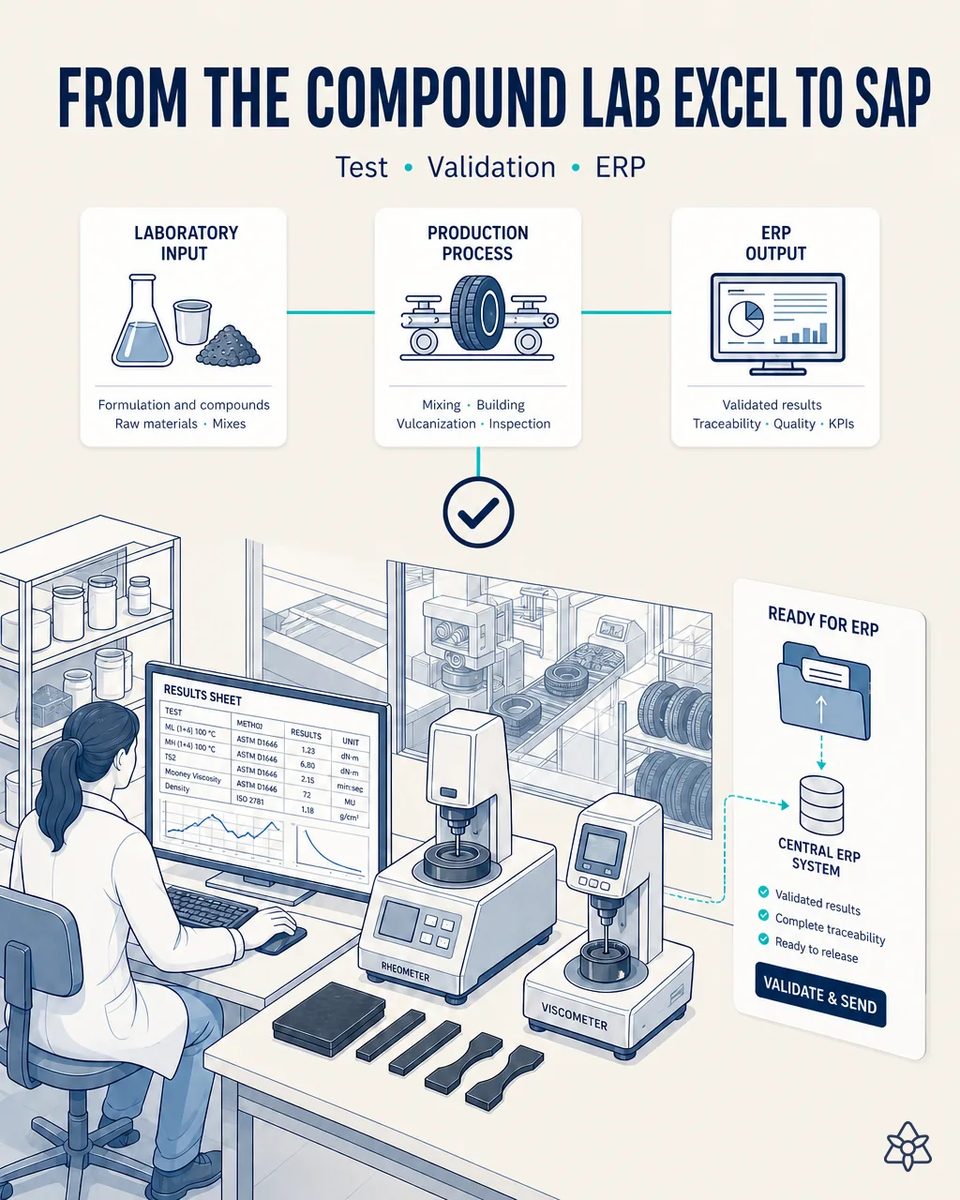
The lab finishes the test; the batch waits for someone to retype it.
The compound lab tests every batch: rheometry, Mooney viscosity, hardness, density. The results live in an Excel file on a shared folder, which is where the real work happens. SAP needs those results to release or block the batch, so several people log into the quality module just to type them in. There is lag, there are transcription errors and there are licenses paid only for copying.
- The compound lab tests every batch: rheometer cure curve, Mooney viscosity, hardness and density. The results go into an Excel on a shared folder, which is where the real work happens.
- SAP needs those results to release or block the batch, so several people log into the quality module just to type them in. Their job is to copy numbers, not to judge them.
- There is lag between the test and the release, so skids wait in the intermediate store while extrusion asks for compound. The compound loses shelf life while it waits for a keyboard.
- There are transcription errors that release a batch that should have been held, and there are ERP licenses paid only for copying numbers. None of that adds anything to the quality of the compound.
Connect on the shared folder — the lab keeps its Excel, SAP gets the results.
iLEAN Connect observes the shared folder: when the Excel is saved, it reads what is new, structures it and shows it to the lab lead for validation. Once validated, it posts it to SAP QM through the API. The lab keeps using its Excel. If five people log into the ERP today only to enter results, with Connect only the lead who validates needs access. Typical reduction of 50 to 80 percent in quality or lab module licenses, as a recurring annual saving depending on the vendor's pricing.
The lab does not change its tool or its routine. What disappears is the copy: one validation by the lab lead replaces several people retyping, and the batch can be released minutes after the test instead of hours. For extrusion, that means compound available sooner and less waiting in the store.
The compound lab spreadsheet retyped versus read on save
| Aspect | Today | With iLEAN Connect |
|---|---|---|
| Rheometer and Mooney results in SAP | Hours later, retyped | Seconds after validation |
| People logging into the quality module | Several, only to type | The lab lead who validates |
| Compound batch release for extrusion | Waits for transcription | Follows the test result |
| Transcription errors in lab results | Found when a batch misbehaves | Removed: nothing is retyped |
| The lab's Excel template | — | Unchanged |
| Out-of-spec rheometer result | Seen when someone reads it | Highlighted on the validation screen |
Results retyped by hand with lag and several ERP licenses → results in SAP within seconds after one validation, with a single license.
Impact estimate — to be validated with your numbers.
The block below is an estimate to be validated against your plant's actual data. We put it forward so the committee has an order of magnitude; we refine it during the assessment.
- Estimated payback 4-9 months, counting license savings, faster release and fewer transcription errors. We calculate it with your number of batches per day and your current quality module users.
- Typical reduction of 50 to 80% in quality or lab module licenses, as a recurring annual saving that depends on the vendor's pricing. It is a saving that repeats every year, not a one-off.
- Faster batch release, so compound spends less of its shelf life waiting in the intermediate store. Less waiting means more of each batch's life is available to extrusion and calendering.
- Zero transcription errors between the rheometer result and the batch decision in SAP QM. A batch is released or held on the number the rheometer actually gave.
Payback 4-9 months · quality module ERP licenses -50 to -80% (estimate to be validated). On top of license savings: faster batch release and zero transcription errors. We estimate a payback of 4 to 9 months. This is an estimate to be validated.
And the fair question from the production manager
“What if the lab changes the sheet and the reading breaks?” — the reading does not depend on fixed cells: it interprets the sheet, tolerating new columns, comments and merged cells. It is an anchored task, where the best models drop below 1.5% error [1], and the lab lead validates every batch on a summary screen before anything is posted to SAP QM. If a value looks wrong, the lead sees the original line of the sheet next to it.
[1] OpenAI paper "Why Language Models Hallucinate", 2025 — on the reliability of AI in anchored tasks.
What people ask about moving compound lab results into SAP
Does it read files exported by the rheometer, or only the Excel?
Both. If the rheometer or the Mooney viscometer exports a file to the shared folder, it is read the same way as the Excel the technicians fill in. The technicians do not change anything in their routine.
Do the lab technicians still need SAP access?
Only the person who validates. That is where the reduction of 50 to 80% in quality module licenses comes from, depending on the vendor's pricing. The lab lead validates on a summary screen instead of typing into the quality module.
Can it block a compound batch automatically if the cure curve is out of spec?
It highlights the out-of-spec value and proposes the block, but the lab lead decides. Nothing is released or blocked without that validation. The decision and the result are stored together for the batch history.
How is each result tied to the right compound batch?
By the batch code in the sheet, checked against the batches open in SAP. If the code does not exist or is duplicated, the validation screen shows it. That catches the typo that today releases the wrong batch.
Does it also cover hardness and density testers?
Yes. Any result that ends up in the lab's spreadsheets or export files can be read, structured and posted the same way. Specific gravity, tensile tests and scorch times follow the same pattern when they are in a file.
More cases from this series
- Synchronized compound flow: zero expired materialConnect, Edge and Agents coordinate mixing, components, building and curing so no compound expires and…
- Human check of every component before buildingEverything iLEAN captures goes through a tablet at the building machine: the operator confirms each…
- Compound batch card captured with one photoHow one photo of the compound batch card traces every rubber skid from mixing onwards, with no typing…
- The legacy curing press that now talksA camera reads the panel of legacy tire curing presses and digitizes every cure cycle curve without…
- The curing supervisor talks to the AI on the moveBuilding and curing supervisors dictate issues on the move; iLEAN structures them, links them to press…
- Mixer weighing system wired to the ERPiLEAN wires the mixer weighing and dosing system to the ERP: recipes flow down automatically and actual…
Tell us how many people log into your quality module only to enter compound lab results.
We work on your plant's real data, not ours. Assessment with no commitment.
Request estimated ROI within 48h ‹ See all cases of radial tires See automotive