Mixer charge checked by vision before the cycle
The internal mixer charge decides the compound: if a bale of the wrong rubber type goes in or a chemical bag is missing, the batch comes out off-spec and ends up in the tread or sidewall of hundreds of tires. Today it depends on the charging operator's attention. With iLEAN Edge, cameras identify every bale and bag and the cycle is not authorized until the charge matches the recipe.
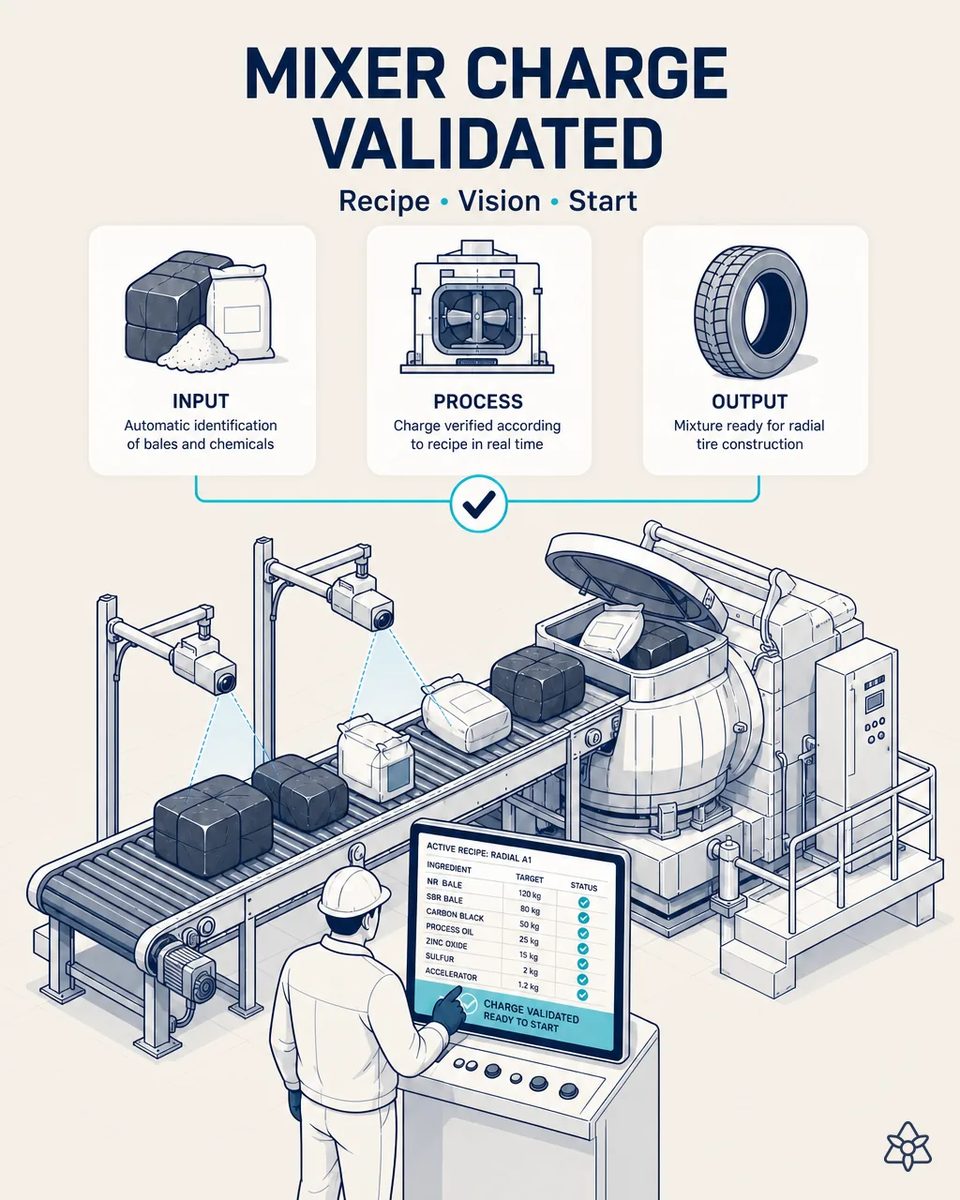
One wrong bale in the mixer becomes the tread of hundreds of tires.
In mixing, the internal mixer charge decides the compound. One bale of the wrong rubber type or one missing chemical bag, and the batch comes out off-spec. Today the charge depends on the operator's attention. The error is found in the lab or, worse, in the tire: batch on hold, compound scrapped and downstream production at risk.
- In mixing, the internal mixer charge decides the compound: natural rubber, SBR or BR bales, carbon black, oils and small-chemical bags, in the right types and quantities. Each recipe has its own list, and the plant runs many recipes.
- One bale of the wrong rubber type or one missing accelerator bag, and the batch comes out off-spec. It looks like any other batch until it is tested.
- Today the charge depends on the charging operator's attention, shift after shift and recipe after recipe. Fatigue and similar-looking bales do the rest.
- The error is found in the lab or, worse, in the tire: batch on hold, compound scrapped and the extruders and building machines downstream waiting for material. One charging mistake can disturb the plan of the whole day.
Edge with JIDOKA AI on the charging conveyor — no match, no mixer cycle.
iLEAN Edge places cameras over the charging conveyor. They identify each bale and bag by shape, label and code and compare them with the active order's recipe. If something is missing or extra, they flag it before it enters the mixer. The cycle is not authorized until the charge matches the recipe and the operator confirms. JIDOKA AI applied to mixing: the line stops on an anomaly and the human decides with evidence, not from memory.
This is jidoka applied to mixing: the line stops on an anomaly and the human decides with evidence. The operator still authorizes the cycle, but now they authorize on what the cameras saw, not on memory. Every charge leaves images that the lab and quality can review.
Mixer charging by attention versus charging checked by vision
| Aspect | Today | With iLEAN Edge |
|---|---|---|
| Wrong rubber bale type | Found in the lab or in the tire | Flagged on the conveyor |
| Missing accelerator or chemical bag | Undetected until testing | Cycle held until it is added |
| Mixer cycle authorization | On the operator's memory | On a charge matched to the recipe |
| Evidence of what went into the mixer | None | Images per batch |
| Off-spec compound batch | Hold, test, often scrap | Prevented before mixing |
| Final call on the cycle | — | The operator, with the evidence on screen |
Charge checked only by operator attention → every bale and bag identified against the recipe and cycle authorized with evidence.
Impact estimate — to be validated with your numbers.
The block below is an estimate to be validated against your plant's actual data. We put it forward so the committee has an order of magnitude; we refine it during the assessment.
- Estimated payback 4-10 months, depending on the current rate of off-spec compound batches. We calculate it with your lab rejection history before you commit. A pilot on one mixer line is enough to measure it.
- Fewer compound batches rejected in the lab for a wrong or incomplete charge. Each one saved is mixer time, raw material and lab time recovered. It also frees the lab from retesting batches that should never have been mixed.
- Fewer tires built with a wrong compound and fewer downstream lots put on hold. A wrong compound found in the tire costs far more than one found at the conveyor.
- Images of every charge, which close the investigation of a doubtful batch in minutes. The question of what really went into the mixer stops being a matter of opinion. That evidence also supports IATF audits and carmaker claims. It is the first link in the evidence chain of every tire.
Payback 4-10 months · zero compound batches with a wrong charge (estimate to be validated). Fewer rejected compound batches and fewer tires affected by a wrong compound. We estimate a payback of 4 to 10 months depending on the current off-spec batch rate. This is an estimate to be validated.
And the fair question from the production manager
“Will the camera tell an SBR bale from a natural rubber bale?” — it does not guess from color: it combines shape, label and code and compares them with what the active recipe expects, which makes it an anchored task where the best models drop below 1.5% error [1]. When it is unsure, it does not block silently: it asks the operator, who looks and confirms. The decision and the images are stored with the batch, so the lab knows exactly what went in.
[1] OpenAI paper "Why Language Models Hallucinate", 2025 — on the reliability of AI in anchored tasks.
What people ask about checking the mixer charge by vision
Does it slow down the internal mixer cycle?
No. Identification happens while the bales and bags travel on the conveyor, before the ram goes down, so the check is finished by the time the charge is complete. The mixer keeps its cycle time.
What if a rubber bale has no readable label?
It is identified by shape and by the code on the wrapping where there is one. If it still cannot be identified, the operator is asked to confirm it before the cycle. That confirmation is stored with the images of the charge.
Does it check weights or only the items charged?
It checks the items and their count against the recipe. Weights still come from the weighing system, which keeps its own tolerances. Vision and weighing together close both sides of the charge.
Can the charging operator override a hold?
Yes, with a recorded reason and a signature. What is no longer possible is starting a cycle with no trace of who decided. Overrides become visible and can be reviewed by the process engineer.
Does it work for both masterbatch and final batch stages?
Yes. Each stage has its own expected charge, and the check switches with the active mixing order. Remills and productive batches are handled in the same way.
More cases from this series
- Synchronized compound flow: zero expired materialConnect, Edge and Agents coordinate mixing, components, building and curing so no compound expires and…
- Human check of every component before buildingEverything iLEAN captures goes through a tablet at the building machine: the operator confirms each…
- Compound batch card captured with one photoHow one photo of the compound batch card traces every rubber skid from mixing onwards, with no typing…
- The legacy curing press that now talksA camera reads the panel of legacy tire curing presses and digitizes every cure cycle curve without…
- The curing supervisor talks to the AI on the moveBuilding and curing supervisors dictate issues on the move; iLEAN structures them, links them to press…
- From the compound lab Excel to SAPiLEAN reads the rheometer and Mooney results Excel in the shared folder and, after human validation,…
Tell us how many compound batches a month come out off-spec because of the charge.
We work on your plant's real data, not ours. Assessment with no commitment.
Request estimated ROI within 48h ‹ See all cases of radial tires See automotive