IATF and claim evidence pack in minutes
When a carmaker opens a claim or the IATF 16949 audit arrives, someone spends days or weeks rebuilding a lot's history: which compound, which components, which cure curve, which inspection. iLEAN Edge and Agents build that dossier on their own, with photos and data for every stage, organized by standard or by claim, ready to download.
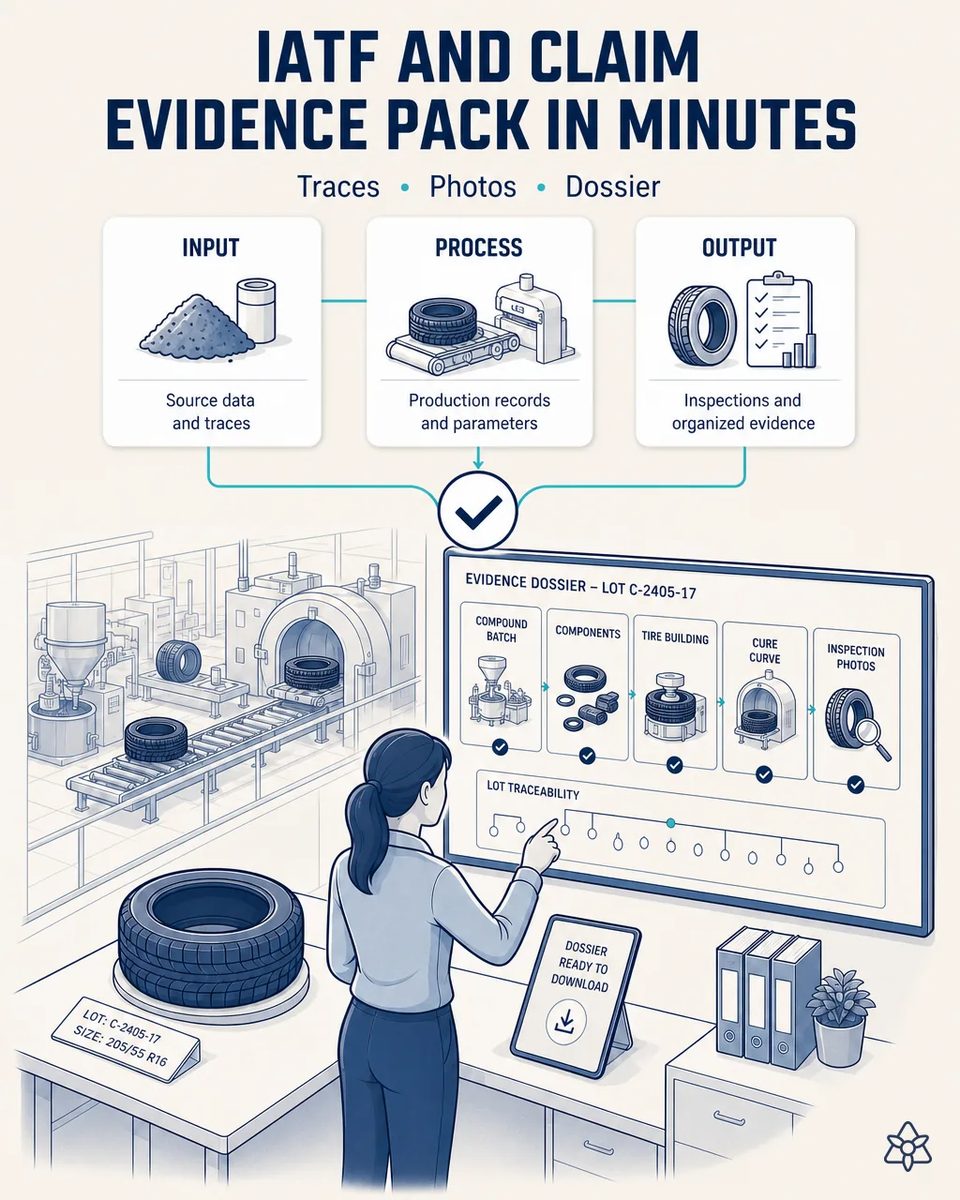
Proving a tire lot's history takes days because it was never put together.
When a carmaker opens a claim on a tire, the plant must prove which compound, which components, which cure cycle and which inspection it had. Today that is rebuilt from paper and extracts from several systems. Preparing an IATF 16949 audit or answering an 8D takes days of the quality team's time, and there is always a documentation gap that becomes a nonconformity.
- When a carmaker opens a claim on a tire, the plant must prove which compound, which components, which cure cycle and which inspection it had. And it must prove it quickly, because the carmaker sets the deadline.
- Today that history is rebuilt from batch cards, shift sheets and extracts from several systems, by hand and against the clock. Each system has a piece of the story and none has all of it.
- Preparing an IATF 16949 audit or answering an 8D takes days of the quality team's time, every single time. The work is repeated for every audit and every customer.
- And there is always a documentation gap somewhere between mixing and final inspection that becomes a nonconformity. It is usually a missing record that existed only on paper for a few hours.
Edge and Connect capture each stage; Agents files it by tire lot and by standard.
iLEAN joins what the other pieces already capture: compound batch card, validated components, press curve, Edge inspection photos. Agents organizes it into a traceability tree per lot and per standard. The evidence pack for any lot or period downloads in minutes, with photos, data and signatures. It serves IATF 16949, national tire regulations and the response to the carmaker.
The dossier is not prepared for the audit: it closes as each stage happens. When the auditor or the carmaker asks, the work is to filter and download, not to search. Gaps are flagged when they happen, while they can still be fixed.
Tire lot history rebuilt versus the lot dossier always ready
| Aspect | Today | With iLEAN Edge |
|---|---|---|
| Preparing an 8D for a carmaker | Days of searching | Minutes to download |
| Compound batch behind the tire lot | Rebuilt from cards | Linked from the batch photo |
| Cure curve from the press | Often unavailable | Attached per tire |
| Final inspection evidence | A signature on a sheet | Edge images of each tire |
| Gap in the lot documentation | Found by the auditor | Flagged when it occurs |
| Scope of a tire containment | Wide, to be safe | Bounded to the affected lots |
Days or weeks rebuilding traceability with gaps → evidence pack per lot in minutes, with photos, data and signatures.
Impact estimate — to be validated with your numbers.
The block below is an estimate to be validated against your plant's actual data. We put it forward so the committee has an order of magnitude; we refine it during the assessment.
- Estimated payback 6-12 months, depending on claim and audit volume. We calculate it with the number of claims and audits you handle each year. The time currently spent on each 8D is the main input.
- From weeks to minutes of preparation for an IATF 16949 audit or a carmaker claim. The quality team spends that time on prevention instead of on searching. Audit week stops being a crisis for the whole department.
- Fewer nonconformities from documentation gaps, because missing evidence is flagged when it should have been created. The auditor finds the evidence where the standard expects it. Nonconformities for missing records drop because the gap is closed when it appears.
- Shorter, tighter containments, bounded to the lots that share the suspect compound, component or press. Fewer tires are held and fewer are recalled when the root cause is clear.
Payback 6-12 months · from weeks to minutes for audit or claim (estimate to be validated). From weeks to minutes of preparation, fewer nonconformities and shorter, tighter containments. We estimate a payback of 6 to 12 months depending on claim and audit volume. This is an estimate to be validated.
And the fair question from the production manager
“Isn't this just a document repository with a nicer interface?” — the difference is that nobody uploads anything: each stage leaves its evidence the moment it happens, and Agents files it by lot and standard. Linking a batch card, a component and a press curve to a tire is an anchored task, where the best models drop below 1.5% error [1], and the quality engineer reviews the pack before it goes out. Gaps are not hidden: if a stage has no evidence, the pack shows it so it can be explained.
[1] OpenAI paper "Why Language Models Hallucinate", 2025 — on the reliability of AI in anchored tasks.
What people ask about the tire lot evidence pack
Which standards and requirements does the tire evidence pack cover?
IATF 16949, the customer-specific requirements of each carmaker and national tire regulations. The evidence is the same; what changes is how it is indexed. The same pack is filtered differently for each request.
Can it answer an 8D for a single tire from its DOT code?
Yes. From the DOT or serial, the pack shows the compound batches, components, press and cure curve, and the inspection images of that tire. The 8D starts from facts instead of from a search.
Do the other eleven cases need to be running first?
No. The pack starts with what is already captured, such as batch cards and press curves, and becomes more complete as more stages are added. Each new case adds a layer of evidence to the same tree.
Does the IATF auditor get access to our plant systems?
No. They receive a view scoped to the lots or period audited, or a downloaded pack, never a login to the plant systems. Access is limited to what was requested and for the time agreed.
Who signs the pack before it reaches the carmaker?
The quality engineer. Agents assembles it and checks completeness, but the response to the carmaker is reviewed and signed by a person. The engineer's signature is part of the pack.
More cases from this series
- Synchronized compound flow: zero expired materialConnect, Edge and Agents coordinate mixing, components, building and curing so no compound expires and…
- Human check of every component before buildingEverything iLEAN captures goes through a tablet at the building machine: the operator confirms each…
- Compound batch card captured with one photoHow one photo of the compound batch card traces every rubber skid from mixing onwards, with no typing…
- The legacy curing press that now talksA camera reads the panel of legacy tire curing presses and digitizes every cure cycle curve without…
- The curing supervisor talks to the AI on the moveBuilding and curing supervisors dictate issues on the move; iLEAN structures them, links them to press…
- From the compound lab Excel to SAPiLEAN reads the rheometer and Mooney results Excel in the shared folder and, after human validation,…
Tell us how many days your last carmaker claim took to answer.
We work on your plant's real data, not ours. Assessment with no commitment.
Request estimated ROI within 48h ‹ See all cases of radial tires See automotive