The rubber supplier alert that arrives on time
A natural rubber container is delayed, a carbon black lot arrives with an out-of-spec certificate, a cord supplier moves a delivery. Alerts arrive by email or WhatsApp to one person who reads them hours later, when the mixing plan is already running. With iLEAN Connect the alert is read at second zero, matched to the plan, and the right person gets the concrete action.
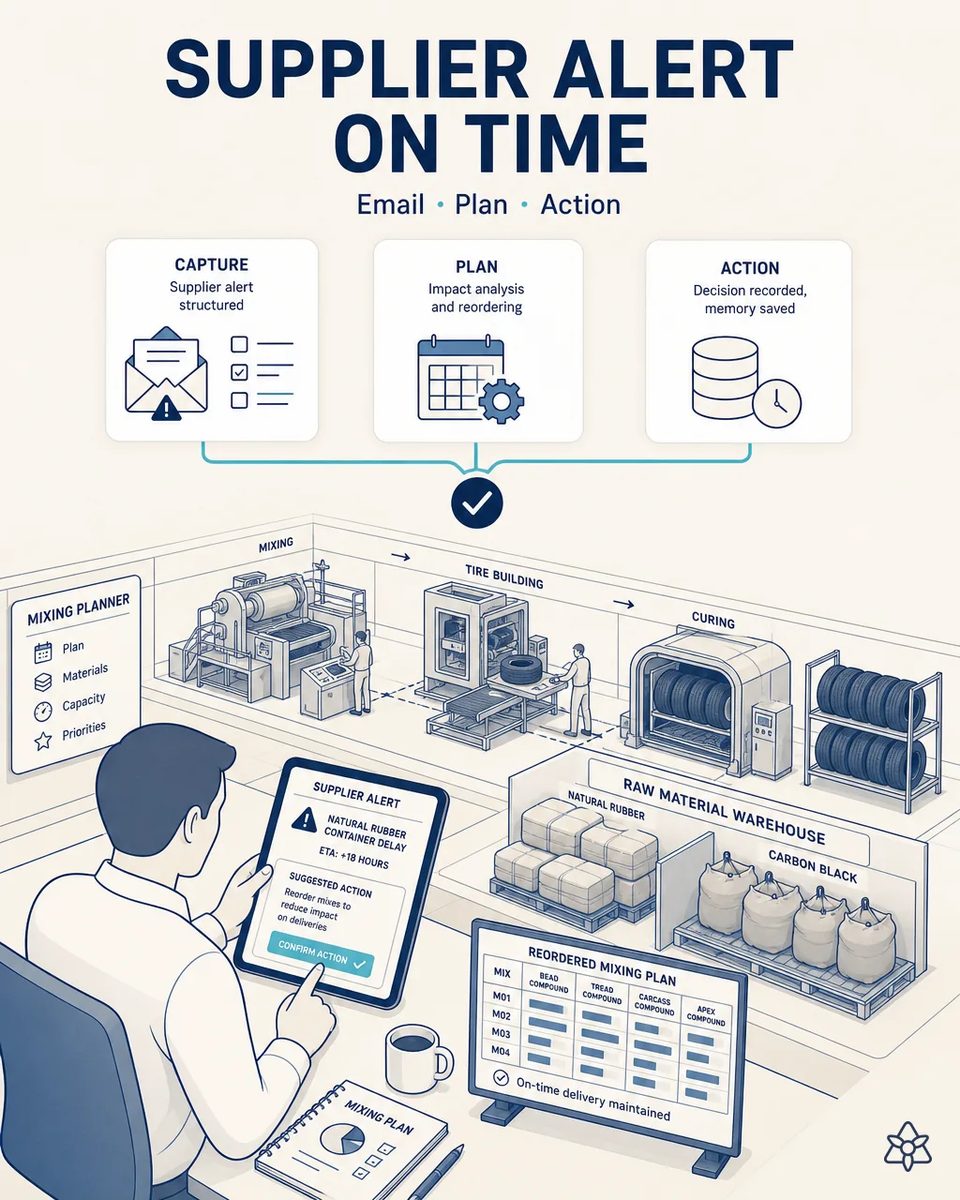
The supplier warns in time; the mixing plan finds out too late.
In a tire plant, the mixing plan depends on natural and synthetic rubber, carbon black, silica and chemicals from outside suppliers. When one of them warns of a delay or an out-of-spec lot, the email lands with one specific person. If that email is read mid-afternoon, the mixer is already set up for a recipe with no material, or a lot that quality was about to block has already been mixed. Downtime, emergency recipe changes and compound at risk.
- The mixing plan depends on natural rubber, synthetic rubber, carbon black, silica, oils and curatives from outside suppliers, plus textile and steel cord for the components. Most of it comes from far away, with long lead times and little slack.
- A delayed container, a carbon black lot with an out-of-spec certificate of analysis or a moved cord delivery is announced by email or WhatsApp to one specific person. If that person is in a meeting, on a shift change or on holiday, the alert waits.
- If that message is read mid-afternoon, the Banbury is already set up for a recipe with no material, or a lot that quality was about to block has already been mixed. Neither the planner nor quality knew in time.
- The result is mixer downtime, emergency recipe changes and compound at risk that then has to be held, tested and sometimes scrapped. The cost is paid in the mixing area, not by the supplier.
Connect on email and messaging — the alert becomes a proposed mixing reschedule.
iLEAN Connect sits in copy on a dedicated mailbox and on the purchasing messaging channel. It understands the alert: supplier, material, lot, new date. It matches it against the mixing plan and SAP inventory and proposes the action: which recipes to bring forward and which to move. The proposal reaches the mixing planner's tablet, who confirms or corrects with one tap. iLEAN does not change the plan on its own: it prepares the decision so a human can take it in minutes, not hours.
iLEAN does not change the mixing plan on its own. It reads, matches and prepares the decision, so the planner chooses in minutes with the impact already calculated, instead of discovering the problem when the mixer stops. Purchasing, quality and the planner see the same alert at the same time.
Supplier alerts by inbox versus alerts matched to the plan
| Aspect | Today | With iLEAN Connect |
|---|---|---|
| Time to read a rubber supplier alert | Hours, depending on one person | Seconds after it arrives |
| Impact on the mixing plan | Worked out by hand, if at all | Affected compound recipes listed automatically |
| Out-of-spec carbon black lot | Sometimes already mixed | Flagged before it reaches the mixer |
| Who gets the reschedule proposal | Whoever was copied | The mixing planner, on the tablet |
| Recipe changes at the mixer | Made in an emergency | Planned with the reschedule proposal |
| Final call on the mixing plan | — | Confirmed or corrected by the planner |
Hours of human latency and broken plans → alert read in seconds and reschedule proposed to the right role.
Impact estimate — to be validated with your numbers.
The block below is an estimate to be validated against your plant's actual data. We put it forward so the committee has an order of magnitude; we refine it during the assessment.
- Estimated payback 3-7 months, depending on how often critical supplier alerts occur. We calculate it with the alerts and mixer stops of your last months.
- Avoided Banbury downtime when a recipe would otherwise be started without its rubber or filler. Each avoided stop protects the extrusion and building plan downstream.
- Fewer emergency recipe changes and fewer compound batches mixed with a lot quality was about to block.
- A written trail of every alert and every decision, useful when the supplier performance review comes around. The trail shows how often each supplier warned late or shipped out of spec.
Payback 3-7 months · mixing plan rescheduled in minutes (estimate to be validated). We estimate a payback of 3 to 7 months depending on how often critical alerts occur, through avoided downtime and fewer emergency recipe changes. This is an estimate to be validated.
And the fair question from the production manager
“And if it misunderstands the supplier's message and proposes a bad reschedule?” — extracting supplier, material, lot and new date from an operational message is an anchored task, where the best models drop below 1.5% error [1]. And the reschedule is only a proposal: the mixing planner sees the original message next to it and confirms or corrects with one tap. If the reading was wrong, the planner sees it at once, because the source is on the same screen.
[1] OpenAI paper "Why Language Models Hallucinate", 2025 — on the reliability of AI in anchored tasks.
What people ask about rubber and chemical supplier alerts
Does it read certificates of analysis attached to the supplier's email?
Yes. If the attached certificate shows a Mooney value or a carbon black property outside the purchase specification, the alert says so and the lot is flagged for quality. Quality decides whether to block it before it is charged into the mixer.
Which inboxes does it see?
Only a dedicated mailbox and the purchasing messaging channel that suppliers already write to. It does not read personal inboxes. Suppliers do not need to change how or where they write.
How does it know which compound recipes use the delayed material?
It crosses the material with the active compound recipes and with stock in SAP, so it knows which masterbatches will run short and which can be brought forward. It also looks at the curing plan, so the proposal protects the sizes that are due first.
Does it work with natural rubber suppliers that write in other languages?
Yes. Natural rubber and chemical suppliers often write in English or their own language, and the alert is structured the same way regardless. The planner always sees the original message next to the summary.
Can the mixing planner reject the proposal?
Always. The planner confirms, corrects or discards it, and that decision is recorded together with the original alert. Over time those decisions show which suppliers and materials cause the most reschedules.
More cases from this series
- Synchronized compound flow: zero expired materialConnect, Edge and Agents coordinate mixing, components, building and curing so no compound expires and…
- Human check of every component before buildingEverything iLEAN captures goes through a tablet at the building machine: the operator confirms each…
- Compound batch card captured with one photoHow one photo of the compound batch card traces every rubber skid from mixing onwards, with no typing…
- The legacy curing press that now talksA camera reads the panel of legacy tire curing presses and digitizes every cure cycle curve without…
- The curing supervisor talks to the AI on the moveBuilding and curing supervisors dictate issues on the move; iLEAN structures them, links them to press…
- From the compound lab Excel to SAPiLEAN reads the rheometer and Mooney results Excel in the shared folder and, after human validation,…
Tell us how many hours a critical rubber supplier alert takes to reach your mixing planner today.
We work on your plant's real data, not ours. Assessment with no commitment.
Request estimated ROI within 48h ‹ See all cases of radial tires See automotive