Rubber and chemicals receiving to the ERP by photo
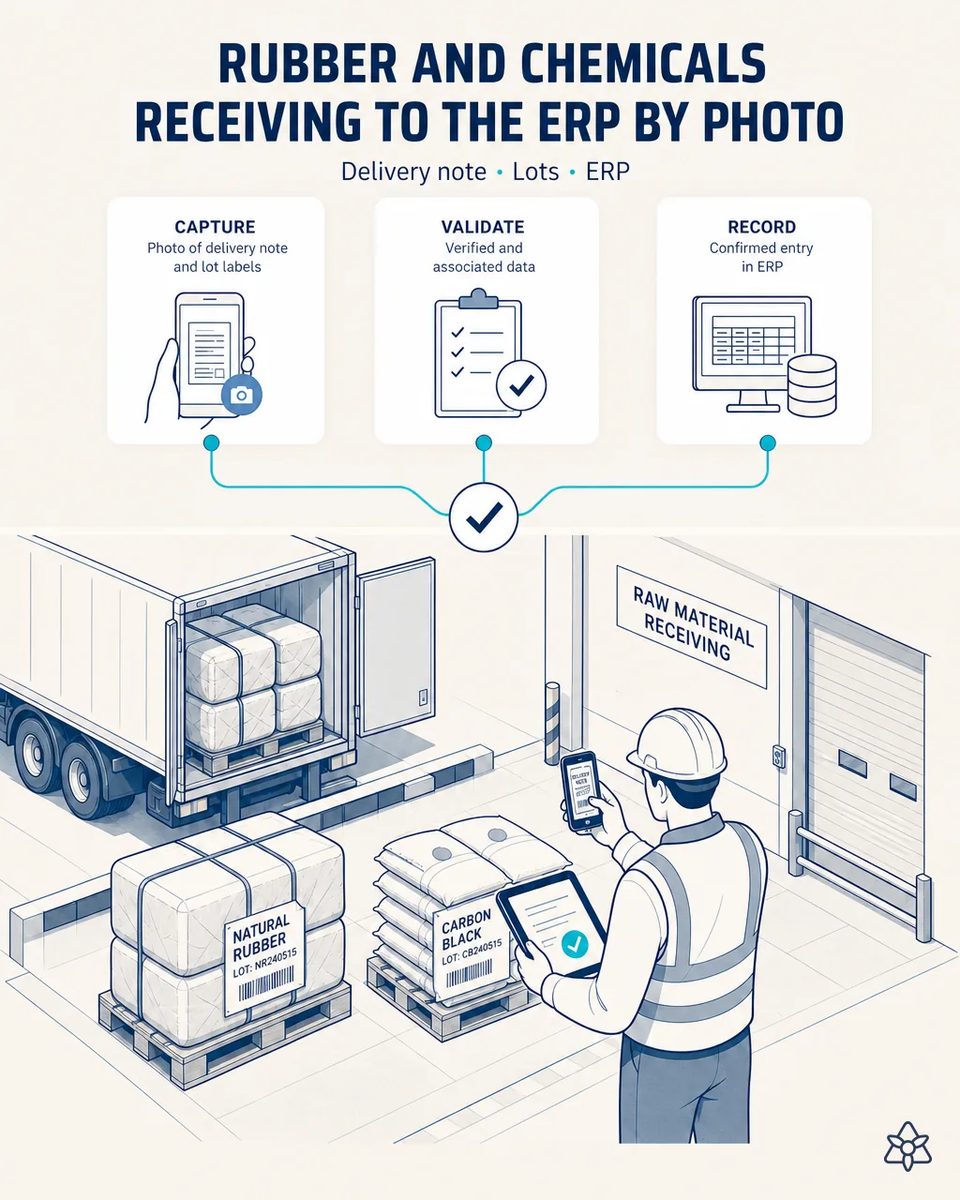
The truck arrives with natural rubber bales, carbon black, silica, chemicals or cord reels. The receiving lead has a delivery note with many lines, lot labels and certificates of analysis, and must key it all into the ERP. With iLEAN Connect they take photos, iLEAN extracts lots, quantities and certificates, and after one validation tap posts them to SAP through the API.
The truck waits while the lots are typed, or the lots are typed in a rush.
Every day a tire plant receives natural rubber bales, synthetic rubber, carbon black, silica, chemicals and textile or steel cord. Each pallet has its lot and often its certificate of analysis. The receiving lead has to log into the ERP and type line by line. Either the truck waits, or it is rushed and a lot is badly traced, which surfaces weeks later in a claim nobody can follow.
- Every day a tire plant receives natural rubber bales, synthetic rubber, carbon black, silica, chemicals and textile or steel cord. Each pallet has its lot and often its certificate of analysis.
- The receiving lead has to log into the ERP and type delivery note lines, lots and quantities one by one. A single truck can mean dozens of lines and lots.
- Either the truck waits at the dock and the carrier charges demurrage, or it is rushed and a lot is badly traced. Both options cost money, one now and one later.
- That bad trace surfaces weeks later, when a compound misbehaves or a claim arrives and nobody can follow which rubber or filler lot went into it. Traceability breaks at the very first step of the chain.
Connect in photo mode at the dock — one tap and the lots are in SAP MM.
With iLEAN Connect, the lead photographs the delivery note, the labels and the certificate. iLEAN reads barcodes, QR codes or plain text, extracts lot, quantity, date and supplier, and checks them against the purchase order. One validation tap and it goes into SAP MM through the API. Today the receiving module needs several active licenses. With Connect, the lead validates without typing into the ERP. Typical reduction of 50 to 70 percent in receiving or warehouse module licenses, plus fewer carrier demurrage charges.
The lead stops being a typist and becomes the person who validates. The photos carry the lot, the quantity and the certificate, and the check against the purchase order is done before the tap, not after. The truck can leave as soon as the lead has checked the summary.
Dock receiving typed by hand versus captured by photo
| Aspect | Today | With iLEAN Connect |
|---|---|---|
| Delivery note lines for rubber and fillers | Typed one by one into SAP | Extracted from one photo |
| Rubber and carbon black lot numbers | Copied from labels, sometimes wrong | Read from barcode, QR or text |
| Certificate of analysis for each lot | Filed on paper | Attached to the lot in the ERP |
| Check against the purchase order | Done later, if at all | Done before validation |
| Rubber truck time at the dock | Waiting for data entry | Released after one tap |
| SAP MM receiving licenses | Several active users | The lead who validates |
Truck waiting and lots typed by hand → receiving validated with one tap, lots and certificates traced from the dock.
Impact estimate — to be validated with your numbers.
The block below is an estimate to be validated against your plant's actual data. We put it forward so the committee has an order of magnitude; we refine it during the assessment.
- Estimated payback 3-8 months, from faster unloading, full lot traceability and recurring license savings. We calculate it with your trucks per day and current receiving users.
- Typical reduction of 50 to 70% in receiving or warehouse module licenses, depending on the ERP vendor's pricing.
- Fewer carrier demurrage charges, because the truck no longer waits for line-by-line data entry. Unloading slots also become more predictable for the carriers.
- Complete raw material traceability from the dock: every bale, bag and cord reel tied to its lot and certificate. When a compound misbehaves, the rubber and filler lots behind it are one query away.
Payback 3-8 months · receiving module ERP licenses -50 to -70% (estimate to be validated). Faster unloading, complete raw material traceability from the dock and recurring license savings. We estimate a payback of 3 to 8 months. This is an estimate to be validated.
And the fair question from the production manager
“Can it read a dusty carbon black bag label or a bale tag that got wet?” — barcodes and QR codes are read directly; plain-text reading only comes in when there is no code, and then it is an anchored task where the best models drop below 1.5% error [1]. And every lot is checked against the purchase order and the delivery note, so a mismatch is highlighted instead of being posted. The lead validates a summary that has already been checked, not a raw reading.
[1] OpenAI paper "Why Language Models Hallucinate", 2025 — on the reliability of AI in anchored tasks.
What people ask about receiving rubber, fillers and cord by photo
What if the delivery note and the lot labels do not match?
The validation screen highlights the difference line by line. The lead decides whether to accept, correct or put the lot on hold. Nothing reaches SAP MM until that decision is taken.
Is the certificate of analysis attached to the rubber or filler lot?
Yes. The certificate photo or PDF is linked to the lot in SAP, and its key values can be checked against the purchase specification. A Mooney or carbon black value outside spec is flagged at the dock, not after mixing.
Does it handle cord reels and chemical drums as well as rubber bales?
Yes. Each material has its own label type, and the reading adapts to the codes and formats of each supplier. Steel cord, textile cord and chemicals are received with the same gesture.
Where does the receiving license saving come from?
From the people who log into the receiving module only to type. With Connect the lead validates without typing, which typically cuts 50 to 70% of those licenses. The exact figure depends on the ERP vendor's pricing.
Can a raw material lot be received without a purchase order?
It can be captured, but it is flagged as having no order to match against, so purchasing sees it before it enters stock. That avoids lots in the store that nobody can match to a purchase.
More cases from this series
- Synchronized compound flow: zero expired materialConnect, Edge and Agents coordinate mixing, components, building and curing so no compound expires and…
- Human check of every component before buildingEverything iLEAN captures goes through a tablet at the building machine: the operator confirms each…
- Compound batch card captured with one photoHow one photo of the compound batch card traces every rubber skid from mixing onwards, with no typing…
- The legacy curing press that now talksA camera reads the panel of legacy tire curing presses and digitizes every cure cycle curve without…
- The curing supervisor talks to the AI on the moveBuilding and curing supervisors dictate issues on the move; iLEAN structures them, links them to press…
- From the compound lab Excel to SAPiLEAN reads the rheometer and Mooney results Excel in the shared folder and, after human validation,…
Tell us how long a rubber or carbon black truck waits at your dock today.
We work on your plant's real data, not ours. Assessment with no commitment.
Request estimated ROI within 48h ‹ See all cases of radial tires See automotive