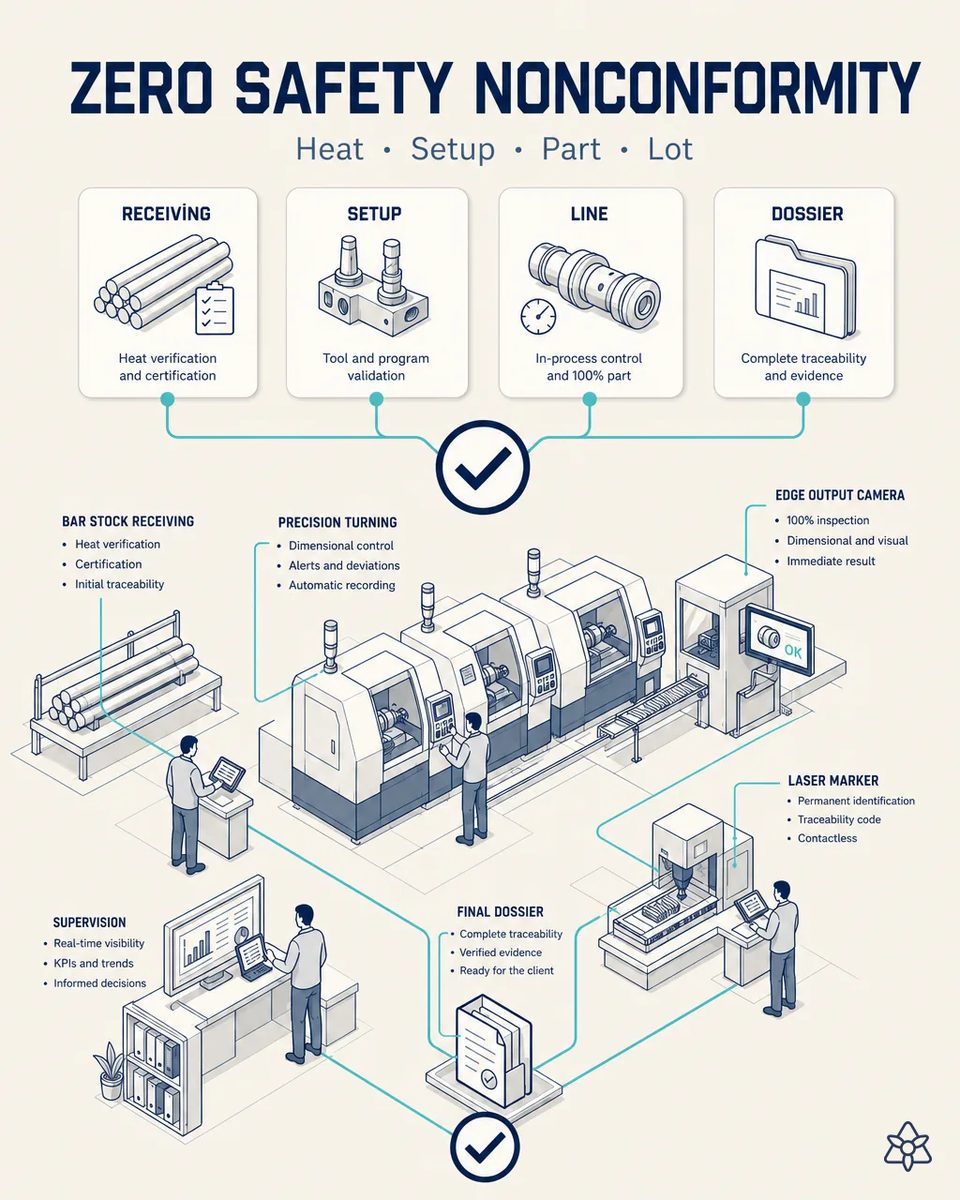
The full iLEAN system against safety-part nonconformity
Every precision-machining plant producing safety parts shares the same capital pain: zero nonconformity or recall from an out-of-tolerance part or a mistraced lot. The iLEAN flagship system coordinates Connect, Edge and Agents in cross-checking verification rings, stopping the line before the box leaves the plant if anything doesn't match.
A safety-part recall is rarely one failure. It is several small ones nobody crossed.
a nonconformity or recall on a safety part is the sub-sector's biggest reputational and financial risk — it can range from lot containment to losing homologation as an OEM supplier.
- A heat typed with one wrong digit, an insert slightly off after a changeover, a burr on one spindle, a lot typed by hand into the marker. Each one is small enough to pass unnoticed.
- Each one passes its own control. Together they produce the out-of-tolerance brake piston or the mistraced transmission shaft that reaches the OEM. Nothing in the individual controls was wrong; nothing crossed them.
- A nonconformity on a safety part is the sub-sector's biggest risk: it ranges from lot containment to losing homologation as an OEM supplier. And the OEM looks at how the escape happened, not only at the part.
- That is why isolated controls are not enough: they have to check each other, automatically and on every lot.
Verification rings that cross-check — Connect, Edge and Agents under JIDOKA AI.
certified heat at receiving (Connect) + setup validated by camera (Edge + JIDOKA AI) + Edge reading at the lathe output + laser marking driven straight from the ERP (Connect) + an evidence-pack dossier (Agents), with SMED AI keeping changeovers fast.
No single ring solves the problem, because each control already exists in some form and parts still escape. The strength is in the cross-check: when independent sources stop agreeing — heat, setup, output, mark — the box does not leave the plant until a person has looked. Each ring also pays on its own, so the system grows without a big-bang project.
The verification rings, and what each one closes in bar turning
| Ring | Which cases it draws on | What it closes |
|---|---|---|
| 1 · Heat | Bar receiving (7) + supplier alert (3) | Certified heat linked to every lot |
| 2 · Startup | Work order (1) + first-off tablet (5) | Lot defined and confirmed by a person |
| 3 · Setup | Changeover validation (10) | No run on a misplaced insert or cam |
| 4 · Output | Lathe output vision (9) + panel (2) | 100% of parts seen, causes on record |
| 5 · Mark | Laser marker (8) | The engraved lot is the ERP lot |
| 6 · Dossier | Evidence pack (11) + metrology (6) | Proof per lot, with SMED AI keeping changeovers fast |
nonconformity incidents with recall risk → discrepancies caught in line, before the part leaves the plant.
Impact estimate — to be validated against your nonconformity history.
The block below is an estimate to be validated against your plant's actual data. We put it forward so the committee has an order of magnitude; we refine it during the assessment.
- Estimated payback 6-12 months, counted against the first avoided nonconformity. One avoided escape usually covers the whole deployment.
- Protection against a recall, where a single incident can exceed hundreds of thousands of euros in sorting, freight and penalties.
- Protection of OEM supplier homologation, which carries multi-year value in future part-number awards. OEMs award new part numbers to suppliers with clean records.
- And discrepancies are caught in line, before the part leaves the plant, instead of at the OEM's incoming inspection.
protection against recall (a single incident that can exceed hundreds of thousands of euros) and against losing OEM supplier homologation (multi-year value), estimated payback 6-12 months against the first avoided nonconformity. *Estimate to be validated*.
And the fair question from the production manager
“Do we need all twelve cases before this works?” — no. The rings are built in layers and each case pays on its own. Each cross-check compares known fields between sources, an anchored task where the best models drop below 1.5% error [1], and JIDOKA AI stops the line on a verifiable discrepancy, with a person deciding what happens next.
[1] OpenAI paper "Why Language Models Hallucinate", 2025 — on the reliability of AI in anchored tasks.
What people ask about the zero-nonconformity system
Which case should a bar turning plant start with?
Usually the work order at startup or bar receiving: fewest dependencies, fastest to deploy, and they open the heat and startup rings that everything else builds on. Starting there also gives the quickest proof that the approach works on your floor.
Does the line restart by itself after a stop?
No. JIDOKA AI stops on a discrepancy; a person reviews the evidence and decides whether the lot continues, is quarantined or is reworked. Every stop and every decision are recorded, which feeds the evidence pack.
What does SMED AI add to the system?
It keeps changeovers short while the setup ring adds verification, so protection does not cost lathe hours on a fleet where changeovers are frequent. Changeover time is measured before and after, so the effect is visible.
Which parts should the rings protect first?
Safety parts with the highest exposure, such as brake pistons and transmission shafts, where a nonconformity costs the most and the OEM scrutiny is highest. The rings can then be extended to the rest of the part numbers in order of risk.
Can we size the return before signing anything?
Yes, from your complaint and containment history, your scrap by lathe and your number of changeovers per week. That gives a return per ring before deciding the order. The estimate is reviewed with quality and finance before anything is committed.
More cases from this series
- From delivery note and heat certificate to ERP, by photoPhotograph the delivery note and heat certificate; after one validation tap, it's all in the ERP. Less…
- Early human verification: two taps before it hits the ERPEvery iLEAN capture goes through an in-line tablet: the operator confirms with two taps before data…
- The shift lead's knowledge, captured hands-freeWearing an earpiece, the shift lead dictates issues while walking the floor; iLEAN structures them and…
- The laser marker, stitched to the ERP with no manual typingLot and part number travel automatically from ERP to the laser marker, eliminating the typing error that…
- The vintage multi-spindle lathe that now "talks"An external camera reads RPM, feed rate and wear off the vintage panel; the machine stays itself, but…
- From the metrology spreadsheet to the ERP, no retypingiLEAN detects the metrology spreadsheet on save and, after validation, pushes it to the ERP. Up to -80%…
Tell us what your last safety-part containment cost you.
We work on your plant's real data, not ours. Assessment with no commitment.
Request estimated ROI within 48h ‹ See all cases of precision machining See automotive