Visual setup validation before the run starts
Switching part numbers on a multi-spindle lathe means readjusting tooling and cams; if it's off, the first minutes produce out-of-tolerance parts. With iLEAN Edge, fixed cameras compare the current setup against the reference state and block the run until OK.
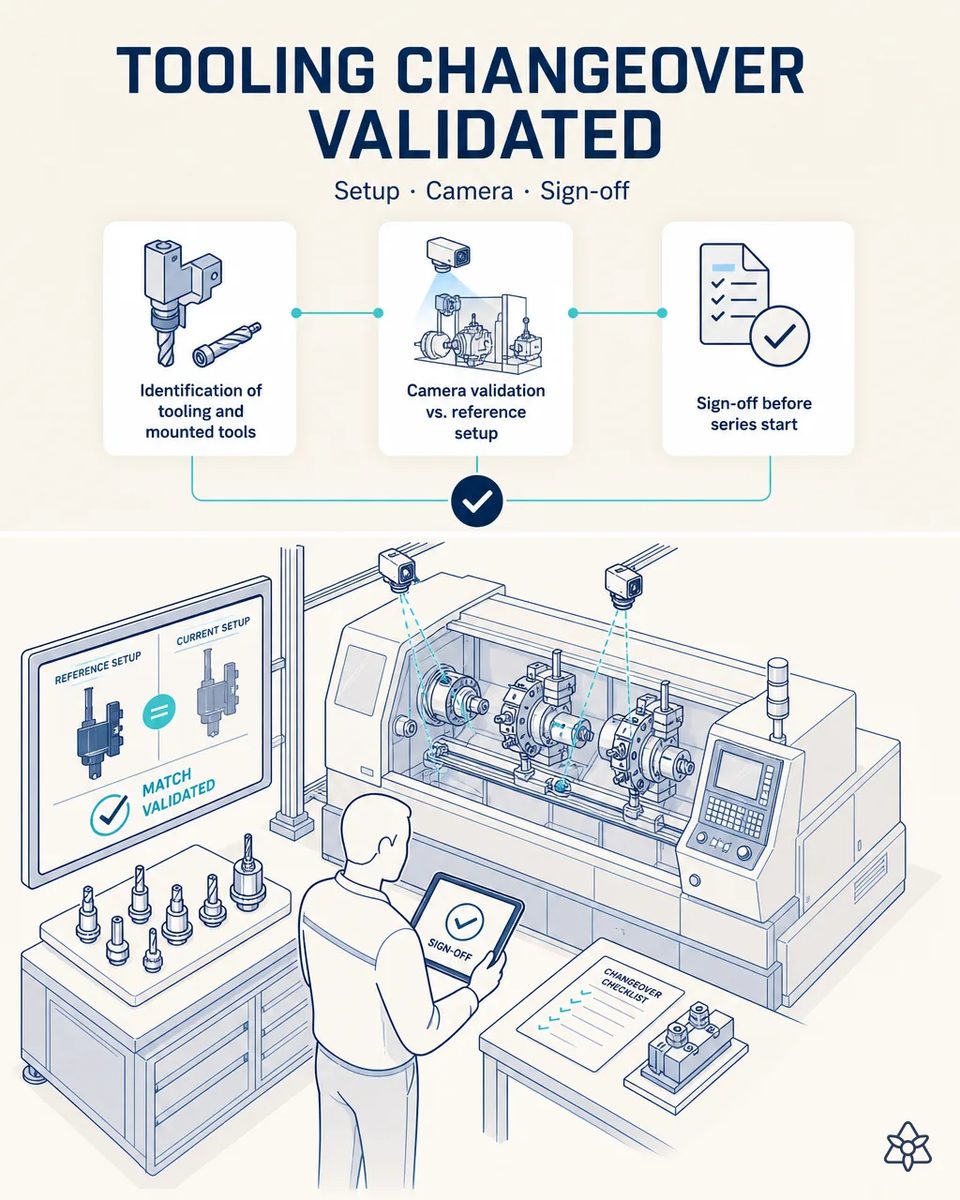
After a part-number change, the first minutes decide the first lot.
the responsibility for a correct setup today rests on a human sign-off with no objective visual evidence.
- Switching part numbers on a multi-spindle lathe means resetting tool holders, inserts and cams across several stations, often under time pressure. On a high-mix fleet that can mean several changeovers per shift.
- If one is off, the first minutes produce out-of-tolerance parts, and on a safety part those parts are a containment risk, not just scrap. The scrap is visible; the risk of a part that passed is not.
- Today the setup is closed by a human sign-off with no objective visual evidence behind it, however experienced the setter is.
- When something goes wrong, the investigation finds a signature, not a reason, and the corrective action ends up being another line on the checklist.
Edge plus JIDOKA AI — the run does not start until every camera and the quality lead agree.
Edge + JIDOKA AI. Industrial cameras with CNNs trained to recognize "correct setup vs. misplaced tooling"; the run is blocked until all cameras pass plus the quality lead's sign-off.
The cameras do not replace the setter's judgment: they put evidence next to it. What changes is not who signs, but what they sign on — and every signature comes with the images of each station at the moment of approval. For a setter, it is also proof that the setup they signed was right.
A signed setup versus a camera-evidenced setup
| Aspect | Today | With iLEAN Edge |
|---|---|---|
| Setup sign-off | A signature, no evidence | Cameras at every critical point, plus sign-off |
| Misplaced insert or holder | Found on the first parts | Detected before the run |
| First lot after changeover | Born under suspicion | Protected from minute one |
| Reference state per part number | In the setter's memory | Stored images per station |
| Run start | When the setter says so | Blocked until all cameras pass |
| Evidence for an investigation | None | Images of every station |
blind sign-off with risk of out-of-tolerance parts from minute one → visual evidence at every critical setup point.
Impact estimate — to be validated with your changeover calendar.
The block below is an estimate to be validated against your plant's actual data. We put it forward so the committee has an order of magnitude; we refine it during the assessment.
- Payback depends on changeover frequency: we do not fix a range because it scales with how many part-number changes you run per week.
- Direct protection of the first lot after every changeover, which is where most setup-related scrap and risk concentrate.
- Blind sign-off is replaced by visual evidence at every critical setup point. The setter no longer carries the responsibility alone.
- And the investigation, if one is ever needed, starts with images instead of a tick on a sheet. Repeated discrepancies at one station also show where the setup procedure needs work.
direct protection of the first lot after every changeover, payback depending on changeover frequency. *Estimate to be validated*.
And the fair question from the production manager
“What if the camera blocks a correct setup and the lathe sits idle?” — comparing a station against its reference image is an anchored task, where the best models drop below 1.5% error [1]. And on doubt the system does not block silently: it escalates to the quality lead, who signs on the evidence, so the lathe stops on a real discrepancy, not on model uncertainty.
[1] OpenAI paper "Why Language Models Hallucinate", 2025 — on the reliability of AI in anchored tasks.
What people ask about validating the setup by camera
What exactly do the cameras check in bar turning?
Tool holders, inserts, cam positions and bar feed setup at each station, as defined with your setters during commissioning. The list is per part number, not generic. Points are prioritized by the defects they would cause on that part number.
How is the reference state created for a part number?
From the first approved setup of that part number, with the setter and quality confirming it as the reference. When the part is revised, the reference is updated the same way. Reference images are stored per part number and revision.
Does it add time to the changeover?
The check takes seconds. It also tends to shorten the safety margin people add when they are unsure, which is where SMED AI helps keep changeovers short. Over time, the images also show where each changeover loses minutes.
Can a run start with one station not OK?
Only with an exception signed by the quality lead, and it is logged as such with the images. What cannot happen is a silent start with no record of who decided. Exceptions are reviewed weekly so they do not become the norm.
Does it work on sliding-head lathes too?
Yes, with camera positions adapted to the guide bush and tool gang layout. The logic of reference state plus sign-off is the same. A first lathe is usually enough to define the method for the rest of the fleet.
More cases from this series
- From delivery note and heat certificate to ERP, by photoPhotograph the delivery note and heat certificate; after one validation tap, it's all in the ERP. Less…
- Early human verification: two taps before it hits the ERPEvery iLEAN capture goes through an in-line tablet: the operator confirms with two taps before data…
- The shift lead's knowledge, captured hands-freeWearing an earpiece, the shift lead dictates issues while walking the floor; iLEAN structures them and…
- The laser marker, stitched to the ERP with no manual typingLot and part number travel automatically from ERP to the laser marker, eliminating the typing error that…
- The vintage multi-spindle lathe that now "talks"An external camera reads RPM, feed rate and wear off the vintage panel; the machine stays itself, but…
- From the metrology spreadsheet to the ERP, no retypingiLEAN detects the metrology spreadsheet on save and, after validation, pushes it to the ERP. Up to -80%…
Tell us how many part-number changes your multi-spindles run per week.
We work on your plant's real data, not ours. Assessment with no commitment.
Request estimated ROI within 48h ‹ See all cases of precision machining See automotive