Zero customer PPM in APQP launches: iLEAN's 4 coordinated rings
The capital pain point of any premium LED headlight Tier 1 is the same: zero customer escape during APQP launches. A single post-SOP escape triggers escalation, six-figure containment, a falling Q-rating, and the risk of losing the next program. iLEAN coordinates 4 rings that cross-check each other —QM ERP · laser marker · Edge · evidence pack—: if all 4 don't agree, Jidoka locks the line before the pallet ships. It's the flagship built so the Quality Development Manager and the program owner defend the same decision before the committee and before the OEM with no translation.
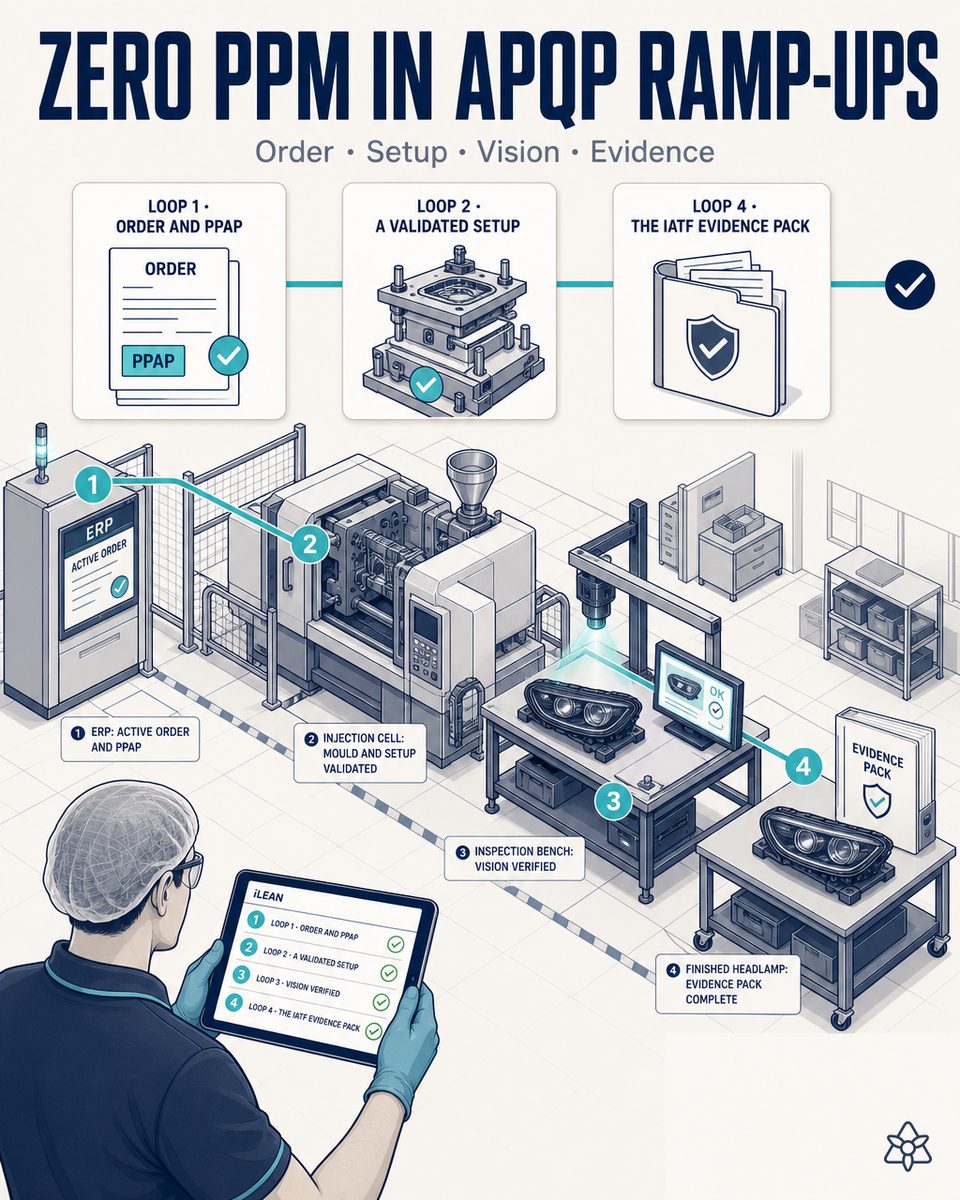
An escape in an APQP launch isn't a quality incident: it's the next program at stake.
In a premium LED headlight Tier 1, a customer escape during the APQP launch of a new program is the biggest reputational and financial risk in the sub-sector. A headlight engraved with the previous design version, a component mounted from the wrong binning reel, a scratch on the lens that visual inspection didn't catch — every incident costs tens to hundreds of thousands of euros directly in escalation, containment, 100% sorting and urgent transport. But the direct cost is the least of it: behind it comes the falling Q-rating on the OEM scorecard, a lasting damage that drags on for years over the plant's ability to win the next nomination.
The error is almost never in the headlight. It's in the coherence between four points that should say the same thing and, mid-launch, sometimes don't: what the active production order defines in the QM ERP (program, version, cavity, binning, current PPAP, the OEM's CSR), what the laser marker engraves on each headlight, what the final-line camera actually sees on the part, and what is documented as evidence when the pallet is released. A mismatch in any of those four points is indistinguishable from the rest until the customer's assembly plant catches it or, worse, the resident engineer does mid process audit.
And the APQP launch is precisely the period when those four points move most: the version changes week to week, the cavities are new, the binning varies between supplier lots and the crew isn't yet run in on the reference. That's why escapes concentrate there — and why protection can't depend on anyone's memory: either the four points verify each other on the line, or the customer makes the first finding.
The 4 coordinated rings — the heart of the system.
No ring on its own closes the risk. What armors the launch is that the four cross-check each other: each one verifies what the previous one said, and none lets a pallet ship without the other three agreeing.
- Ring 1 · QM ERP. As the single source of truth, the active production order defines the program, the current design version, the mold cavity, the authorized LED reel binning, the current PPAP and the destination OEM's CSR. Everything that happens afterwards is measured against this definition, not against anyone's memory — and when Engineering approves a version change mid-launch, the change propagates to the other three rings in the same shift. See the paperless batch startup (Ring 1) →
- Ring 2 · Laser marker. The marker engraves the serial and version on each headlight via API directly from the active production order, with no intermediate typing. The headlight ships marked with what the QM ERP says is being built — not with what someone remembered was being built. The classic version mix-up point in a launch drops off the map. See the laser marker ERP integration (Ring 2) →
- Ring 3 · Edge. The final-line camera reads the real marking on the headlight and cross-checks it against the active production order; the same Edge vision intercepts the scratch on the lens, the fingerprint and the missing component before packing. If anything doesn't match —a previous version engraved, a serial out of range, a cosmetic defect— AI Jidoka locks the line before the headlight enters the pallet: no need to wait for the customer's assembly plant to detect it. See final-assembly defect vision → · See changeover validation →
- Ring 4 · Evidence pack. Every pallet ships with a dossier that cross-references the three prior rings —the production order definition, the engraved marking and the Edge verification— plus the photo of the marked headlight and the quality technician's signature, formatted for the destination OEM's CSR. If the resident engineer or the auditor asks, the answer already exists reconciled; there's nothing to rebuild by hand. See the IATF CSR evidence pack (Ring 4) →
A fifth element isn't a ring, it's what keeps the four from penalizing productivity: AI SMED speeds up the program changeover —with the propagation of version, cavity and binning included— so coordinating four verification points doesn't mean penalizing OEE. The coordination protects without braking.
See the full IRIS architecture →
Satellite cases from the same plant, with the technical detail of each ring: paperless batch startup (Ring 1) · laser marker ERP integration (Ring 2) · final-assembly defect vision (Ring 3) · changeover validation (Ring 3) · IATF CSR evidence pack (Ring 4).
Plant without coordinated rings vs. plant with iLEAN's 4 rings
| Aspect | Plant without coordination | Plant with iLEAN's 4 rings |
|---|---|---|
| Program startup (version, cavity, binning, PPAP, CSR) | Read on paper or screen, transcribed by hand at each station | Ring 1 (QM ERP): the active production order defines everything as single source; version changes propagate in the same shift |
| Headlight marking (serial and version) | Typed or selected by hand at the marker; version mix-up typical of a launch | Ring 2: the laser marker engraves via API from the production order, with no intermediate typing |
| Final-line inspection | Manual visual sampling; the scratch, fingerprint or missing component is caught late or at the customer | Ring 3 (Edge): marking and finish cross-checked 100% against the active production order; AI Jidoka locks the line if anything doesn't match |
| Evidence per pallet | Scattered across spreadsheets and station logs; rebuilt if the OEM complains | Ring 4 (evidence pack): dossier reconciled in the moment, with photo of the marked headlight and quality technician's signature, in each OEM's CSR format |
| Program changeover | Penalizes OEE; the changeover pressure multiplies the startup error | AI SMED speeds up the changeover with the propagation of version, cavity and binning included |
| Customer escapes during APQP launches | 3-8 per year, some with six-figure containment | Zero — the discrepancy is detected on the line, not at the customer's assembly plant. Estimate to be validated. |
Impact estimate for your plant — to validate with your numbers.
The following block is an estimate to be validated with the Quality Development Manager and the program owner of your plant. We lay it out so the committee has an order of magnitude; we refine it in the diagnosis.
- Premium LED headlight Tier 1 with several programs running simultaneously in different APQP phases, a mix of versions and cavities per line, LED reel binning variable between supplier lots and a different CSR per destination OEM.
- Pilot on the line of the next program in launch with the coordination of the 4 rings —QM ERP, laser marker via API, Edge with AI Jidoka and evidence pack per pallet. First value in a few weeks starting with the Edge vision ring at final line.
- The hard Quality lever is protecting the Q-rating on the OEM scorecard — a multi-year asset whose value far exceeds the one-off cost of any escape — and with it the ability to win the next program from the same OEM.
- The hard Program lever is avoiding the six-figure containment and the escalation a single post-SOP escape triggers: 100% sorting, urgent transport, a team dispatched to the customer's site and weeks of crisis management mid-launch.
- Indicative payback between 6 and 12 months, counted against the first escape avoided. With a single serious event avoided, the system pays for itself. Estimate to be validated.
And the reasonable doubt: "what if the system itself gets it wrong?"
The quality manager's correct question. Two answers that hold each other up. The technical one: hallucination is a problem of free generation, not of anchored tasks — reading the serial and version engraved on a headlight and comparing them with the active production order published by the QM ERP, or cross-checking the image of a lens against the approved defect pattern, are anchored tasks as anchored as they come. In tasks of this kind, the best models brought the error below 1.5% [1]. The architectural one: the system is built on the three IRIS safety rings — Connect transports, the Agents decide, the person signs. And because the 4 rings of the case cross-check each other, an isolated fault in one is exposed by the other three before it becomes an escape. It isn't that everything passes through a person; it's that the system allows it where it matters, and here it matters.
[1] OpenAI paper "Why Language Models Hallucinate", 2025 — on the reliability of AI in anchored tasks.
What people ask about iLEAN's 4-ring system in premium LED headlights
Why is a customer escape in an APQP launch the biggest risk in the sub-sector?
Because the APQP launch is the program's window of maximum risk, and a single post-SOP escape does far more than cost money. The direct bill is already heavy — tens to hundreds of thousands of euros in escalation, 100% sorting, containment and urgent transport — but the lasting damage is the falling Q-rating on the OEM scorecard, an asset that conditions the plant's ability to win the next nomination for years. During the launch the design version changes week to week, the PPAP is still provisional, the mold cavities are new, the LED reel binning varies between supplier lots and the crew isn't yet run in on the reference. That is exactly when escapes concentrate — and why protection can't depend on anyone's memory: either the four points verify each other on the line, or the first to find the discrepancy is the customer.
How do the 4 rings cross-check each other?
Each ring acts as witness to the previous one, so no pallet ships unless all four agree. Ring 1 (QM ERP) defines the active production order as the single source of truth — program, version, cavity, LED reel binning, current PPAP and the OEM's CSR. Ring 2 (laser marker) engraves serial and version via API straight from that production order, with no intermediate typing, so the headlight is marked with what the QM ERP says is being built. Ring 3 (Edge) reads the real marking on the headlight and cross-checks it against the active production order, while the same Edge vision intercepts scratches, fingerprints and missing components. Ring 4 (evidence pack) closes the loop: every pallet ships with a dossier that cross-references the three prior rings plus the photo of the marked headlight and the quality technician's signature. An isolated fault in one ring is exposed by the other three before it becomes an escape.
What happens when one ring disagrees with the others?
The line locks before the pallet ships. If the Edge camera reads a previous design version engraved on the headlight, a serial out of range, a component from the wrong reel binning or a cosmetic defect on the lens, the discrepancy is caught on the line and AI Jidoka locks the line before the headlight enters the pallet — not at the customer's assembly plant, where the same finding is already an escape with containment. The critical release is never executed alone either: the quality technician signs the evidence pack before the pallet leaves, and that signature is anchored to the dossier. The system is built on the three IRIS safety rings — Connect transports, the Agents decide, the person signs — so the decision to stop is grounded, not a black box.
How does AI SMED keep the four rings from penalizing OEE?
Coordinating four verification points must not slow the line, and program changeover is where that risk concentrates. AI SMED speeds up the changeover — with the propagation of version, cavity and binning to the laser marker and the Edge camera included — so switching programs during the launch doesn't penalize OEE. It isn't a fifth ring; it's what lets the four rings protect without braking. When Engineering approves a version change mid-launch, that change reaches the marker and the final-line camera in the same shift, with no email or intermediate typing, so the changeover pressure that normally multiplies startup errors is absorbed by the system rather than by the crew.
Does this actually help win the next program from the same OEM?
That's the point of the flagship. The hard Quality lever is protecting the Q-rating on the OEM scorecard — a multi-year asset whose value far exceeds the one-off cost of any single escape — and with it the ability to win the next program from the same OEM. An APQP launch delivered at zero customer PPM, with unit-level traceability generated in the moment and an evidence pack in the OEM's own CSR format, is exactly the track record the sourcing committee weighs at the next nomination. The estimate is one to validate with your Quality Development Manager and the program owner, but the mechanism is direct: a clean launch defends the rating, and the rating opens the next award.
More cases from this series
- Early human validation at the FAI bench: two taps, IATF-traceable signatureNothing enters the QM ERP without a human signature; the iLEAN tablet shows a summary and the quality…
- The assembly supervisor dictates while walking, and iLEAN listensThe headlight supervisor dictates while walking; iLEAN structures it as a nonconformity candidate linked…
- LED reel receiving in 5 minutes with full traceabilityPhotograph the delivery note and reel labels; the ERP receives part number, binning and MSL in one tap.…
- OEM spec changes that reach the line on timeiLEAN monitors the customer resident's mailbox 24/7, cross-checks live orders and current PPAP, and…
- Paperless LED headlight batch startup, with production order and PPAP at zero-second latencyDigitize the production order, the PPAP checklist and the first LED reel label at zero-second latency:…
- From goniophotometer Excel to live QM ERP, with license savingsiLEAN reads the goniophotometer Excel the moment it's saved and pushes it to the QM ERP after…
Zero customer PPM in your next APQP launch — with the 4 coordinated rings.
We work on your plant's real data, not ours. Diagnosis with no commitment.
Design the iLEAN flagship for your next APQP launch — kick-off with an AI-FDE in 2 weeks ‹ See all LED headlight cases See automotive