Paperless LED headlight batch startup, with production order and PPAP at zero-second latency
In a Tier 1 premium LED headlight plant, three critical paper documents define every batch and today they live outside the system: the hand-annotated production order, the signed PPAP checklist, and the first LED reel label. With iLEAN Connect the operator takes three photos and the batch exists in the QM ERP at shift start, with IATF-traceable signatures.
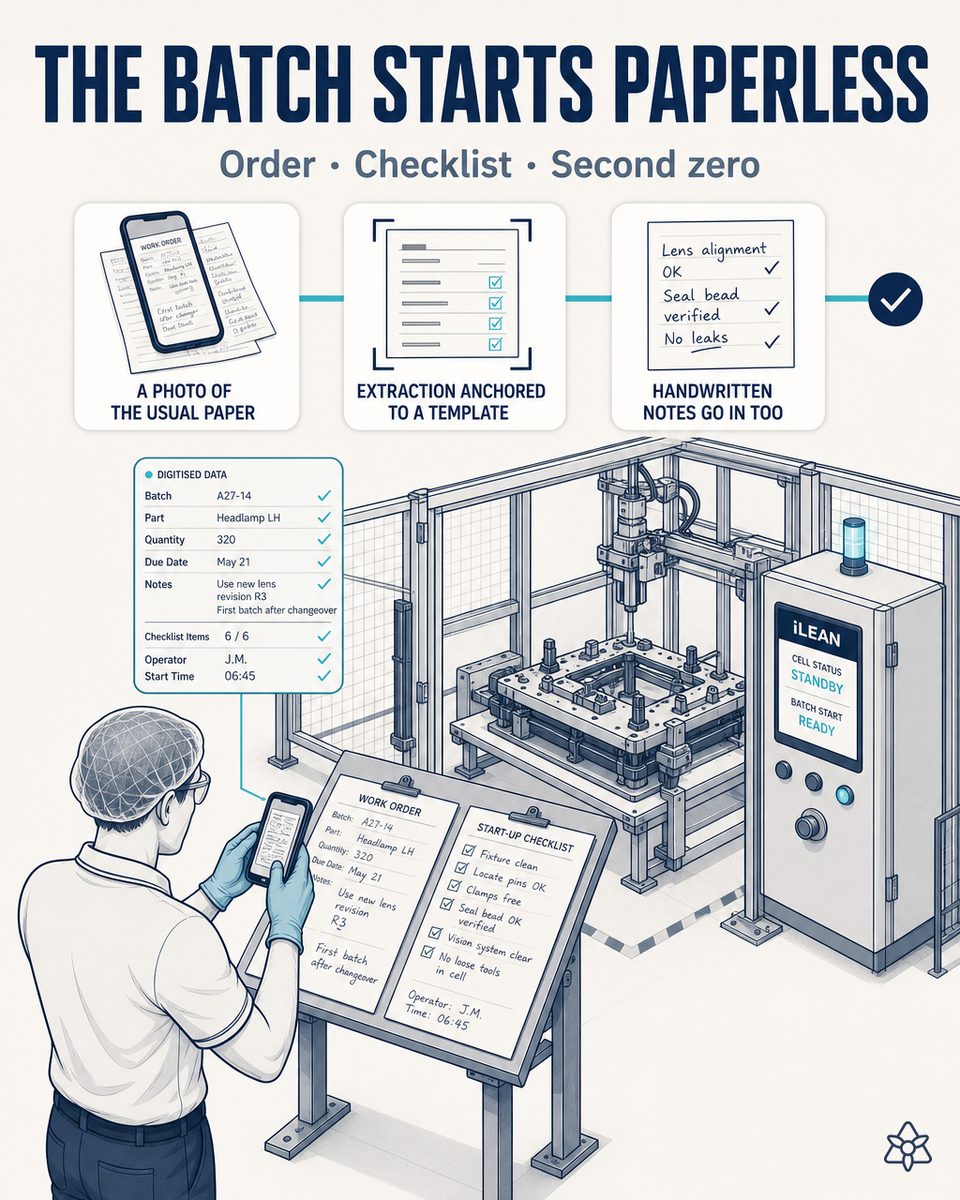
The production order, the PPAP checklist and the reel label define the batch — and they live on paper until the end of the shift.
In a Tier 1 premium LED headlight plant, every batch startup generates three critical documents that today are born outside the system. The shift production order is printed from the ERP and annotated by hand: active mold cavity, lens version, program change. The quality technician signs a 20-30 point PPAP checklist. And the first LED reel label defines the color binning of the entire batch. The process is qualified and stable; the gap is in what happens to those papers afterwards:
- Late transcription — the three documents pile up in the supervisor's office and get transcribed into the QM ERP at the end of the shift, with a latency of 4-8 hours and frequent typing errors: a miscopied cavity, a transposed binning, a signature that doesn't carry over.
- Traceability that arrives late — when the customer resident engineer asks for traceability of a batch in the afternoon, the data isn't in the QM ERP yet. What the paper says and what the system says don't match for hours, and that gap is exactly what an IATF 16949 or VDA 6.3 auditor will look for.
- Work that isn't theirs — the operator already has enough to do starting the line per the work instruction; typing the production order into the QM ERP is not their job. And every hour the supervisor or the quality technician spends transcribing papers is an hour not spent on production or quality.
Nobody sees that gap until the customer resident engineer or an auditor asks for the record of a specific headlight and it has to be reconstructed from the annotated production order, the filed checklist and the reel label. That's where a routine transcription turns into an audit finding.
Connect in photo mode — three photos at shift start, and the batch exists in the QM ERP at second zero.
Headlight batch startup doesn't need a new MES or forcing the operator to type on the line. It needs the information that already exists on paper — the annotated production order, the signed PPAP checklist and the reel label — to reach the central memory at second zero, without the supervisor or the quality technician having to transcribe it at the end of the shift. That's what Connect in photo mode is for.
The operator photographs the production order, the PPAP checklist and the first reel label at shift start and gets on with their work. Connect extracts the fields with an anchored LLM, stores them in the central iLEAN memory and presents them on the industrial tablet for human validation. With two taps from the quality technician, they cross into the QM ERP via API.
How Connect photo operates at batch startup in a Tier 1 LED headlight plant:
- Photo over the same old paper — the operator starts the shift exactly the same and takes three photos with the line tablet or phone: the production order with its hand annotations, the signed PPAP checklist and the first LED reel label. Zero habit change, zero fields to type.
- Extraction anchored to the real templates — a language model anchored to the plant's templates extracts the structured fields: program, active cavity, lens version, reel binning and checklist signatures. It doesn't generate free data; it recontextualizes what is already written.
- Human validation on the tablet — the data appears for validation on the industrial tablet at the FAI bench or the APQP cell. The quality technician reviews and confirms with two taps; if something doesn't add up — a doubtful binning, a missing signature on the checklist — the system holds it before accepting the data as good.
- Cross into the QM ERP via API with a traceable signature — the validated fields cross into the QM ERP at second zero, stamped with a timestamp and with a role-traceable signature compliant with IATF 16949, linked to the original image of each document.
- Instant query for the auditor and the resident — the auditor or the customer resident engineer types the headlight or batch number on the web and finds the production order, the PPAP checklist and the reel binning with their full audit trail. Nobody reconstructs records at the end of the shift.
Paper headlight batch startup vs. digitized startup with Connect
| Aspect | Classic paper startup | With iLEAN Connect photo |
|---|---|---|
| Production order → QM ERP latency | 4-8 h — transcription at the end of the shift | Zero-second — three photos and central memory |
| PPAP checklist transcription errors | Frequent: miscopied cavity, transposed binning, signature not carried over | 0 — anchored extraction plus quality-technician validation |
| LED reel color binning | Paper label, typed in hours later | Digitized and linked to the batch instantly |
| Auditor query by headlight number | Papers in the supervisor's office, record to reconstruct | Instant via web, with original image and audit trail |
| Record signature | Transcription with no traceability of who typed what | Role-traceable signature compliant with IATF 16949, with timestamp |
| Supervisor and quality-technician time | Hours per shift transcribing papers into the QM ERP | Recovered for production and quality. Estimate to be validated. |
Impact estimate for your plant — to validate with your numbers.
The following block is an estimate to be validated with the specific data of your plant. We lay it out so the committee has an order of magnitude; we refine it in the diagnosis.
- Tier 1 premium LED headlight plant, with several assembly lines, parallel APQP programs for more than one OEM, hand-annotated production order and a paper PPAP checklist per shift.
- Connect photo pilot on batch startup — the tablet or phone already on the line, without changing the work instruction or touching the qualified process. First expected value in a few weeks.
- Indicative payback between 3 and 8 months, depending on the plant's parallel APQP programs. Estimate to be validated.
- Recovery of the time the supervisor and the quality technician spend today transcribing the production order, the PPAP checklist and the reel labels into the QM ERP — hours per shift that return to production and quality. Estimate to be validated with your data.
- The hard lever is traceability available when the customer resident engineer asks for it, not at the end of the shift: a complete, queryable batch record from second zero avoids the finding that conditions an entire IATF 16949 or VDA 6.3 audit.
And the quality manager's reasonable doubt
"What if the model misreads the reel binning or confuses a signature on the PPAP checklist?" — hallucination is a problem of free generation, not of anchored tasks. In tasks where the AI merely recontextualizes a specific piece of data from one medium to another (reading the annotated production order, the signed checklist and the reel label, and extracting their fields against the real template), the best models brought the error below 1.5% [1]. And even so, the critical decision isn't made alone: the doubtful data is held and the quality technician signs on the tablet before the record crosses into the QM ERP. The three safety rings are there precisely for this.
[1] OpenAI paper "Why Language Models Hallucinate", 2025 — on the reliability of AI in anchored tasks.
What people ask about batch startup in a Tier 1 LED headlight plant
Why does batch startup fail today in a Tier 1 LED headlight plant?
Because the three documents that define the batch are born outside the system: the production order printed from the ERP and annotated by hand (active cavity, lens version, program change), the 20-30 point PPAP checklist signed by the quality technician and the first LED reel label, which sets the color binning of the entire batch. They pile up in the supervisor's office and get transcribed into the QM ERP at the end of the shift, with 4-8 h of latency and frequent errors. When the customer resident engineer asks for traceability in the afternoon, the data isn't in the QM ERP yet.
Does the work instruction or the operator's habit change?
No. The operator still starts the shift exactly the same way: the same production order printed with its hand annotations, the same PPAP checklist the quality technician signs, the same LED reel label. The only thing added is three photos with the line tablet or phone. Connect captures what is already written; it doesn't force anyone to type anything on the line or rewrite the approved work instruction. The document change is managed through change control, as IATF 16949 requires, without touching the production habit.
How is the record signed with an IATF 16949 role?
Each extracted field enters the central iLEAN memory stamped with a timestamp and linked to the original image of the document. Validation is human and early: the quality technician reviews the fields on the industrial tablet at the FAI bench or the APQP cell and confirms with two taps; their confirmation is recorded as a traceable signature associated with their role — who validated what, when and against which evidence. That is exactly the trail an IATF 16949 or VDA 6.3 auditor expects to find, with no after-the-fact reconstructions.
Does it work with multi-program lines and several OEMs at once?
Yes — it's the normal case for a Tier 1. The language model doesn't read "a generic production order": it is anchored to the plant's real templates, one per program and per PPAP checklist format, including the variants that each OEM's CSR imposes. For each batch it extracts program, active cavity, lens version, reel binning and signatures against the matching template. It doesn't generate free data — it recontextualizes what is already printed or handwritten. If a photo doesn't match the expected template or a field comes in doubtful, it is held and the quality technician resolves it on the tablet.
What does the auditor or customer resident engineer see when they ask for traceability?
Instant query via web, by headlight or batch number. The IATF 16949 or VDA 6.3 auditor — or the customer resident engineer preparing a report for the OEM — types the number and finds the production order with its annotations, the PPAP checklist with the quality technician's signature and the LED reel binning, each field with its timestamp and the original document image. The batch record exists from second zero in the QM ERP: no waiting until the end of the shift or digging through papers in the supervisor's office.
More cases from this series
- Early human validation at the FAI bench: two taps, IATF-traceable signatureNothing enters the QM ERP without a human signature; the iLEAN tablet shows a summary and the quality…
- The assembly supervisor dictates while walking, and iLEAN listensThe headlight supervisor dictates while walking; iLEAN structures it as a nonconformity candidate linked…
- LED reel receiving in 5 minutes with full traceabilityPhotograph the delivery note and reel labels; the ERP receives part number, binning and MSL in one tap.…
- OEM spec changes that reach the line on timeiLEAN monitors the customer resident's mailbox 24/7, cross-checks live orders and current PPAP, and…
- From goniophotometer Excel to live QM ERP, with license savingsiLEAN reads the goniophotometer Excel the moment it's saved and pushes it to the QM ERP after…
- Vintage vacuum metallizer now talks, with zero replacement CAPEXAn external camera reads the vacuum and temperature curve off the reflector metallizer's vintage panel —…
Talk to an iLEAN AI-FDE — the paperless headlight batch startup of your Tier 1 plant, with your production order, your PPAP checklist and your LED reels.
We work on your plant's real data, not ours. Scoped pilot on your line, no commitment.
Talk to an iLEAN AI-FDE — scoped pilot on your line ‹ See all LED headlight cases See automotive