OEM spec changes that reach the line on time
At 10:40 the customer resident engineer emails a photometric spec change for the program launching to series next month. If the email is read at 14:00, light engines are already built to the old spec. With iLEAN Connect the system reads the email at zero-second latency, cross-checks it against the active production orders and the current PPAP, and returns to the Quality Development Manager the exact action: stop the cell, flag the batch as conditional hold, convene engineering for a PSW update.
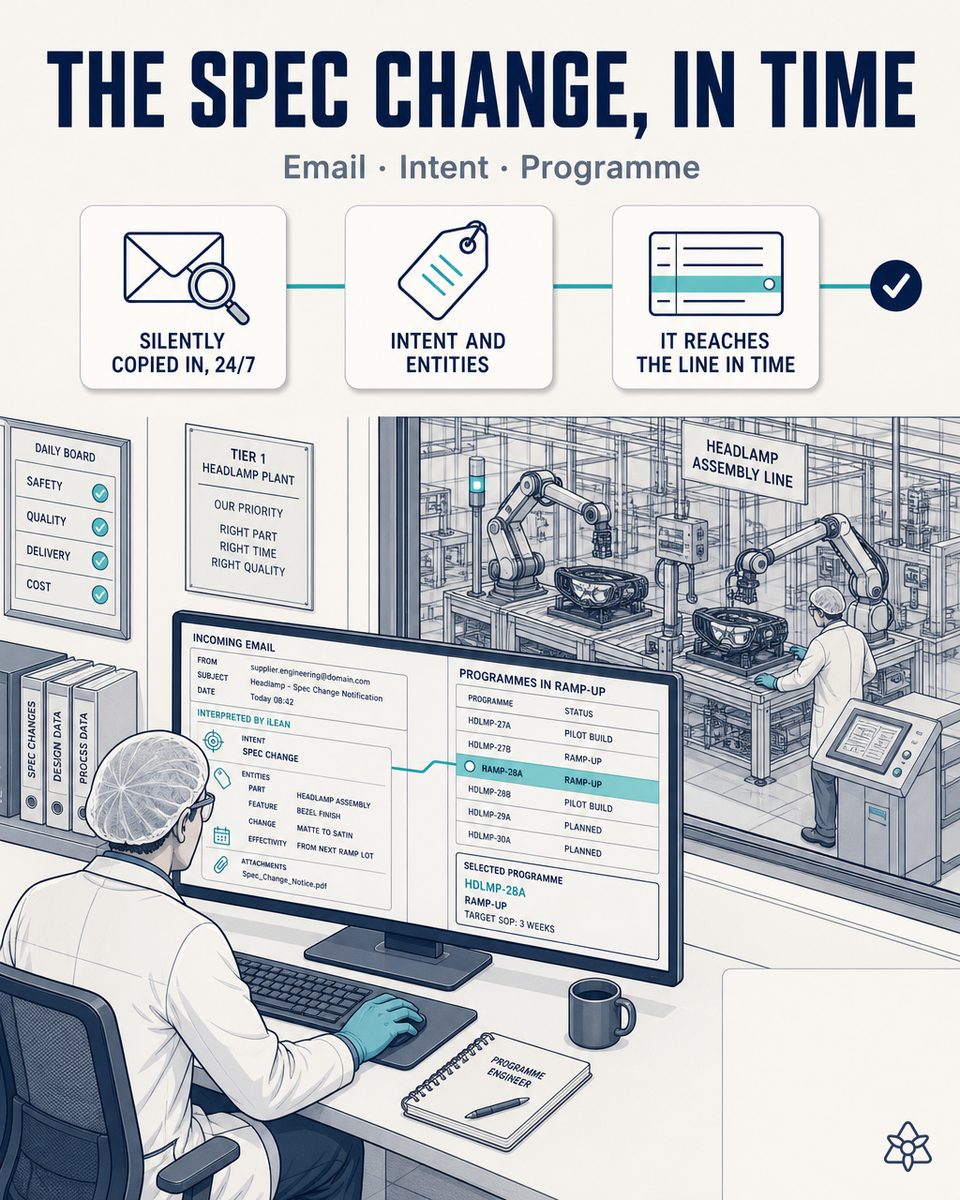
The OEM spec change arrives on time. The person who has to read it doesn't.
In a Tier 1 premium LED headlight plant the customer's critical notices — photometric spec change, CSR change, PPAP update — already arrive, but they arrive by email to specific people:
- At 10:40 an email comes in from the customer resident engineer notifying a photometric spec change for the program that starts series next month, with light-engine production orders already in progress.
- In parallel another one arrives with a CSR change that affects the documentation of a program already in series.
The Quality Development Manager cannot follow the inbox in real time: they are on the line, in an audit or in a program meeting. When they finally read the email — at 14:00 — the cell has spent hours building light engines to the old spec. What follows is familiar: resident escalation, batch in quarantine, scrap of non-recoverable material and days of rework on the rest. It is the natural bottleneck of the inbox, not of the factory.
Connect in chaotic-sources mode — reads the resident's mailbox before the next batch is built.
The customer resident's notice doesn't need an EDI integration project or a new portal. It needs the email that already arrives to be read, understood and cross-checked against the active production orders and the current PPAP the moment it lands — without waiting for the right person to find a gap. That is what Connect in chaotic-sources mode is for.
An email lands in the resident's mailbox. Connect reads it at zero-second latency, extracts what changes and on which program and parameter, and returns a concrete action to the Quality Development Manager. Nothing is touched in the ERP without a person confirming it.
How Connect operates in chaotic-sources mode over the customer resident's notices:
- The resident's mailbox on silent copy, 24/7 — Connect receives a copy of the mailbox where the customer's notices arrive, without replacing anyone or changing the channel the resident already uses.
- The LLM extracts intent and entities — spec change, CSR change, PPAP change or complaint as intent; program, version and affected parameter as entities. In seconds, the message stops being loose text and becomes a structured record.
- Immediate cross-check with the ERP and the current PPAP — Connect compares the extracted intent against the active production orders and the program's current documentation, and detects which batches and which cells are affected by the change.
- A concrete action returned to the relevant role — not a bare notification that an email has arrived, but a proposal grounded in the real state: stop cell X, flag batch Y as a conditional hold, convene engineering for the PSW update of program Z. The person sees the option already built; they don't have to reconstruct it by reading the thread.
- Human confirmation before touching the ERP — Connect doesn't stop or hold anything on its own. The person confirms the action and only then is it moved to the ERP or the production plan.
Inbox with no cross-check vs. spec change handled with Connect
| Aspect | Inbox with no automatic cross-check | With iLEAN Connect |
|---|---|---|
| Human latency to detect the spec or CSR change | Email read when the Quality Development Manager finds a gap — 3-4 h | Read and extracted in seconds, 24/7 |
| Who watches the inbox | A specific person who can't follow it in real time on the line or in an audit | Silent copy of the mailbox, read at zero-second latency, 24/7 |
| Action vs. notification | At best a notification that an email arrived — the person reconstructs the thread | A concrete action grounded in the ERP state, returned to the relevant role |
| PSW update trigger | Discovered late, with light engines already built to the old spec | Proposed in seconds as part of the action — convene engineering for the PSW update |
| Scrap and rework from missed communications | Resident escalation, batch in quarantine and days of rework | Protected by the automatic conditional hold, confirmed by the person. Estimate to be validated |
| Traceability of the decision | Reconstruct the email thread after the fact | Message, extraction and action archived by program and by production order |
Impact estimate for your plant — to validate with your numbers.
The block below is an estimate to validate with your plant's concrete data. We put it forward so the committee has an order of magnitude; we refine it in the diagnostic.
- Tier 1 premium LED headlight plant with several programs in progress and spec- and CSR-change notices arriving by email to the resident or the quality team.
- Connect pilot in chaotic-sources mode over the customer resident's mailbox — without touching the ERP except on human confirmation. First value expected in a few weeks.
- Indicative payback between 3 and 6 months, depending on the frequency of spec and CSR changes per program your plant handles. Estimate to be validated.
- Expected avoidance of scrap and rework from missed communications — every batch built to the old spec is days of rework and a resident escalation that no longer happen. Estimate to be validated with your data.
- The hard lever is a cell stopped in time: the same batch that was going to be built to the old spec goes into conditional hold because the email was read at zero-second latency.
And the production manager's reasonable doubt
'And what if Connect misreads an email and stops a cell that shouldn't have?' — hallucination is a problem of free generation, not of anchored tasks. In tasks where the AI only recontextualizes a specific datum from one medium to another (reading a resident's notice and comparing it with the open production orders in the ERP and the current PPAP), the best models pushed the error below 1.5% [1]. And even so, the critical decision is never taken alone: Connect proposes the action and the person confirms before touching the ERP. The three safety rings are there precisely for this.
[1] OpenAI paper "Why Language Models Hallucinate", 2025 — on the reliability of AI in anchored tasks.
What people ask about OEM spec changes in premium LED headlights
Why do critical spec-change emails get missed today?
The notice itself arrives on time — the problem is the inbox. A photometric spec change, a CSR change or a PPAP update reaches a specific person: the customer resident engineer or a named quality contact who cannot follow their mailbox in real time while on the line, in an audit or in a program meeting. By the time the email is opened — often three or four hours later — the cell has been building light engines to the old spec for hours. What follows is familiar: the resident escalates, the batch goes to quarantine, non-recoverable material becomes scrap and the rest needs days of rework. It is the natural bottleneck of the inbox, not of the plant.
How does the silent-copy mailbox work — does iLEAN read private mail?
Connect receives a silent copy of a dedicated corporate mailbox, not of personal accounts, and access is limited to the threads relevant to quality and program — no scraping and no forwarding outside the plant perimeter. iLEAN reads the copy it receives; it does not sit over anyone's shoulder. Messages are processed encrypted, inside the confidentiality agreement that already governs the customer relationship, and the history is archived by program and by production order: the spec-change thread stays linked to the affected batch, available if quality needs it in an audit or a complaint investigation.
How does it extract intent and entities and cross-check the current PPAP?
The LLM first extracts the intent of the message (photometric spec change, CSR change, PPAP update or complaint — or a meeting invite, minutes or a commercial thread with no effect on production) and the entities it refers to (program, spec version, affected parameter, effective date). In seconds the message stops being loose text and becomes a structured record. Connect then cross-checks that intent against the active production orders in the ERP and the current PPAP, and detects which batches and which cells are affected. Only when the intent touches a live program does the message become an actionable alert for the Quality Development Manager.
What does returning a concrete action mean instead of a notification?
Not a bare notification that an email has arrived, but a proposal grounded in the real state: stop cell X, flag batch Y as a conditional hold, convene engineering for the PSW update of program Z. The Quality Development Manager sees the option already built and does not have to reconstruct it by reading the thread. And Connect proposes, it does not execute: nothing moves to the ERP, the production plan or the program documentation until a person confirms. In a Tier 1 environment, where stopping a cell or holding a batch has an immediate cost, that human confirmation is the same principle of the three safety rings that governs the rest of IRIS — the critical decision is never taken alone.
Does it handle the different formats each OEM uses?
Yes. Because Connect extracts intent and entities from the natural language of the message rather than from a fixed template, it does not depend on each OEM writing in a set structure. A photometric spec change written in prose, a CSR change buried in a long thread or a PPAP update sent as a single line are all reduced to the same structured record — program, spec version, affected parameter — and cross-checked against the active orders and the current PPAP the same way. When a message is ambiguous or incomplete, Connect does not guess: it flags the gap, shows which programs are candidates, and waits for a person to complete or confirm before proposing an action.
More cases from this series
- Early human validation at the FAI bench: two taps, IATF-traceable signatureNothing enters the QM ERP without a human signature; the iLEAN tablet shows a summary and the quality…
- The assembly supervisor dictates while walking, and iLEAN listensThe headlight supervisor dictates while walking; iLEAN structures it as a nonconformity candidate linked…
- LED reel receiving in 5 minutes with full traceabilityPhotograph the delivery note and reel labels; the ERP receives part number, binning and MSL in one tap.…
- Paperless LED headlight batch startup, with production order and PPAP at zero-second latencyDigitize the production order, the PPAP checklist and the first LED reel label at zero-second latency:…
- From goniophotometer Excel to live QM ERP, with license savingsiLEAN reads the goniophotometer Excel the moment it's saved and pushes it to the QM ERP after…
- Vintage vacuum metallizer now talks, with zero replacement CAPEXAn external camera reads the vacuum and temperature curve off the reflector metallizer's vintage panel —…
Connect iLEAN to your customer resident's mailbox — 4-week pilot.
We work on your plant's real data, not ours. No-obligation diagnostic.
See this case grounded in your quality and program flow ‹ See all LED headlight cases See automotive