Vintage vacuum metallizer now talks, with zero replacement CAPEX
The reflector's vacuum metallizer defines the premium headlight's optical performance. Its panel shows vacuum curve, substrate temperature and cathode current — vital data — but it's isolated by the manufacturer's design. With iLEAN Connect an external camera points at the HMI and OCR + an anchored LLM digitize the curve every cycle without touching the original SCADA, deferring a €800K–1.2M replacement CAPEX indefinitely.
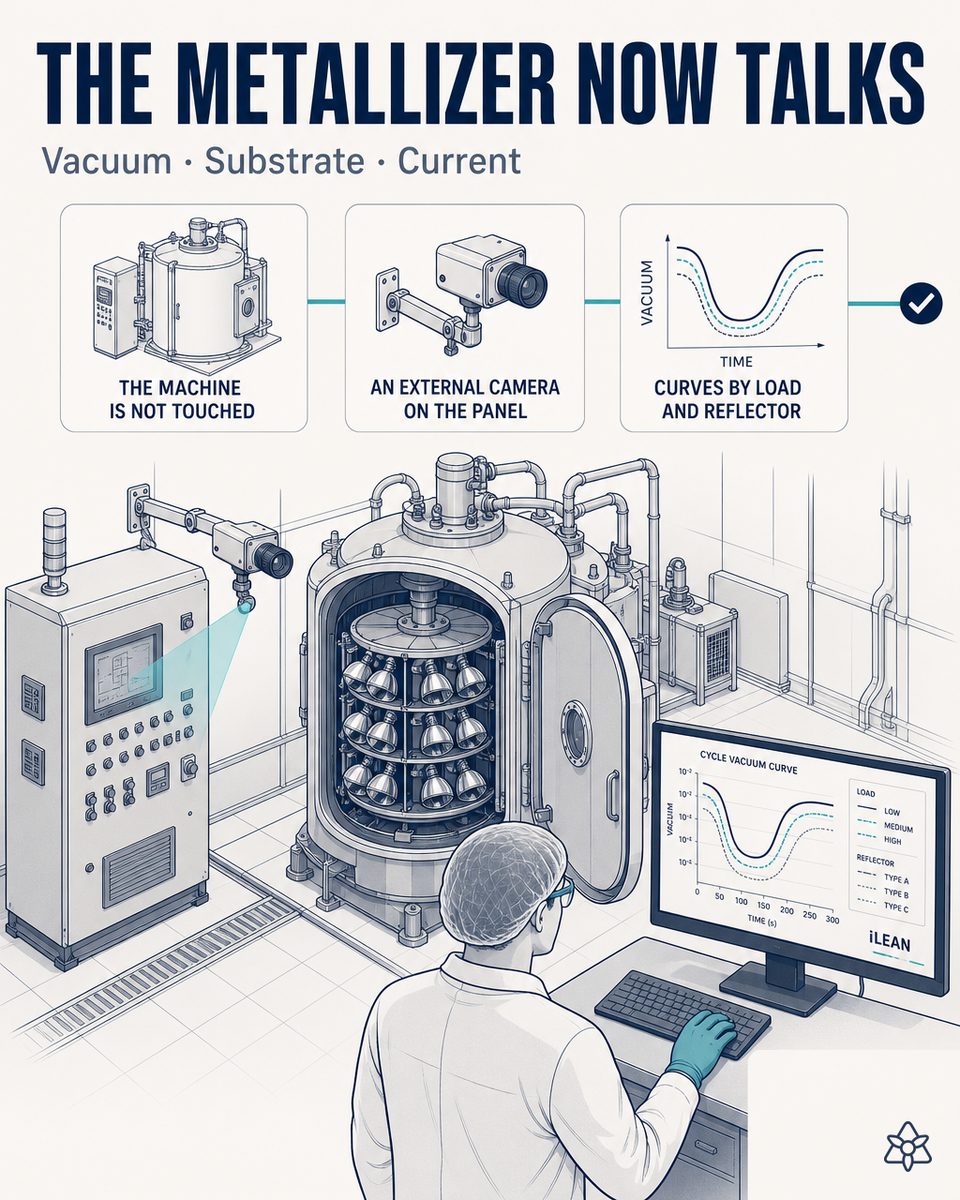
The asset that defines the headlight's optics is also the most isolated on the line.
The reflector's vacuum metallizer is a 15-20 year old asset that still deposits within tolerance — and precisely because of that nobody signs off its replacement. Its panel shows in real time the data that defines the headlight's optical performance, but that data dies on the screen glass at the end of every 90-second cycle.
- Proprietary HMI isolated by design — the panel shows the vacuum curve, substrate temperature and cathode current of every cycle, but that data lives and dies on the screen. When the cycle ends and the next reflector batch comes in, the previous curve disappears with no structured record.
- Replacing the machine is not realistic short term — a new metallizer with native connectivity means a CAPEX in the region of €800K–1.2M and months of reflector line downtime. As long as the asset keeps depositing within tolerance, that CAPEX is not signed.
- Direct consequence in quality — zero correlation between the metallizing cycle curve and the final reflectivity measured downstream, and zero ability to reconstruct root cause when the reflector's internal ppm rises.
Investigating a batch of reflectors with low reflectivity turns into manual archaeology with a high risk of not reconstructing the root cause — because the only witness of what happened during the cycle is a screen that nobody photographs or logs in a structured way.
Connect photo mode over the panel — the camera reads the curve, the machine stays itself.
The metallizer needs no new PLC, no communications card nobody manufactures anymore, and no intervention on its original electronics. It needs the curve that is already shown on screen — vacuum curve, substrate temperature, cathode current — logged per cycle without depending on someone noting it by hand. That is what Connect photo mode over the panel is for.
A fixed industrial camera looks at the metallizer's HMI without touching the original SCADA network. Connect reads the screen via OCR with an anchored LLM, structures the time curve of each cycle and cross-references it with the reflector batch and with the downstream reflectivity vision system. Root-cause analysis per batch goes from weeks to minutes. The machine stays exactly what it is — but now the plant sees the curve.
How Connect operates on the metallizer panel:
- Fixed industrial camera on an external bracket — installed pointing at the HMI from outside, without touching the network or wiring of the original asset. It captures the screen frame by frame throughout the metallizing cycle.
- OCR with an anchored LLM interprets every frame — each capture is read by OCR specialized in industrial panels, anchored to that specific HMI layout, to extract vacuum curve, substrate temperature and cathode current without interpretation errors.
- Structures the time curve per cycle and cross-references it with the batch — each reading is ordered into a time series per cycle and automatically associated with the reflector batch metallized in that cycle.
- Curve ↔ reflectivity correlation in real time — the cycle curve is cross-referenced with the downstream reflectivity vision system and with the reflector's internal ppm, so the metallizer's replacement CAPEX is deferred indefinitely without losing visibility.
Isolated metallizer vs. metallizer with Connect on the panel
| Aspect | Before | With iLEAN Connect |
|---|---|---|
| Cycle curve (vacuum, substrate temperature, cathode current) | Only visible on screen, dies every 90 s | Captured by camera and structured as a time curve per cycle in central memory |
| Curve ↔ final reflectivity and reflector internal ppm correlation | Absent — no exportable data from the asset | Automatic cross-reference per batch with the downstream vision system |
| Root-cause analysis facing a batch with low reflectivity | Manual archaeology, weeks, risk of not reconstructing the cause | Analysis per batch in minutes with the curve history at hand |
| Intervention on the machine and its original SCADA | Any connection requires touching the proprietary electronics | None — external camera, no touch on network, wiring or control logic |
| Metallizer replacement CAPEX (€800K–1.2M) | Pending, no date, on the committee's table | Indefinitely deferrable while the asset performs, without losing visibility. Estimate to be validated. |
| Vital metallizing process data | Dying on screen at the end of every cycle | Logged in central memory, traceable per cycle and per batch |
Impact estimate for your plant — to validate against your numbers.
The block below is an estimate to be validated against the concrete data of your plant. We lay it out so the committee has an order of magnitude; we refine it in the diagnosis.
- Tier 1 premium LED headlight plant with a 15-20 year old vacuum metallizer, proprietary HMI isolated by the manufacturer's design.
- Connect pilot in photo mode over the metallizer panel — external camera on an independent bracket only, without touching the original SCADA or the machine's electronics.
- Indicative payback between 6 and 12 months, depending on the frequency of batches with low reflectivity and no reconstructable cause and the cost of each per-batch investigation in your plant.
- Avoided replacement CAPEX over €800,000 by deferring the metallizer change while it keeps depositing within tolerance, plus the reduction in per-batch root-cause analysis time. Estimate to be validated with your data.
And the quality engineer's reasonable doubt
"What if the camera misreads a digit of the curve on a 15 year old HMI and gives me a false data point in a reflectivity investigation?" — hallucination is a problem of free generation, not of anchored tasks. On tasks where the AI just recontextualizes a concrete data point from one medium to another — reading a fixed field of the panel curve and moving it into a structured series —, the best models dropped the error below 1.5% [1]. And even so, the critical call is not made alone: Connect discards the reading when it does not reach the confidence threshold and a person reviews the history before validating a correlation. The three safety rings are there precisely for this.
[1] OpenAI paper "Why Language Models Hallucinate", 2025 — on the reliability of AI in anchored tasks.
What gets asked about digitizing a vintage metallizer panel without touching the SCADA
Why does the panel data die on screen today?
Because the metallizer's proprietary HMI is isolated by the manufacturer's design and has no structured data export. The panel shows the vacuum curve, substrate temperature and cathode current of each metallizing cycle in real time, but that data lives and dies on the screen. When the cycle ends every 90 seconds and the next reflector batch comes in, the previous curve disappears without leaving a structured record. The only witness of what happened during the cycle is a screen that nobody photographs or logs, so there is zero correlation between the cycle curve and the final reflectivity measured downstream.
Does the camera touch the metallizer's original SCADA or PLC?
No. The industrial camera is an independent device installed on an external bracket pointing at the HMI from outside. It does not connect to the proprietary SCADA network, shares no wiring with the metallizer and writes nowhere in its control logic. It simply photographs the screen the operator already sees every cycle, exactly as a person noting down the curve by hand would. The metallizer stays the same machine, with the same process configuration and the same metallizing recipe, without a single change to its original electronics or PLC.
How does the camera read a 15-20 year old HMI without integration?
Connect combines OCR specialized in industrial panels with a language model anchored to that specific HMI layout — it does not interpret the machine generically, it reads the same fields (vacuum curve, substrate temperature, cathode current, cycle time) in their fixed position, frame after frame, and rebuilds the time curve of each metallizing cycle. It is an anchored recontextualization task, not free generation: on that kind of task the best models drop the error below 1.5%. When a reading does not reach the confidence threshold — glare on the glass, screen in another view, a covered digit — it discards that capture instead of forcing a value.
How does it cross-reference the curve, the reflector batch and reflectivity?
Each reading is ordered into a time series per cycle and automatically associated with the reflector batch metallized in that cycle. Facing a batch of reflectors with low reflectivity or a rise in internal ppm, the quality engineer opens the history by batch and sees the vacuum curve, substrate temperature and cathode current of the cycle that metallized that batch, cross-referenced with the downstream reflectivity vision system. Instead of rebuilding by hand what happened weeks ago, they filter the affected batch and check in minutes which stretch of the curve deviated from the conforming cycles — for example a vacuum that took longer to reach setpoint before deposition. That root-cause analysis, which today does not exist because the curve dies on screen every 90 seconds, is the basis for adjusting the process before the next batch.
Does it work on a 15-20 year old machine, and does it need a stoppage?
Yes, and no stoppage is needed. Precisely because the metallizer is a 15-20 year old asset with an isolated proprietary HMI, Connect works over the panel it already has instead of demanding a new PLC or a communications card nobody manufactures anymore. Installation consists of fixing an external bracket with the camera pointing at the HMI and powering it independently — the metallizer's electrical cabinet is not opened, its network is not tapped and its wiring is not touched. The physical mounting is done with the machine in production or during a routine stop of minutes, and anchoring the model to the screen layout is done with captures of normal cycles. The full pilot, from bracket to the first curve↔reflectivity correlation per batch, is planned in about 4 weeks without stopping production.
More cases from this series
- Early human validation at the FAI bench: two taps, IATF-traceable signatureNothing enters the QM ERP without a human signature; the iLEAN tablet shows a summary and the quality…
- The assembly supervisor dictates while walking, and iLEAN listensThe headlight supervisor dictates while walking; iLEAN structures it as a nonconformity candidate linked…
- LED reel receiving in 5 minutes with full traceabilityPhotograph the delivery note and reel labels; the ERP receives part number, binning and MSL in one tap.…
- OEM spec changes that reach the line on timeiLEAN monitors the customer resident's mailbox 24/7, cross-checks live orders and current PPAP, and…
- Paperless LED headlight batch startup, with production order and PPAP at zero-second latencyDigitize the production order, the PPAP checklist and the first LED reel label at zero-second latency:…
- From goniophotometer Excel to live QM ERP, with license savingsiLEAN reads the goniophotometer Excel the moment it's saved and pushes it to the QM ERP after…
Try iLEAN Connect on your vintage panel — non-invasive photo pilot, 4 weeks. We'll send you in 48h the estimated ROI of bringing the reflector metallizer to life without touching its original SCADA.
We work on your plant's real data, not ours. Diagnosis with no commitment.
Try iLEAN Connect on your vintage panel — non-invasive photo pilot, 4 weeks ‹ See all LED headlight cases See automotive