LED reel receiving in 5 minutes with full traceability
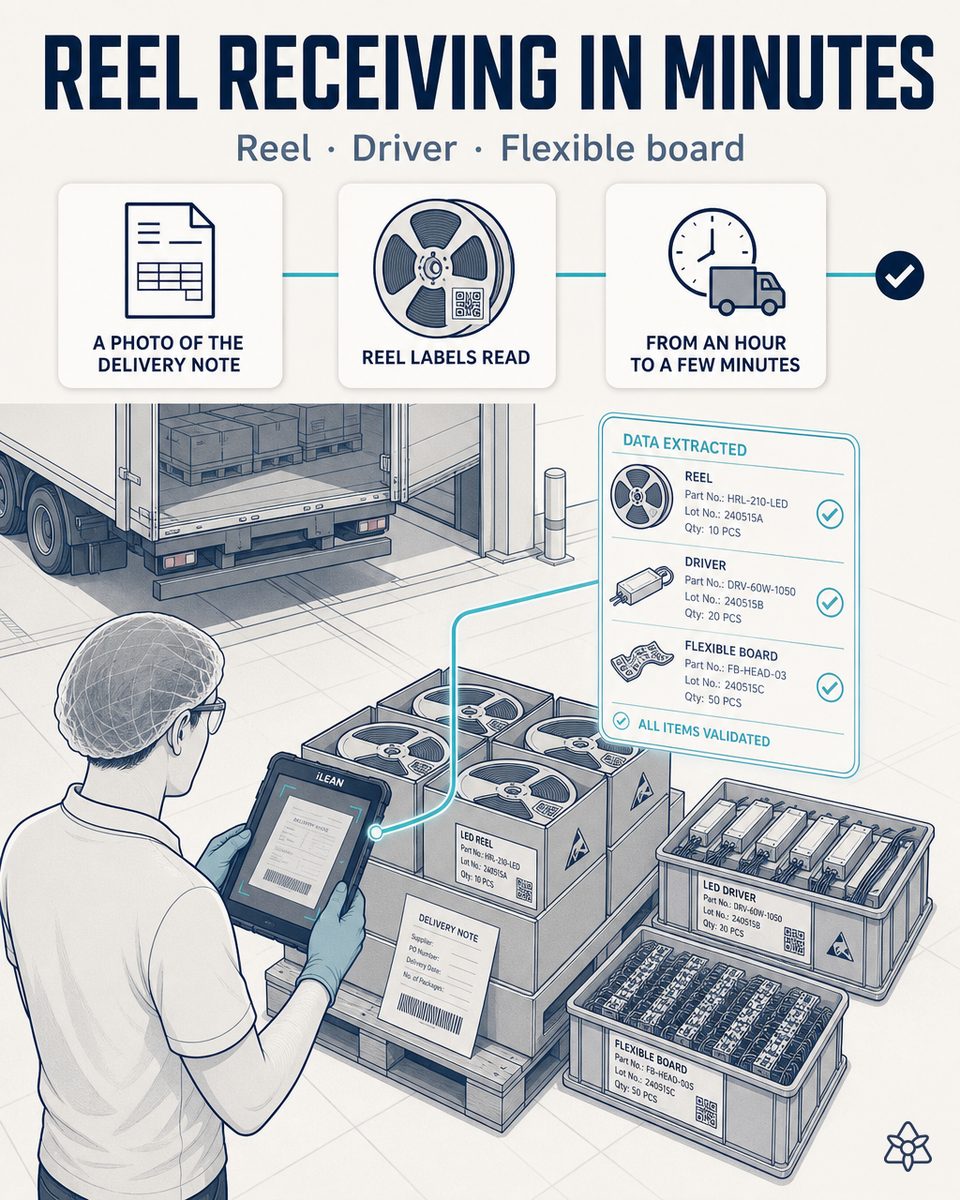
The truck arrives with LED reels, drivers and FPCBs. If the receiving supervisor types each reel into the ERP by hand, the truck waits 45-60 min. With iLEAN Connect, one photo of the A3 delivery note and the reels' DataMatrix labels is enough: the system extracts part number, color binning, MSL and date, and pushes them to the ERP after a one-tap validation. A 50-70% reduction in receiving/warehouse module licenses.
Reel receiving is where the supervisor gets stuck — and where the headlight with color non-uniformity that appears 3 weeks later is born.
In a Tier 1 premium LED headlight plant, every component truck unloads boxes of LED, driver and FPCB reels, and today that entire inbound flow goes through the receiving supervisor's keyboard:
- Supplier's A3 delivery note — dozens of material lines, quantities and lots, typed by hand into the ERP while the truck waits at the dock racking up demurrage: 45-60 minutes per unload.
- Reel labels — DataMatrix, QR or plain text depending on the supplier, with part number, color binning, MSL and date code, cross-checked from memory against the delivery note, reel by reel.
- Recording the binning and the MSL — the two fields that hurt most if they come in wrong, jotted down in a hurry to release the carrier as soon as possible.
And if the supervisor types fast, they mistype binnings. A wrong binning on a reel isn't visible at the dock or on the SMT line: it becomes, 3 weeks later, a headlight with color non-uniformity that reaches the customer resident engineer. A mis-logged MSL means a reel silently exceeds its shelf life without anyone noticing, contaminating the light engine's SMT process with LEDs that absorbed moisture outside their window.
Connect in photo-on-paper mode — delivery note and reel labels into the ERP with reel-to-headlight traceability, no typing.
Reel receiving doesn't need a new station at the dock or the suppliers to change their paperwork. It needs the A3 delivery note that already arrives in the truck cab and the labels the reels already carry to enter the ERP at second zero, with the right binning and MSL per reel. That's what Connect in photo-on-paper mode is for.
The receiving supervisor photographs the delivery note and the reel labels with the dock's industrial tablet. Vision AI extracts part number, color binning, MSL and date, crosses them against the delivery note and the order, and after a one-tap validation everything is pushed to the ERP — the truck never waited for the typing.
How Connect photo operates at receiving in an LED headlight plant:
- Photo of the A3 delivery note — Vision AI recognizes each supplier's delivery-note format, without asking them to change it and with no predefined templates, and digitizes its lines by OCR in seconds.
- Reel label reading — Connect recognizes DataMatrix, QR or plain text by OCR, whatever each reel carries, with the tablet camera and no dedicated scanner.
- Binning and MSL extraction — part number, color binning, MSL and date code are recorded per reel and crossed against the delivery note before validating, so a bin that doesn't add up shows at the dock, not in the finished headlight.
- One-tap validation — the receiving supervisor reviews what was extracted on the industrial tablet; if a label doesn't match the delivery note or a value doesn't reach the reliability threshold, Connect flags it before the tap. The person decides, not the system.
- Push to the ERP — after validation, the receipt is recorded in the ERP with reel-to-headlight traceability from second zero: each reel, with its bin and its MSL window, linked to its inbound lot.
Reel receiving with manual typing vs. digitized receiving with Connect
| Aspect | Classic receiving with manual typing | With iLEAN Connect photo |
|---|---|---|
| Truck wait at the dock | 45-60 min, racking up demurrage | 5 min — photo and one-tap validation |
| Hidden binning errors | Surface 3 weeks later as color non-uniformity in the headlight | Zero — flagged and corrected at the dock |
| MSL / reel shelf-life tracking | Jotted down in a hurry; reels exceed shelf life undetected | Registered per reel from second zero, with the exposure window in the ERP |
| Reel-to-headlight traceability | Broken — reconstructed by hand at each claim | Complete via photo and DataMatrix from receiving |
| Receiving/warehouse licenses | 2-3 active seats to key entries into the module | -50-70%, only the supervisor validates with one tap. Estimate to be validated. |
| Carrier demurrage | Truck waits ~an hour per unload with the meter running | Minutes, not an hour — released after the one-tap validation |
Impact estimate for your plant — to validate with your numbers.
The following block is an estimate to be validated with the specific data of your plant. We lay it out so the committee has an order of magnitude; we refine it in the diagnosis.
- Tier 1 premium LED headlight plant receiving LED, driver and FPCB reels from several suppliers: one or two receiving docks, several trucks per week, an A3 delivery note with dozens of lines per unload.
- Connect photo pilot on receiving — only the dock's industrial tablet, no construction work and no new integration with the supplier. It starts after the first kick-off meeting.
- The ERP's receiving/warehouse module requires 2-3 active licenses today to key in the entries. With Connect, only the supervisor validates with one tap: a typical reduction of 50-70% in the module's licenses. Estimate to be validated.
- Indicative payback between 3 and 7 months, plus a recurring saving on licenses and the elimination of carrier demurrage at the dock. Estimate to be validated with your data.
- On top of the CFO's hard lever — fewer receiving/warehouse module licenses and fewer truck-hours racking up demurrage — comes the avoidance of the non-quality costs of a wrong binning and an expired MSL, measurable from the first month of the pilot. Estimate to be validated.
And the plant manager's reasonable doubt
"What if the system misreads a binning or registers an MSL on the wrong reel?" — hallucination is a problem of free generation, not of anchored tasks. In tasks where the AI merely recontextualizes a specific piece of data from one medium to another (reading the delivery note and the reels' printed labels and extracting their fields), the best models brought the error below 1.5% [1]. And even so, the critical decision isn't made alone: if a bin doesn't match the delivery note or a value doesn't reach the reliability threshold, Connect holds the reel and the person validates with one tap on the tablet. The three safety rings are there precisely for this.
[1] OpenAI paper "Why Language Models Hallucinate", 2025 — on the reliability of AI in anchored tasks.
What people ask about reel receiving in a premium LED headlight plant
Why does typing reels into the ERP at receiving cause binning errors?
Because the receiving supervisor is typing dozens of A3 delivery-note lines by hand while the truck waits at the dock racking up demurrage, and under that pressure they mistype the field that hurts most: the color binning. LED makers sort each reel into bins by luminous flux, forward voltage and chromatic coordinates — two reels with the same part number can emit slightly different whites. A wrong binning typed on a reel isn't visible at the dock or on the SMT line: it becomes, 3 weeks later, a headlight with color non-uniformity that reaches the customer resident engineer. Connect removes the typing — it extracts the binning from the label and the delivery note and crosses the two before the one-tap validation, so a bin that doesn't match shows up at the dock, not in the finished headlight.
Does the supplier have to change its delivery note?
No — no predefined templates and no asking the supplier to change its format. Vision AI recognizes the layout of each delivery note — the A3 with dozens of lines from a component distributor, the PDF attached to an email, each LED, driver or FPCB maker's own format — and extracts the material lines, quantities and lots the same way in every case. When a new supplier enters the panel, Connect learns its format over the first few receipts and the receiving supervisor's flow doesn't change: photo of the delivery note, photo of the labels and a one-tap validation on the tablet.
What if a reel's DataMatrix label is damaged or unreadable?
Connect first attempts the DataMatrix read; if the label arrives creased, torn or with packing tape over it — common on a reel that has travelled in a dry bag inside a stacked box — it automatically falls back to the alternate QR if one exists and, as a last resort, to OCR of the plain text printed next to the code (part number, binning, quantity and date code). If no read reaches the reliability threshold, Connect does not invent the data: it flags the reel as pending manual verification and the receiving supervisor enters it on the tablet, reel by reel, without blocking the rest of the unloading or breaking reel-to-headlight traceability.
How do the receiving license savings show up?
The ERP's receiving/warehouse module requires 2-3 active licenses today so the supervisor and the warehouse team can type in the entries. With Connect, the entry is born from the photo and only the supervisor validates with one tap, so the seats that existed solely to key delivery notes into the module are no longer needed: a typical reduction of 50-70% in the module's licenses. It is a recurring saving the CFO sees on the ERP license bill, on top of the eliminated carrier demurrage. Estimate to be validated with your numbers.
How are reel-to-headlight traceability and the MSL protected?
Every reel enters the ERP from the dock with its part number, binning, MSL and date code linked to its inbound lot, so reel-to-headlight traceability is complete from second zero — captured by photo and DataMatrix, not reconstructed by hand at each claim. The MSL (Moisture Sensitivity Level) defines how many hours a reel can stay exposed outside its dry bag before reflow; past that window, absorbed moisture can damage the LEDs during the light engine's soldering. Because Connect registers the MSL and date code at receiving, the system knows each reel's exposure window from the minute it comes through the dock, and a reel with expired or near-expired shelf life is flagged before it reaches the SMT line, not after it has contaminated the process.
More cases from this series
- Early human validation at the FAI bench: two taps, IATF-traceable signatureNothing enters the QM ERP without a human signature; the iLEAN tablet shows a summary and the quality…
- The assembly supervisor dictates while walking, and iLEAN listensThe headlight supervisor dictates while walking; iLEAN structures it as a nonconformity candidate linked…
- OEM spec changes that reach the line on timeiLEAN monitors the customer resident's mailbox 24/7, cross-checks live orders and current PPAP, and…
- Paperless LED headlight batch startup, with production order and PPAP at zero-second latencyDigitize the production order, the PPAP checklist and the first LED reel label at zero-second latency:…
- From goniophotometer Excel to live QM ERP, with license savingsiLEAN reads the goniophotometer Excel the moment it's saved and pushes it to the QM ERP after…
- Vintage vacuum metallizer now talks, with zero replacement CAPEXAn external camera reads the vacuum and temperature curve off the reflector metallizer's vintage panel —…
Connect pilot on your receiving dock — starts after the first kick-off meeting.
We work on your plant's real data, not ours. Diagnosis with no commitment.
Request estimated ROI in 48h ‹ See all LED headlight cases See automotive