Pattern plate changeover validated with evidence, not a blind signature
A pattern change on a vertical molding line is the most expensive and most fragile moment of the day: the line stops, several pairs of hands have to work together, and start-up depends on somebody signing that everything is ready without objective evidence that it is. With iLEAN Edge, the line does not start until the cameras confirm pattern plate, cores and a clean molding chamber, and until the supervisor signs.
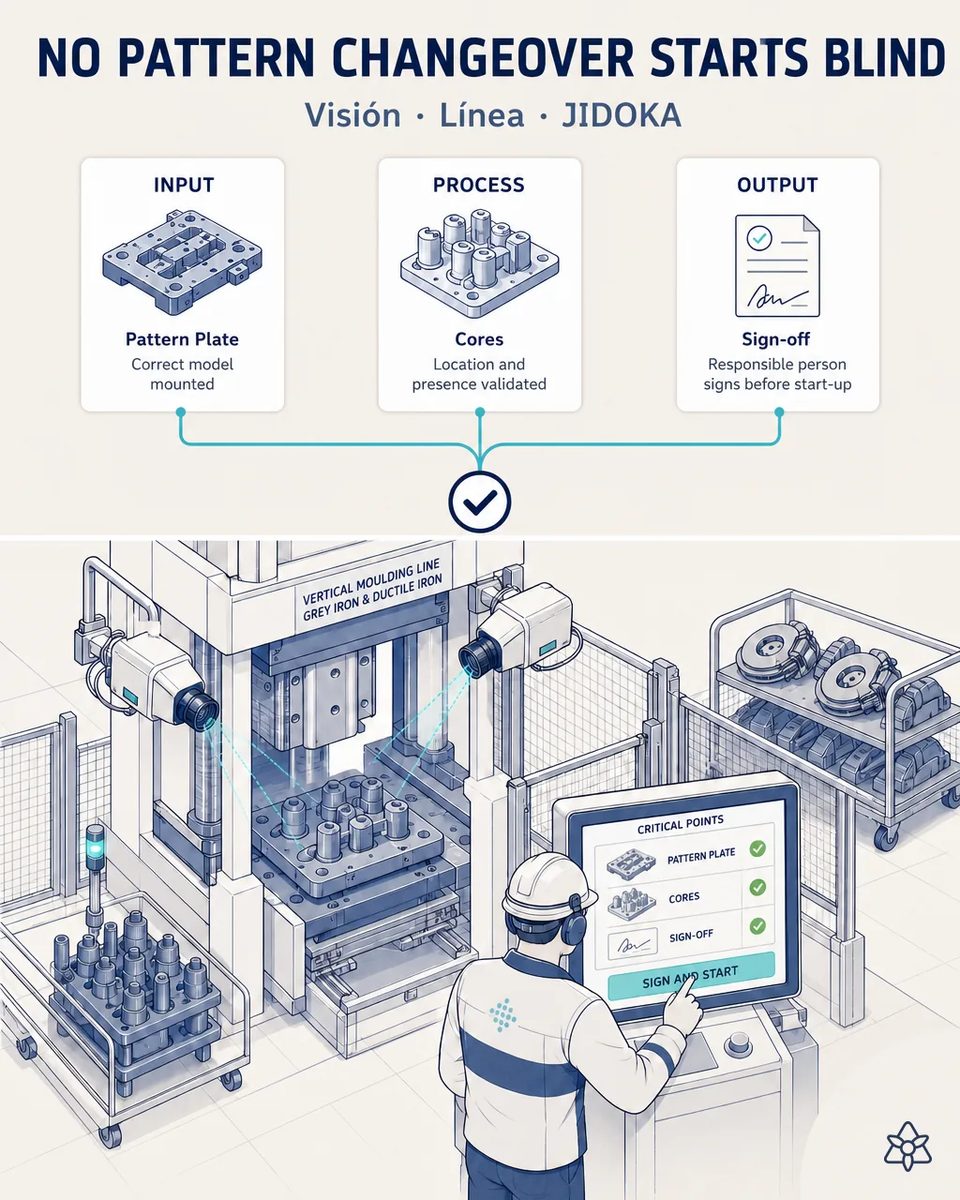
The most fragile moment of the day starts on a blind signature.
A badly started changeover is paid in two currencies. The cheap one: the first molds to scrap and a long hour of lost cadence at the heart of the plant. The expensive one: a run with the wrong core or residual sand that passes visual inspection and ends up as a defective brake part at the customer. On top of that, the number of changeovers keeps growing. Part mix increases with electrification — differential cases, control arms and calipers for hybrid and electric vehicles run alongside traditional production — so the pattern change goes from being an event to being a daily routine. And there is no data: changeover duration is "whatever it takes", different on every shift, with nobody knowing where the time goes.
- The line stops, several pairs of hands work together, and start-up depends on somebody signing that pattern plate, cores and chamber are ready — with no objective evidence that they are.
- The cheap failure: the first molds to scrap and a long hour of lost cadence at the heart of the plant. The expensive one: a run with the wrong core or residual sand that passes visual inspection and ends up as a defective brake part at the customer.
- Changeovers keep growing. Differential cases, control arms and calipers for hybrid and electric vehicles run alongside traditional production, so the pattern change is now a daily routine.
- And there is no data: the changeover takes whatever it takes, different on every shift, with nobody knowing where the time goes.
Edge with JIDOKA AI and SMED AI — the line does not start without evidence and a signature.
Edge combined with JIDOKA AI and SMED AI:
The cameras do not decide alone: each critical point is compared against the reference state for that order — this pattern plate, these cores, this chamber clear of residual sand — and it is the supervisor who signs on that evidence. In parallel, SMED AI times every phase, so the best changeover of the month becomes the standard. What changes is not who decides, but what they decide on. JIDOKA AI is the preventive block: if any point is not OK, the line does not start, and blind trust is replaced by a photo of the plate, the cores and the chamber, stored with the signature.
- Cameras at the N critical points compare the current state against the reference state for that order: this pattern plate, these cores, this molding chamber clear of residual sand.
- If any point is not OK, the line does not start. That is JIDOKA AI: preventive blocking replaces blind trust.
- The supervisor sees the evidence point by point and signs. Humans in command: the AI does not sign in their place.
- In parallel, SMED AI times each phase of the changeover and reports where the time goes, comparing across shifts, so the best changeover of the month becomes the standard.
Today's changeover versus the validated changeover
| Aspect | Today | With iLEAN Edge |
|---|---|---|
| Start-up authorization | A blind signature | Point-by-point visual evidence, then a signature |
| Wrong pattern plate or core | Found in the castings | Blocked before the first mold |
| Residual sand in the chamber | Passes visual inspection | Detected before start-up |
| First molds | To scrap as routine | A validated start-up |
| Changeover duration | Whatever it takes | Measured phase by phase, compared across shifts |
| Who signs | The supervisor, blind | The supervisor, on evidence |
from a blind signature to a signature backed by visual evidence point by point · from first molds to scrap as a matter of routine to a validated start-up · from unknown changeover duration to a measured duration comparable across shifts.
Impact estimate — to be validated with your numbers.
The block below is an estimate to be validated against your plant's actual data. We put it forward so the committee has an order of magnitude; we refine it during the assessment.
- Estimated payback 6-12 months, depending on the number of changeovers per week.
- A 20-40% reduction in changeover time through SMED AI, on the line that is the heart of the plant.
- Practical elimination of the risk of a run with the wrong pattern or core — which is mass-containment risk.
- And the first molds stop going to scrap as a matter of routine.
estimated payback 6 to 12 months, with a 20-40% reduction in changeover time through SMED AI and the practical elimination of the risk of a run with the wrong pattern or core, which is mass-containment risk. *Estimate to validate*.
And the fair question from the production manager
“What if the cameras block the line for no reason?” — that is the right objection, because the changeover sits on the critical path of the whole plant. Conformity is checked against the reference state for that specific order, and comparing a mounted pattern plate or a core set against its reference image is an anchored task where the best models drop below 1.5% error [1]. In case of doubt the system does not block silently: it escalates to the supervisor, who signs on the evidence. It stops on a verifiable discrepancy, not on model uncertainty.
[1] OpenAI paper "Why Language Models Hallucinate", 2025 — on the reliability of AI in anchored tasks.
What people ask about validating the pattern changeover
What exactly do the cameras check?
The pattern plate mounted against the one the order calls for, the cores present and in position, and the molding chamber clear of residual sand. The critical points are defined at commissioning with your line team, from the failures you have already had.
Does it make the changeover longer?
The check takes seconds. What lengthens the changeover today is the margin added for lack of evidence, and SMED AI shows where the rest of the time actually goes, phase by phase.
Can the supervisor override it in a hurry?
An exception can be defined with a supervisor signature and it is recorded as such. What cannot happen is starting the line with no trace of who decided to skip the check and why.
What does SMED AI measure?
Each phase of the changeover — line stop, plate removal, mounting, core setup, first mold — by shift and by team, so the best changeover of the month can be made the standard and the worst can be explained.
Is it worth it with a growing part mix?
That is where it shows most: the more changeovers electrification adds, the greater the accumulated exposure, and this case makes the number of changes stop increasing it.
More cases from this series
- The audit evidence pack, generated as the process happensEvery heat and every changeover leaves evidence organized by standard: IATF 16949, VDA 6.3, CQI-9,…
- Zero stoppages on the customer's line: the three coordinated ringsThree rings — signal, matter and memory — coordinate Connect, Edge and Agents to eliminate customer line…
- The alert that arrives by email, turned into a scheduling decisionPull-ins, delays and incidents arrive by email and messaging. iLEAN cross-checks them against the EDI…
- First-piece release with early human verificationNo AI-captured data enters the ERP unsigned. The line tablet shows what was captured beside its photo…
- The closed induction furnace that finally talksAn external camera digitizes the isolated induction furnace curve: energy-metal-defect correlation with…
- Planning while walking the bay, hands freeThe planner walks. With an industrial earpiece, iLEAN listens, structures and answers in seconds: the…
Tell us how many pattern changes you run per week and how long the best and the worst take.
We work on your plant's real data, not ours. Assessment with no commitment.
Request estimated ROI within 48h ‹ See all cases of iron castings See automotive