The mold has to be there on its date
Behind a mold's date sits a vehicle launch, and behind a delay sit penalties, paid expedites and a supplier note carried into the next award. A slip never announces itself at once: it builds quietly over weeks and surfaces when there is no margin left. The full iLEAN system puts four rings around the project so it becomes visible earlier.
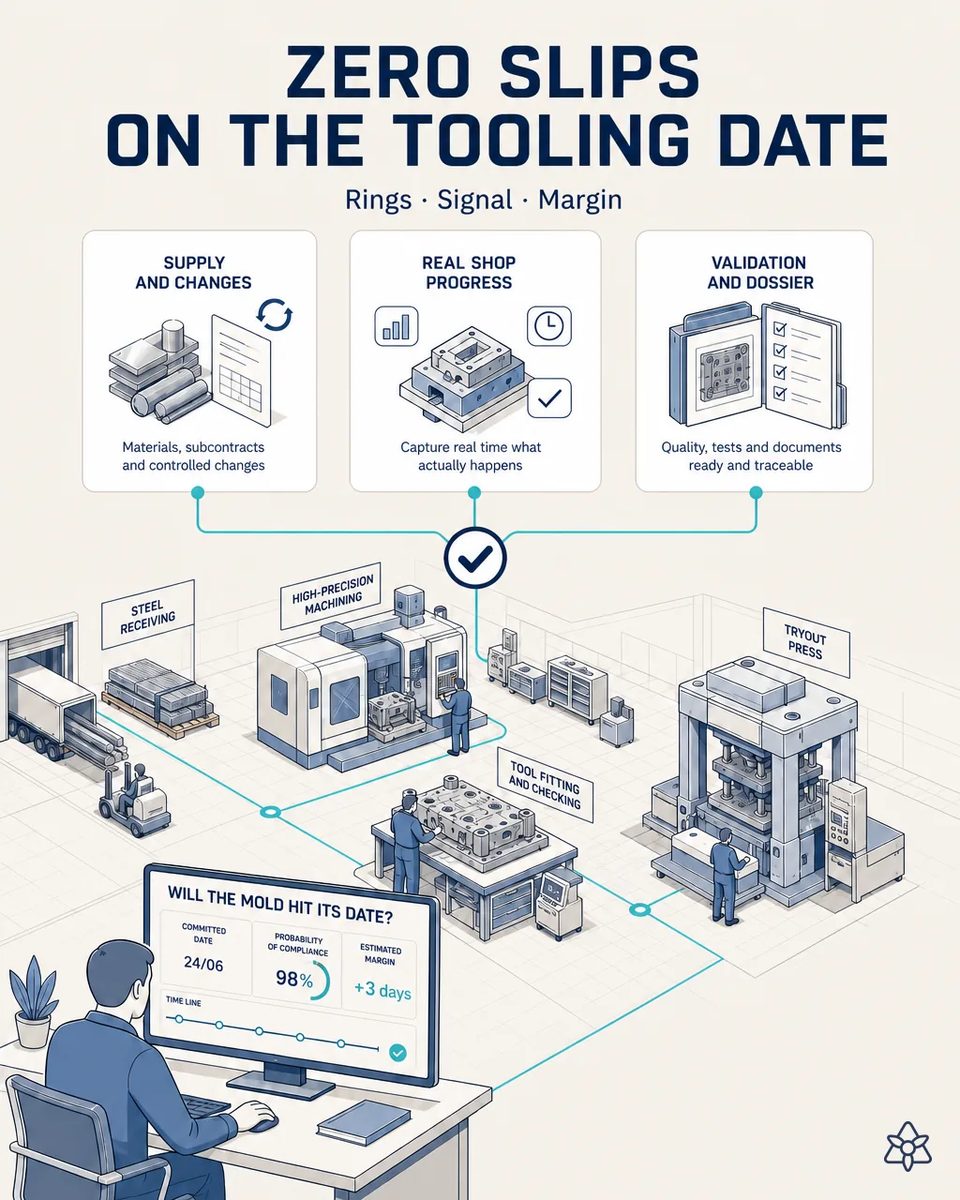
A slip never announces itself at once.
Today the date is defended with a planning sheet and a morning meeting fed by perceptions. The four factors that destroy it — material that does not arrive, an engineering change that lands late, real shop progress diverging from plan, and one tryout loop too many — live in four different places and none of them talk to each other. Nobody is lying. There simply is no complete picture until it is too late for anything but overtime.
- Behind a mold's date sits a vehicle launch, and behind a delay sit penalties, paid expedites and a supplier note carried into the next award.
- The slip builds quietly over weeks and surfaces when there is no margin left for anything but overtime.
- The four factors that destroy the date — material that does not arrive, an engineering change that lands late, real progress diverging from plan, one tryout loop too many — live in four different places and none of them talk to each other.
- Nobody is lying. The date is defended with a planning sheet and a morning meeting fed by perceptions because there is no complete picture until it is too late.
Agents over four rings — it is all of the above, orchestrated.
Four rings, each with its own case behind it:
No single ring solves the problem: each already exists today in some form and the mold still ships late. Above the four rings the Agents keep one answer permanently live — will this mold hit its date, and if not, why and since when — with the cause identified and the alternative proposed. The decision stays human; what changes is that it is taken weeks earlier.
- Ring 1 · Supply. Connect reads supplier alerts and receiving documents and projects the impact of each delay onto the affected mold's date, by name.
- Ring 2 · Real shop progress. Job travelers by photo, legacy machine panels by camera, bench decisions by voice, spindle hours by API and human sign-off on the tablet. Progress stops being an estimate: it is the sum of its real details.
- Ring 3 · Engineering change. When a new data level lands, iLEAN instantly cross-checks which details are machined to the previous revision, which can be saved, what steel must be repurchased and how far the date moves. JIDOKA AI halts what has not yet reached a machine before steel and hours are spent on something obsolete.
- Ring 4 · Validation. Edge classifies defects shot by shot to shorten the tryout loop and blocks an unsafe press closing. SMED AI speeds up mold changeover on the validation presses so an extra trial does not eat a calendar day. The Agents close the dossier as it happens. Above the four rings, the Agents keep one answer permanently live: will this mold hit its date, and if not, why and since when? With the cause identified and the alternative proposed. The decision stays human; what changes is that it is taken weeks earlier.
The four rings, and what each one closes
| Ring | Which cases it draws on | What it closes |
|---|---|---|
| 1 · Supply | Outside alert (3) + steel receipt (7) | The delay projected onto the mold's date, by name |
| 2 · Real progress | Traveler (1) + EDM panel (2) + headset (4) + spindle hours (8) + tablet (5) | Progress as the sum of real, signed details |
| 3 · Engineering change | Outside alert (3) + JIDOKA AI | Details to stop, details to save, steel to reorder |
| 4 · Validation | Tryout vision (9) + safe close (10) + mold book (11) | Fewer loops, no damaged mold, dossier closed as it happens |
| Above the rings | The Agents | Will this mold hit its date, and since when not |
| SMED AI on the tryout presses | Ring 4 | An extra trial does not eat a calendar day |
from discovering the slip in the final weeks of the project → an early signal with the cause identified. From arguing the date with the customer on rhetoric → discussing it with the shop's own evidence.
Impact estimate — to be validated with your numbers.
The block below is an estimate to be validated against your plant's actual data. We put it forward so the committee has an order of magnitude; we refine it during the assessment.
- Estimated payback 6-12 months against the first slip avoided, counting penalties and acceleration costs: overtime, weekends, expedited freight, rescheduled press.
- The slip is discovered as an early signal with its cause, not in the final weeks of the project.
- The date is discussed with the customer on the shop's own evidence, not on rhetoric.
- And the larger, harder-to-quantify value: the reputation for delivery at the next award.
estimated payback 6-12 months against the first slip avoided, counting penalties and acceleration costs (overtime, weekends, expedited freight, rescheduled press). The larger and harder-to-quantify value is the reputation for delivery at the next award. *Estimate to validate*.
And the fair question from the production manager
"Do we have to deploy all twelve cases to get this?" — no, and framing it that way would be the way never to start. The rings are built in layers and each case pays on its own from the first month. With the job traveler and the outside alert you already have most of ring 2 and ring 1, which is where the early signal comes from. Every capture underneath is an anchored task, where the best models drop below 1.5% error [1], and every one is signed at the bench before it counts toward the date.
[1] OpenAI paper "Why Language Models Hallucinate", 2025 — on the reliability of AI in anchored tasks.
What people ask about the complete system
Where do you start?
With the case that has fewest dependencies and the shortest deployment, which in this matrix is the photo to the job traveler. Ring 2 is where the date is lost quietly, and that is where the first signal appears.
What does the answer to 'will this mold hit its date' look like?
A committed date, an estimated margin in days, the cause when the margin turns negative — a plate ten days late, a detail with twice the planned hours, a third tryout loop — and since when. With the alternative proposed.
What if two rings disagree?
That is the signal. Supply says the plate arrived, progress says the detail has not started: the discrepancy is escalated to a person instead of averaged away.
Does it replace our planning tool?
No. The schedule stays where it is. iLEAN cross-checks it against what actually happens in the shop and tells you where it has stopped being true, mold by mold, so the planner corrects the plan instead of defending it.
Can the return be estimated before committing?
Yes: with the number of molds shipped late last year, what recovering them cost and the number of engineering changes received mid-build, the return per ring is sized before deciding the order.
More cases from this series
- The old machine stays itself, but now it reportsAn external camera digitizes the isolated panel of an older EDM: no more blind nights, without opening…
- The human gate sits at the bench, not in an officeNothing the AI captures crosses into the system without a sign-off from the person who knows: two taps…
- The knowledge that walks around and dies at end of shiftThe shop supervisor dictates what he decides while walking: iLEAN structures it against the mold and…
- The job traveler, in the system at second zeroReal progress on every mold detail in the system instantly: one photo of the job traveler and zero habit…
- The shop's most valuable quality data stops living in a folderiLEAN reads the dimensional report as it is saved, ties it to the mold and posts it to the ERP after…
- The mold book writes itself while the mold is builtPhotos, dimensions, parameters, heats and signatures assembled per mold and ordered by automotive…
How many molds shipped late last year and what did recovering them cost? With that number we can size the return together.
We work on your plant's real data, not ours. Assessment with no commitment.
Request estimated ROI within 48h ‹ See all cases of injection mold shops See automotive