Which mold and which date that email moves, answered in seconds
A mold shop stops because of two emails. One comes from the supplier: the steel plate, the hot runner or the standard component slips. The other comes from the customer: engineering change, new data level. Both land in one person's inbox, and what needs answering is not an acknowledgement but which mold it hits and which details just became obsolete. With iLEAN Connect the system is in copy from minute one and returns the consequence, not the notification.
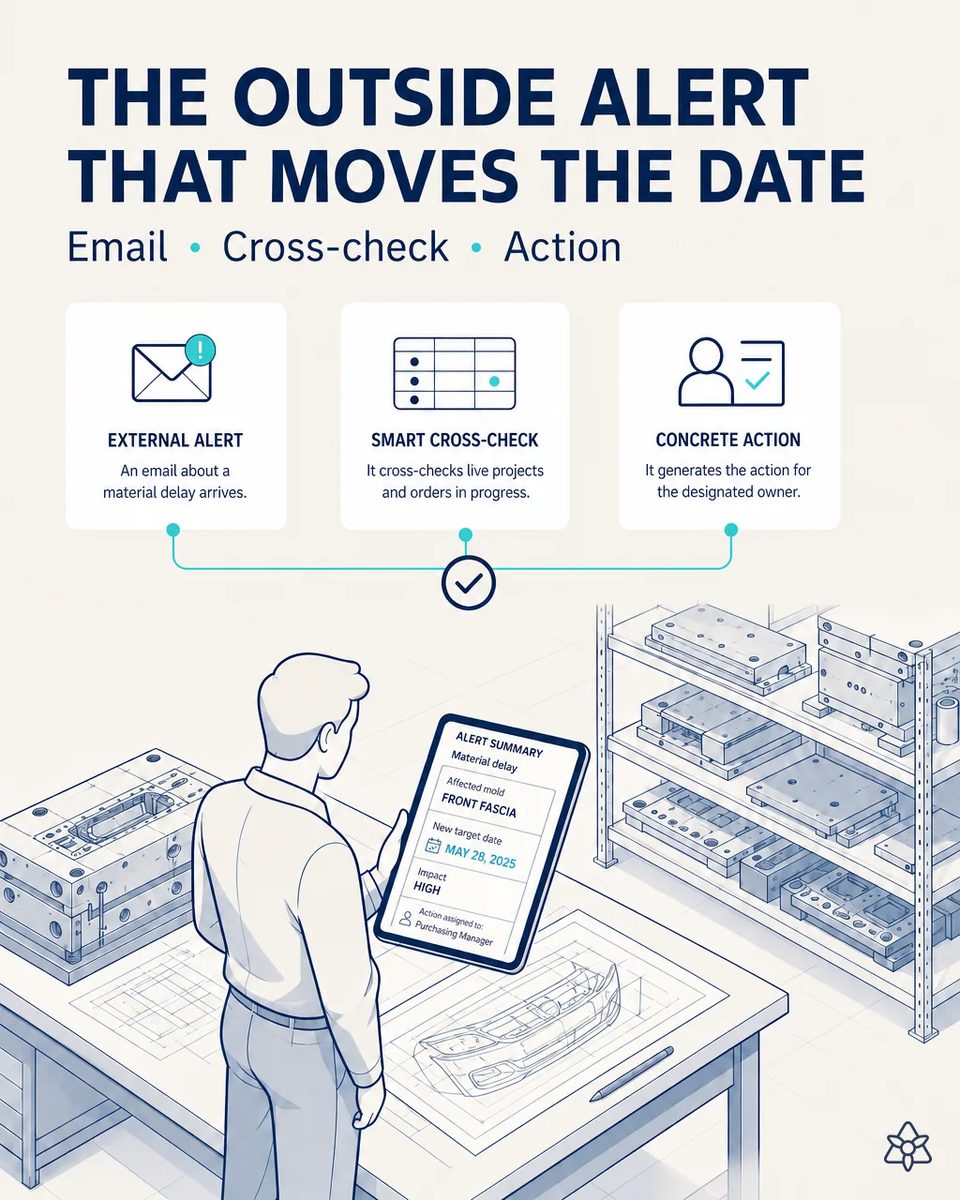
Two emails can stop a mold shop, and both land in one inbox.
Purchasing in a mold shop is per project with no buffer stock: every component bought carries the name of a specific mold. A long lead-time delay is not absorbed, it propagates all the way to the delivery date. The engineering change is more expensive still. If it lands mid-build and nobody cross-checks it in time against the real state of the shop, machining continues against a revision that no longer exists: steel, machine hours and calendar spent on details headed for scrap. Today that cross-check happens in one person's head when they open the mail. It is not a diligence problem: the information needed to answer is split across the mailbox, the schedule and the project bill of materials, and nobody has all three in front of them at once.
- The supplier's email: the steel plate, the hot runner or the standard component slips. Purchasing is per project with no buffer stock, so a long lead-time delay is not absorbed, it propagates to the delivery date.
- The customer's email: engineering change, new data level. If it lands mid-build and nobody cross-checks it against the shop's real state, machining continues against a revision that no longer exists.
- Steel, machine hours and calendar then get spent on details headed for scrap, and the shop finds out when the detail is finished.
- It is not a diligence problem. The answer is split across the mailbox, the schedule and the mold's bill of materials, and nobody has all three in front of them at once.
Connect in chaotic-sources mode — the consequence, not the notification.
Connect in chaotic-sources mode — the mode that turns an unstructured channel into an actionable signal.
Finding out sooner is not the value; the cross-check is. iLEAN reads the intent and the entities, compares them with the schedule and the affected mold's bill of materials, and returns a concrete action: which mold, which details already machined to the old revision, which operation gets resequenced, how far the date moves. The manager still decides — with the full picture and days of margin instead of a weekend lost between the email arriving and someone opening it.
- A dedicated mailbox in silent copy 24/7 and a business messaging channel.
- The LLM extracts intent (supply delay, engineering change, price change), entities (supplier, reference, mold, data level) and lead times.
- It cross-checks against the project schedule and the affected mold's bill of materials.
- It returns a concrete action to purchasing and to the project lead: which mold is affected, which details are already machined to the old revision, which operation gets resequenced and how far the date moves.
The decision still belongs to the manager. What changes is that it is taken with the full picture and with hours or days of margin.
Today's alert versus the cross-checked alert
| Aspect | Today, in the inbox | With iLEAN Connect |
|---|---|---|
| Time to know the impact | Hours, or a weekend | Seconds |
| Which mold is hit | Worked out in someone's head | Named, with its date |
| Details machined to the old revision | Discovered when finished | Listed the same day |
| Steel to repurchase | Noticed at the next receipt | Flagged with its lead time |
| Who acts | Whoever opened the email | Purchasing and the project lead, by role |
| Who decides | The recipient | The manager — iLEAN proposes |
from hours — or a weekend — between an alert arriving and someone working out its impact → seconds. From discovering an engineering change's effect once the detail is finished → knowing it the same day the customer sends it.
Impact estimate — to be validated with your numbers.
The block below is an estimate to be validated against your plant's actual data. We put it forward so the committee has an order of magnitude; we refine it during the assessment.
- Estimated payback 3-8 months.
- The strong lever is not admin time: it is the steel and machine hours no longer spent on details obsolete since the last data level.
- Early warning on a long lead-time repurchase, which is the difference between resequencing and waiting ten weeks.
- And the date is moved with a cause and a number, not discovered in the final weeks.
estimated payback 3-8 months. The strong lever is not admin time but the steel and machine hours no longer spent on obsolete details, plus early warning on a long lead-time repurchase. *Estimate to validate*.
And the fair question from the production manager
"Are you going to read my team's email?" — no. iLEAN sits in silent copy on a dedicated mailbox and a business messaging channel: it only sees what is sent to those operational channels with suppliers and the customer. Classifying the intent of an alert and extracting the reference, the mold and the lead time is an anchored task, where the best models drop below 1.5% error [1], and the action is executed by a person.
[1] OpenAI paper "Why Language Models Hallucinate", 2025 — on the reliability of AI in anchored tasks.
What people ask about cross-checking supplier alerts
Does it understand an engineering change sent as a PDF attachment?
Yes. The attachment is read like the body of the email: the data level, the affected zones and the effective date are extracted and compared with the revision each detail is being machined to.
Does it know which details are already cut?
When the job traveler and spindle hours cases are in place, yes: that is what turns the alert into a list of details to stop, details to save and steel to reorder. Without them, it still names the mold and the zones affected, and the project lead completes the list by hand with the shop in front of him.
What about a delay announced by phone?
The purchaser dictates it or forwards a note to the same channel and the cross-check runs the same way. What matters is that the alert enters the system, not which door it came through.
Does it move the date on its own?
No. It proposes the new date with its cause and the resequencing that would recover part of it. Moving the commitment with the customer remains a management decision, taken with days of margin instead of at the last review.
Can it handle alerts in another language?
That is normal with an imported steel supplier or a foreign OEM and it is designed for: intent extraction does not depend on the language of the message.
More cases from this series
- The old machine stays itself, but now it reportsAn external camera digitizes the isolated panel of an older EDM: no more blind nights, without opening…
- The human gate sits at the bench, not in an officeNothing the AI captures crosses into the system without a sign-off from the person who knows: two taps…
- The knowledge that walks around and dies at end of shiftThe shop supervisor dictates what he decides while walking: iLEAN structures it against the mold and…
- The job traveler, in the system at second zeroReal progress on every mold detail in the system instantly: one photo of the job traveler and zero habit…
- The shop's most valuable quality data stops living in a folderiLEAN reads the dimensional report as it is saved, ties it to the mold and posts it to the ERP after…
- The mold book writes itself while the mold is builtPhotos, dimensions, parameters, heats and signatures assembled per mold and ordered by automotive…
Tell us how engineering changes reach you today and we will show you the automatic cross-check.
We work on your plant's real data, not ours. Assessment with no commitment.
Request estimated ROI within 48h ‹ See all cases of injection mold shops See automotive