Zero nonconformance: all coordinated
The capital pain of an automotive electronics plant is running several high-precision lines in parallel, each with its own bottleneck and its own critical machine, under a zero-nonconformance requirement. iLEAN coordinates Connect, Edge and Agents to attack it at the root.
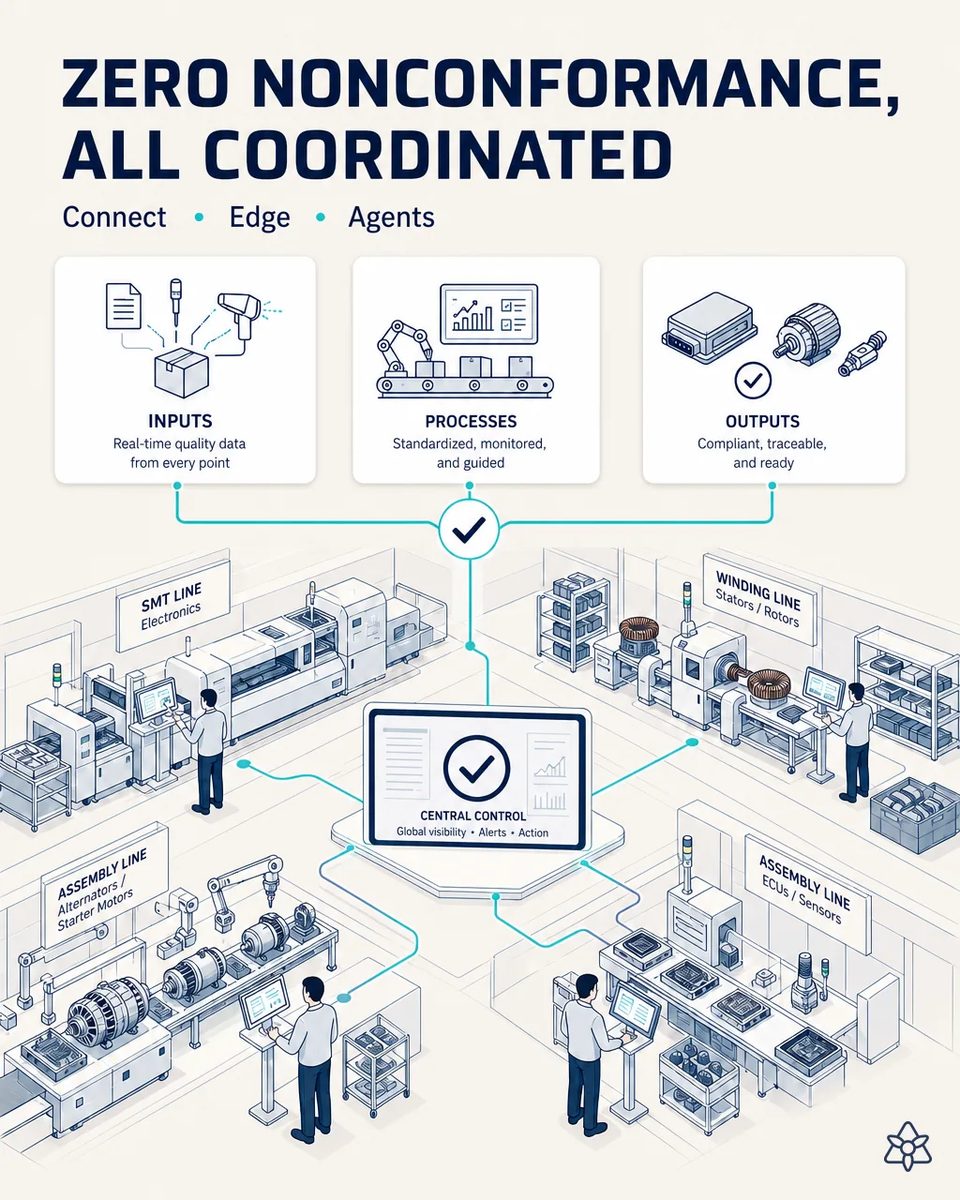
Each line has its own critical machine, its own data and its own way to fail.
- Every specialized line (SMT, winding, electromechanical assembly, test) generates its own isolated data flow and its own nonconformance risk. - Today, coordination between lines depends on the memory and availability of a handful of key supervisors.
- The capital pain of an automotive electronics plant is running several high-precision lines in parallel — SMT, stator and rotor winding, electromechanical assembly, test — each with its own bottleneck and its own critical machine.
- Every one of those lines generates its own isolated data flow and its own nonconformance risk: a stencil on SMT, a wire tension on the winder, a torque in assembly, a program version at test.
- Today, coordination between lines depends on the memory and availability of a handful of key supervisors. When one of them is on vacation, the plant is more exposed.
- And under a zero-nonconformance requirement, a defect that crosses two lines unnoticed is the one that ends up in a vehicle and in a recall.
Agents coordinates the eleven cases — Connect captures, Edge controls, JIDOKA AI blocks.
Connect captures every signal from the startup traveler to a supplier alert; Edge visually controls every critical assembly point and every changeover; Agents organizes the complete evidence pack; JIDOKA AI blocks at any anomaly; SMED AI speeds up changeovers without losing control.
None of the eleven previous cases solves this alone, and none has to be rebuilt for the flagship. What changes is that their signals meet in one central system, so a drift on the winder and a rise in fails at test are read as the same story.
Where each line's risk gets closed
| Line or layer | Cases that feed it | What it closes |
|---|---|---|
| Supply and receiving | Semiconductor alert (3) + delivery note (7) | Component delays and lots, before they reach a line |
| Stator and rotor winding | Startup traveler (1) + winder screen (2) | Winding conditions tied to each lot |
| SMT and test | ICT and AOI (8) + lab spreadsheet (6) | Verdicts and lab results in the system before release |
| Electromechanical assembly | Final assembly vision (9) + ECU tablet (5) | Defects that pass the bench, and unsigned serial data |
| Changeovers and the floor | Changeover validation (10) + line lead's earpiece (4) | Wrong setups, and drifts that die at shift end |
| Evidence | Evidence pack (11) | A downloadable dossier per lot, for audit or recall |
Complexity management dependent on key people → central system with full traceability, continuous visual control, and automatic evidence pack.
Impact estimate — to be validated with your numbers.
The block below is an estimate to be validated against your plant's actual data. We put it forward so the committee has an order of magnitude; we refine it during the assessment.
- No payback range is set for the flagship: we do not put months on it because it is the sum of the cases you deploy, and each of them carries its own estimate.
- What it targets is an order-of-magnitude reduction in nonconformance and recall risk versus the current state.
- Complexity management stops depending on key people and moves to a central system with full traceability, continuous visual control and an automatic evidence pack.
- We estimate it together with plant management and quality, from your nonconformance history and the cost of your last OEM complaint.
Order-of-magnitude reduction in nonconformance/recall risk versus the current state. Estimate to be validated together with plant and quality management.
And the fair question from the production manager
“Do we need all twelve cases before this is worth anything?” — no: the flagship is built layer by layer, and each case earns its place on its own. When lines disagree, JIDOKA AI blocks on a verifiable discrepancy between sources, not on a hunch; each of those cross-checks is an anchored task, where the best models stay below 1.5% [1] error, and a person decides before any lot is held.
[1] OpenAI paper "Why Language Models Hallucinate", 2025 — on the reliability of AI in anchored tasks.
What people ask about coordinating the whole plant
Which case should come first?
Usually the startup traveler or the ICT and AOI integration: few dependencies, short deployment and a return of their own. The flagship grows as each line adds its layer, and nothing built earlier has to be redone.
What does coordination add over each case on its own?
Cross-line reading. A tension drift on the winder, a varnish cure running long and a rise in surge-test fails are three separate facts today; together they explain one nonconforming lot.
How does JIDOKA AI decide to block a lot?
Only on a verifiable discrepancy between sources, such as a traveler revision that does not match the released one or a test verdict missing for a serial. When the doubt comes from the model, a person decides.
Where does SMED AI fit in?
On changeovers. It shortens them without removing the controls, so adding confirmation at startup does not cost line capacity on SMT or on the winder.
How does it help if a recall does happen?
The affected scope is read from the lot dossiers, the component lots booked at receiving and the test results per serial. The conversation with the OEM starts with data rather than with weeks of reconstruction.
More cases from this series
- The electronic components delivery note, straight to the ERPPhoto the delivery note and the PCB/semiconductor lot labels; one validation tap and it all posts to the…
- Industrial tablet validates ECU assemblyNothing iLEAN captures enters the central system without a human confirming it with two taps on an…
- ICT and AOI stitched to the MES, nothing replacedThe ICT/AOI test station's result reflects automatically in the MES/ERP, with no system replaced.
- The metrology lab spreadsheet, straight to the ERPThe metrology lab spreadsheet posts itself to the ERP after human validation, with -50 to -80% fewer…
- The line lead's earpiece that loses no dataThe line lead dictates while walking, without stopping work; iLEAN listens, structures it, and returns…
- Semiconductor delay alert, read in secondsiLEAN reads the supplier's delay email at zero latency and suggests a replan before the line stops.
Book an AI Discovery session to map which line carries most of your nonconformance risk.
We work on your plant's real data, not ours. Assessment with no commitment.
Request estimated ROI within 48h ‹ See all cases of automotive electronics See automotive