Edge validates the changeover before startup
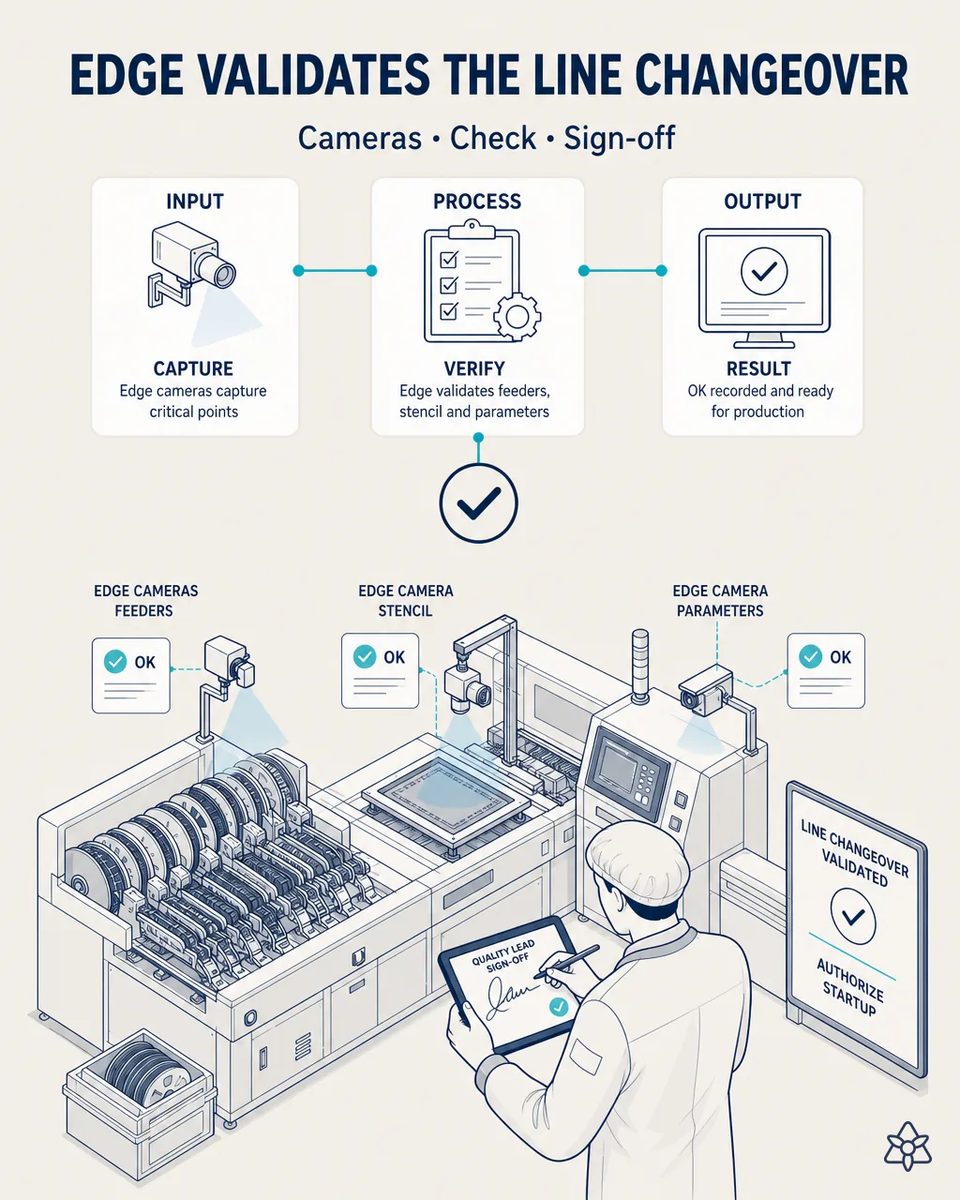
Every reference changeover on the SMT line or the winding machine stops production for 1 to 3 hours and depends on human visual confirmation under time pressure. With Edge cameras at the critical points, the line doesn't start until everything is confirmed and the supervisor signs off.
The first lot after a changeover carries the whole risk of the changeover.
- Visually confirming the correct feeder, stencil, or mold is mounted depends entirely today on human attention under changeover time pressure. - If the confirmation fails, the entire first lot of the new reference ships nonconforming.
- Every reference changeover on the SMT line or the winding machine stops production for 1 to 3 hours, and the pressure to restart grows with every minute.
- Visually confirming that the correct feeder, stencil or mold — or the right wire gauge and winding head — is mounted depends entirely today on human attention under changeover time pressure.
- The check leaves no objective evidence: a signature on a checklist says someone looked, not what they saw.
- If the confirmation fails, the entire first lot of the new reference ships nonconforming, and the error is found at test or, worse, by the customer.
Edge with JIDOKA AI — N cameras confirm, the quality lead signs, then the line starts.
Edge cameras at N critical changeover points compare the current state against the correct reference state for that part. The line doesn't start until N cameras confirm OK plus the quality lead's sign-off — JIDOKA AI.
It is JIDOKA applied to the changeover: the stop is built into the process instead of relying on someone noticing. The cameras check what is mounted, the quality lead decides, and every changeover leaves a photo of the state the line restarted in.
Changeover confirmation today versus Edge confirmation
| Aspect | Today | With iLEAN Edge |
|---|---|---|
| Stencil for the new ECU board | Confirmed by reading its label | Matched to the reference image for that part |
| Wire gauge and winding head on the winder | Checked against the traveler, if time allows | Confirmed from the image |
| Restart condition | The operator decides it looks right | N cameras OK plus quality lead sign-off |
| Evidence of the setup | A tick on a checklist | Photo of every critical point |
| First lot of the new reference | Carries the changeover's risk | Starts from a confirmed state |
| Well-executed changeover time | Stretched by repeated rechecks | Improved: one objective check replaces several |
Human visual confirmation with no objective evidence → Edge confirmation plus human sign-off, with photographic evidence of every change.
Impact estimate — to be validated with your numbers.
The block below is an estimate to be validated against your plant's actual data. We put it forward so the committee has an order of magnitude; we refine it during the assessment.
- Estimated payback 4-9 months.
- Fewer nonconforming lots at startup, because the first lot of the new reference starts from a confirmed setup.
- Better well-executed changeover time: one objective confirmation replaces repeated visual rechecks under pressure.
- From human visual confirmation with no objective evidence to Edge confirmation plus human sign-off, with a photo of every change.
Reduces nonconforming lots at startup, improves well-executed changeover time, estimated payback 4-9 months. Estimate to be validated.
And the fair question from the production manager
“And if the camera blocks a correct setup and we lose even more time?” — comparing a mounted setup with its reference image is an anchored task, where the best models stay below 1.5% [1] error. When a camera flags a difference, it shows which point and the reference next to the current state, so the quality lead resolves it in seconds instead of rechecking the whole line.
[1] OpenAI paper "Why Language Models Hallucinate", 2025 — on the reliability of AI in anchored tasks.
What people ask about validating the changeover with Edge
How many cameras does a changeover need?
As many as there are critical points in that changeover: typically feeders, stencil and machine parameters on SMT, and wire, head and program on the winder. The number is set per line with your process engineers, starting with the points where a wrong setup has cost you a lot before.
Where does the reference state come from?
From a photo of a correct, approved setup for each part number, taken once and reviewed by quality. When the engineering revision changes, the reference is updated with it. A camera never compares against a setup that quality has not approved.
Can the line start if the quality lead is not on the floor?
Not without sign-off: that is the JIDOKA AI rule. The sign-off can be given from the tablet after seeing the camera results, so the quality lead does not have to walk to the line for every changeover. Who signed, when and on which evidence is recorded with the lot.
Does it apply to the stator winding machine as well as SMT?
Yes. On the winder the risk is a wrong wire gauge, head or program for the new stator, and it is checked with the same logic as feeders and stencil on SMT. The winder's own program number, read from its screen, is checked too.
What happens to the photos after startup?
They become part of the lot's record. If a customer asks how the line was set up when a lot was produced, the answer is an image, not a checklist tick. The same photos feed the IATF 16949 evidence pack.
More cases from this series
- The electronic components delivery note, straight to the ERPPhoto the delivery note and the PCB/semiconductor lot labels; one validation tap and it all posts to the…
- Industrial tablet validates ECU assemblyNothing iLEAN captures enters the central system without a human confirming it with two taps on an…
- ICT and AOI stitched to the MES, nothing replacedThe ICT/AOI test station's result reflects automatically in the MES/ERP, with no system replaced.
- The metrology lab spreadsheet, straight to the ERPThe metrology lab spreadsheet posts itself to the ERP after human validation, with -50 to -80% fewer…
- The line lead's earpiece that loses no dataThe line lead dictates while walking, without stopping work; iLEAN listens, structures it, and returns…
- Semiconductor delay alert, read in secondsiLEAN reads the supplier's delay email at zero latency and suggests a replan before the line stops.
Tell us how long your last changeover took and how its first lot was checked.
We work on your plant's real data, not ours. Assessment with no commitment.
Request estimated ROI within 48h ‹ See all cases of automotive electronics See automotive