The camera that never gets tired on the line
At assembly cadence, a badly welded terminal, an irregular seal or a micro acid leak slip past human visual control. iLEAN Edge places a camera over the line with a model trained on the specific product, inspecting every unit in milliseconds.
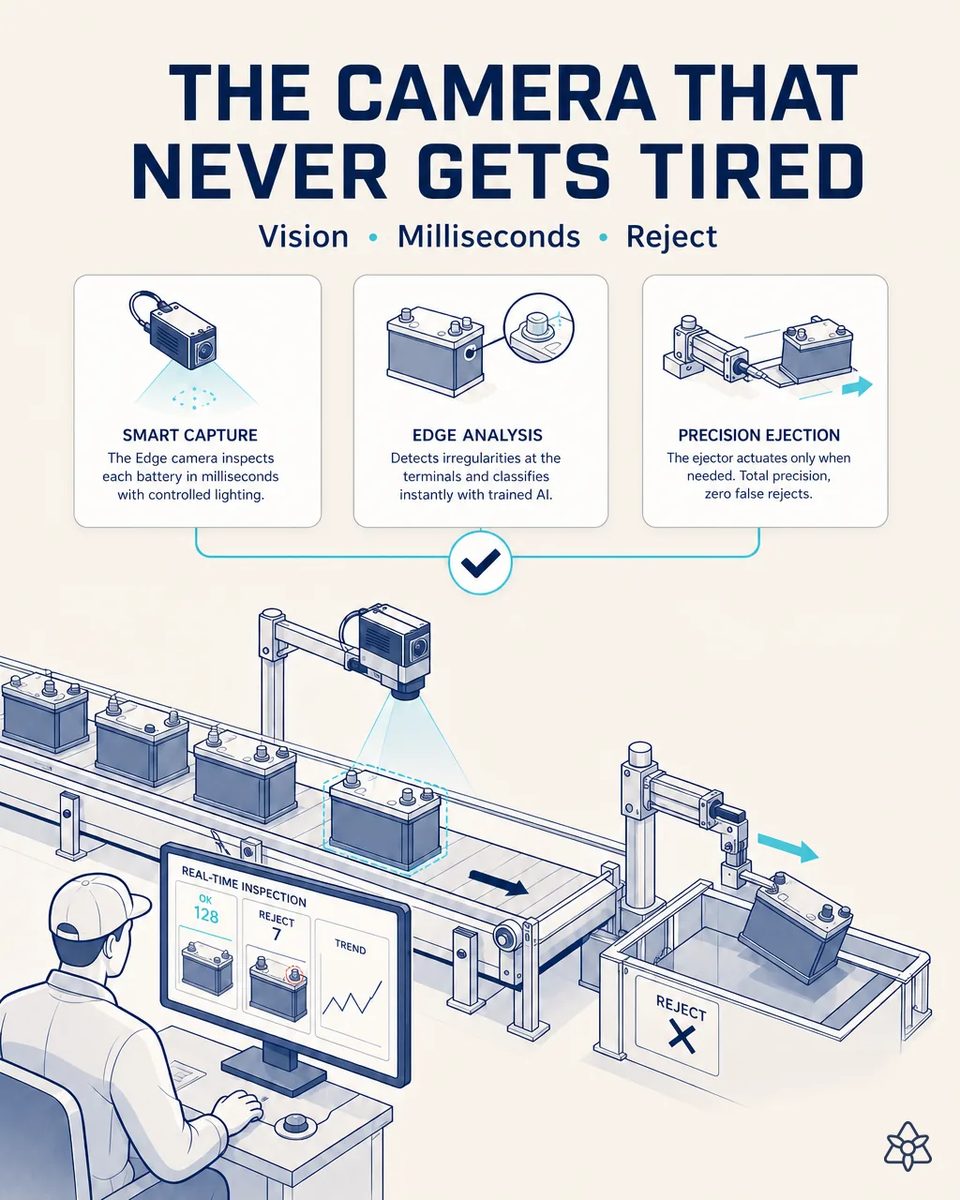
At assembly cadence, the critical defects slip past the human eye.
Those critical defects end up as warranty claims, returns or, worst case, a safety risk for the end user — and 100% human visual control is impossible at real cadence.
- A badly welded terminal, an irregular lid seal or a micro acid leak look like nothing at line speed, and they pass a visual check made on samples. They are the defects most likely to cause a field failure months later.
- 100% human visual control is impossible at real cadence: the inspector sees hundreds of batteries per hour and fatigue sets in long before shift end. The defects that matter are precisely the borderline ones a tired eye lets through. Edge inspection does not get tired at the end of a night shift, which is when most escaped welds are produced.
- Those defects end up as warranty claims and returns, and in the worst case as a safety risk for the end user. Each return damages the relationship with the OEM more than its cost alone suggests.
- Catching them at final test is late: the battery has already been formed, filled and sealed, and all that value is scrapped. The later the defect is found, the more process steps have been spent on a battery that will be scrapped.
Edge — local CNN vision over the welding line, no image sent to the cloud.
Edge — local CNN vision, no image sent to the cloud (latency, cost, bandwidth). The model automatically rejects the defective unit before final test and packaging.
Inference runs next to the line, so the decision comes back in milliseconds without depending on bandwidth or a remote server. The defective battery is rejected before final test and packaging, where it still costs least. Every image is also kept with its verdict, which gives quality a visual record of each battery that left the welding station.
Visual sampling on the welding line versus Edge inspection
| Aspect | Visual sampling | With iLEAN Edge |
|---|---|---|
| Units inspected after terminal welding | A sample, when someone has time | 100%, every battery |
| Cold or porous terminal weld | Caught at final test, if at all | Rejected right after welding |
| Irregular lid heat seal | Depends on the inspector's eye | Classified unit by unit |
| Micro acid leak traces | Rarely seen at cadence | Flagged before packaging |
| Where images are processed | — | On the line, no cloud latency |
| Borderline units | Pass or fail at random | Escalated to a person |
Partial visual sampling → 100% unit inspection, with no cloud latency.
Impact estimate — to be validated with your numbers.
The block below is an estimate to be validated against your plant's actual data. We put it forward so the committee has an order of magnitude; we refine it during the assessment.
- Estimated payback 5-12 months, depending on your current reject ratio and the warranty cost avoided.
- From partial visual sampling to 100% unit inspection, with no cloud latency. Test bench cycles stop being spent on batteries that were already defective at welding.
- Defective batteries stopped before final test and packaging, where they cost least to scrap. Scrap happens earlier in the process, when less value has been added to the battery. Less scrap after formation also means less acid and less energy spent on batteries that were never going to ship.
- And fewer terminal and seal defects reaching the customer as warranty returns. And every rejected unit keeps its image, which gives maintenance a clear view of which welder is drifting.
Estimated payback 5-12 months depending on current reject ratio and avoided warranty cost. *Figure to validate*.
And the fair question from the production manager
“What if it rejects good batteries?” — the false reject is the real risk of any vision system, so the model is trained on good and bad units of your own battery models, under that station's lighting. Classifying a known defect on a fixed view is an anchored task, where the best models drop below 1.5% error [1], and borderline units are escalated to a person instead of being thrown out. Every escalated decision is fed back into training, so the model learns your borderline cases.
[1] OpenAI paper "Why Language Models Hallucinate", 2025 — on the reliability of AI in anchored tasks.
What people ask about vision on battery terminal welding
Which terminal defects can the camera detect?
Cold or porous welds, misshaped posts, bridging, irregular lid seals and visible traces of acid. The exact catalog is built with good and bad units from your own line. New defect types are added as they appear, without retraining from scratch.
Does it keep up with our assembly cadence?
Yes. Inference runs locally and resolves in milliseconds per battery, without depending on the plant network or the cloud. The decision is taken before the battery reaches the next station, so no buffer is needed.
Does it replace the leak test or the high-rate discharge test?
No. Those remain the reference. What changes is that defective batteries are removed earlier, so they stop consuming test cycles and stop reaching packaging. In practice that frees capacity on test benches that are often the bottleneck of the line.
How many sample batteries are needed to train the model?
Fewer than usually feared, because terminal defects repeat. What matters is that they are real good and bad units from your models and your lighting. Collecting them usually takes a few weeks of normal production, setting aside the rejects.
Can one camera handle several battery case sizes?
Yes, by switching the model according to the active program. That is normal on lines running several group sizes in the same week. Each program loads its own reference automatically when the line changes over.
More cases from this series
- Zero critical defects, fully traced4 coordinated verification rings — ERP, marking, Edge vision and evidence pack — against the critical…
- The audit dossier that builds itselfEvery critical change generates a pre/post photo, log and sign-off. Agents builds the audit dossier by…
- The serial marker that no longer gets hand-typedThe ERP publishes lot, date and model straight to the marker via API. Lot change = one tap, not manual…
- Grid casting start, no paperThe grid casting shift log gets photographed with a phone and lands in the central system at zero-second…
- What the line lead knows now stays on recordThe line lead dictates an incident while walking the floor; iLEAN structures it and replies in seconds,…
- The lab Excel sheet that's already in the ERPILEAN reads the lab's quality Excel sheet and pushes it to the ERP after human validation. Up to -80% on…
Bring good and bad battery samples and we will assess your case.
We work on your plant's real data, not ours. Assessment with no commitment.
Request estimated ROI within 48h ‹ See all cases of automotive batteries See automotive