The serial marker that no longer gets hand-typed
The marker that prints serial number, date and plant on every battery is fairly modern and has an API, but today it still sits isolated: every lot change gets typed by hand. With iLEAN Connect, the ERP automatically publishes lot, date and model straight to the marker.
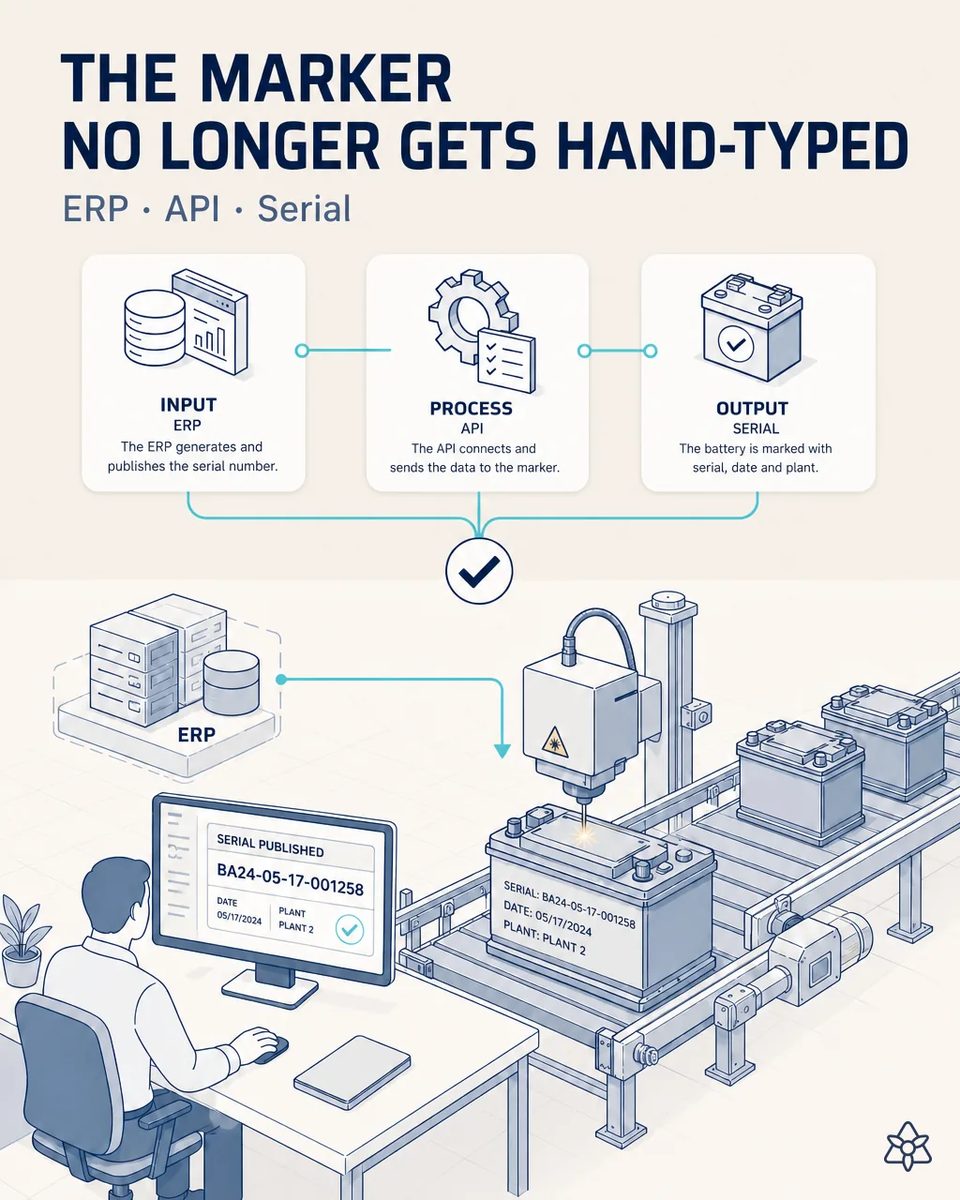
The last physical step before the customer still depends on hand typing.
Serial marking is the last physical step before the customer — a typing error on a lot change breaks full warranty traceability, the worst case when the customer claims warranty by manufacturing date.
- The marker that prints serial number, date code and plant on every battery is fairly modern and already has an API, but it sits isolated from the ERP. Nobody connected the two because each was bought for a different purpose at a different time.
- At every lot or model change, an operator types the new values by hand at the marker's console. Lot changes happen several times a shift on mixed lines, and each one is a chance to mistype.
- One digit wrong in the date code breaks warranty traceability for every battery in that run. The mistake is invisible on the line: the code looks correct, it just belongs to another lot. On mixed EFB and AGM lines, where model changes are frequent, that is where most marking mistakes start.
- That is the worst case when the customer or the OEM claims warranty by manufacturing date: the batteries in the field point to the wrong lot. Containment then has to be drawn far wider than the actual problem, because the date code cannot be trusted.
Connect stitching two modern systems via API — the ERP talks to the marker.
Connect stitches two modern systems together via API. When the ERP flags a program start, it automatically publishes lot + date + model to the marker. The operator no longer types anything.
This is the quickest case to deploy because both ends already speak API. When the ERP flags a program start, lot, date and model reach the marker on their own, and the operator stops being the weakest link in warranty traceability. It is a small integration with a large effect on the one record the customer reads on every battery.
Serial marking typed by hand versus published by the ERP
| Aspect | Today | With iLEAN Connect |
|---|---|---|
| Date code at a lot change | Typed at the marker console | Published by the ERP via API |
| Human-origin marking errors | Occasional, with warranty impact | Zero |
| Warranty claim by manufacturing date | May point to the wrong lot | Points to the right lot |
| Operator task at a model change | Retype serial, date and plant | One tap to confirm the start |
| Marker and ERP | Two isolated systems | Stitched together |
| Deployment effort | — | Short: both ends already have an API |
Occasional typing errors with warranty-traceability impact → zero human-origin error in marking.
Impact estimate — to be validated with your numbers.
The block below is an estimate to be validated against your plant's actual data. We put it forward so the committee has an order of magnitude; we refine it during the assessment.
- Estimated payback 3-6 months, a fast one.
- The return comes from a drastic reduction in the risk of a poorly traced warranty claim. One avoided claim with an untraceable date code usually covers the whole deployment.
- Zero human-origin errors in serial and date code marking. The operator's time at each lot change goes back to the line.
- And when a claim arrives by manufacturing date, the date code on the battery leads straight to the right lot. Which keeps a warranty containment limited to the lot that actually failed, not the whole month. That shortens every warranty investigation that starts from a battery returned by a dealer.
Fast payback, 3-6 months, from the drastic reduction in the risk of a poorly-traced warranty claim. *Figure to validate*.
And the fair question from the production manager
“If it is just an API link, where does the AI come in?” — in the check, not the typing. Before publishing, iLEAN confirms that the lot, date and model match the active program in the ERP; that comparison is an anchored task, where the best models drop below 1.5% error [1]. If anything disagrees, the marker is not updated and the operator is asked to confirm. Every publication is logged with the program and the time, so the trail is complete.
[1] OpenAI paper "Why Language Models Hallucinate", 2025 — on the reliability of AI in anchored tasks.
What people ask about linking the battery marker to the ERP
Does our marker need to be replaced?
Usually not. Most laser and inkjet markers on battery lines from the last decade already expose an API or a network protocol. We review yours before committing. If the marker has no usable interface, we tell you before any work starts.
What exactly gets published to the marker?
Lot, date code and model, plus plant or line if your marking format includes them. The format stays the one your OEM customers already accept. Nothing about the printed layout changes unless you decide to change it.
What happens at a battery model change mid-shift?
The ERP flags the new program start and the marker receives the new values automatically. The operator confirms with one tap instead of retyping. The change is logged with the time and the program, which also feeds the evidence pack.
Can marking keep running if the network drops?
Yes. The marker keeps the last values received, and the link resynchronizes when the connection returns. Nothing is printed with values that were not confirmed. When the link is restored, the marker is checked against the active program before printing continues.
Does it also read back what was printed?
That is the Edge part of the flagship case: a camera reads the printed code and checks it against the program. This case closes the typing gap first. Together, the two close the loop between what was planned and what is physically on the battery.
More cases from this series
- Zero critical defects, fully traced4 coordinated verification rings — ERP, marking, Edge vision and evidence pack — against the critical…
- The audit dossier that builds itselfEvery critical change generates a pre/post photo, log and sign-off. Agents builds the audit dossier by…
- Grid casting start, no paperThe grid casting shift log gets photographed with a phone and lands in the central system at zero-second…
- What the line lead knows now stays on recordThe line lead dictates an incident while walking the floor; iLEAN structures it and replies in seconds,…
- The lab Excel sheet that's already in the ERPILEAN reads the lab's quality Excel sheet and pushes it to the ERP after human validation. Up to -80% on…
- The delivery note that no longer blocks the truckPhotograph the delivery note and the pallet label: iLEAN extracts lot and quantity and pushes them to…
Tell us which marker you use and we will review its API with you.
We work on your plant's real data, not ours. Assessment with no commitment.
Request estimated ROI within 48h ‹ See all cases of automotive batteries See automotive