Zero critical defects, fully traced
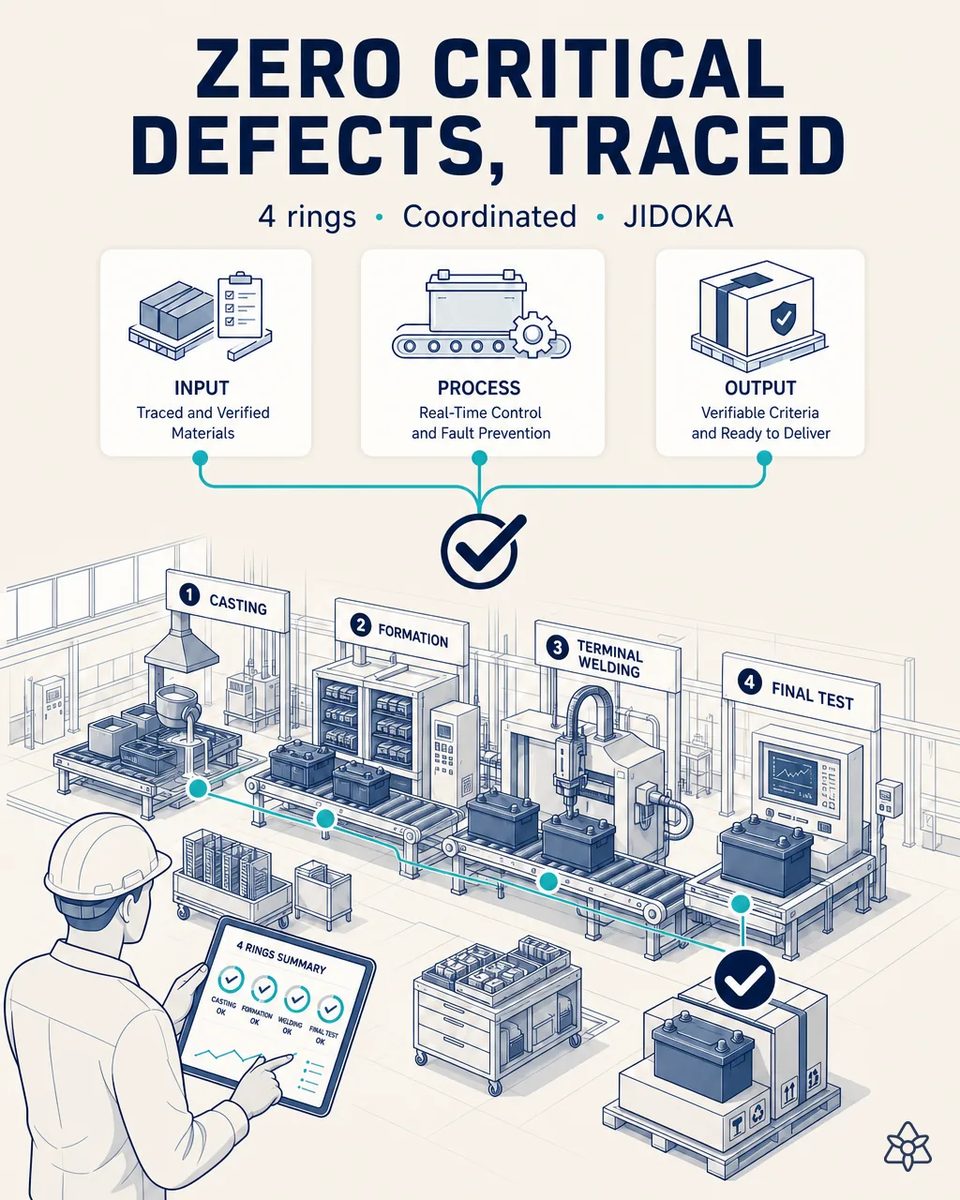
Every starter-battery plant shares the same capital pain point: zero critical assembly defects (bad terminal weld, acid leak, faulty seal) with full lot-to-battery traceability. The iLEAN flagship system coordinates Connect + Edge + Agents across 4 verification rings that cross-check each other.
A mass warranty incident is never caused by one control failing alone.
A mass, poorly-traced warranty incident destroys trust, triggers field-replacement costs, and puts the OEM customer relationship at risk.
- Every starter battery plant shares the same capital pain: zero critical assembly defects — bad terminal weld, acid leak, faulty lid seal — with full lot-to-battery traceability. Leaks and weak welds that reach the customer are the defects that start warranty campaigns.
- Each control on its own looks acceptable: the marker printed, the camera saw something, the leak tester passed. The defect escapes through the gaps between them. No single control is designed to notice that the others disagree. A leak tester can pass a battery whose date code points to another lot, and nothing today notices.
- A poorly traced warranty incident destroys trust, triggers field replacement costs and puts the OEM relationship at risk. The cost lands on quality, on logistics and on the commercial relationship at the same time.
- And without traceability from lot to battery, the containment covers months of production instead of the lot that actually failed. That is the difference between replacing a few hundred batteries and a few hundred thousand.
Agents orchestrating four rings — Connect, Edge and evidence checking each other.
Ring 1 (ERP) defines alloy/lot/model; Ring 2 (Marker) prints with no typing via API; Ring 3 (Edge) reads the assembled unit and cross-checks it against the program — if it doesn't match, JIDOKA AI stops the line; Ring 4 (Evidence pack) ships with every battery. SMED AI speeds up changeovers without breaking the coordination.
No single ring solves the problem; each one exists in some form today and defects still escape. The strength is in the cross-check: when the ERP, the marking, the camera and the evidence stop agreeing, the battery does not ship. That is why the flagship is not a new control, but the coordination of the ones the plant already has.
The four battery rings, and what each one closes
| Ring | What it does | What it closes |
|---|---|---|
| 1 · ERP | Defines alloy, lot and battery model for the run | The program every other ring checks against |
| 2 · Marker | Prints serial and date code via API, no typing | Warranty traceability by manufacturing date |
| 3 · Edge | Reads the assembled battery and cross-checks the program | Bad welds, leaks and seals, stopped by JIDOKA AI |
| 4 · Evidence pack | Ships the record with every battery lot | Proof for the OEM and the IATF auditor |
| SMED AI | Speeds up alloy and model changeovers | Changeovers without breaking the coordination |
| Human tablet gate | Confirms every captured value | Clean master data behind all four rings |
Warranty incidents with mass-claim risk → discrepancy caught on the line, not at the customer.
Impact estimate — to be validated with your quality lead and plant management.
The block below is an estimate to be validated against your plant's actual data. We put it forward so the committee has an order of magnitude; we refine it during the assessment.
- Estimated payback 6-12 months, measured against the first avoided warranty incident.
- Discrepancies caught on the line, not at the customer: the battery that disagrees with its program does not ship.
- Containment scope narrowed from months of production to the exact lot, thanks to lot-to-battery traceability. The heaviest cost is the field replacement campaign, where every battery in the suspect range has to be recovered.
- And protection of the OEM relationship, which is what decides the award of future battery programs.
Estimated payback 6-12 months against the first avoided warranty incident. *Figure to validate* with the quality lead and plant management.
And the fair question from the production manager
“Do we have to deploy all twelve cases to get this?” — no. The rings are built in layers and most cases pay on their own. And when a ring raises a discrepancy, JIDOKA AI stops on a verifiable mismatch between sources, such as a printed date code that differs from the ERP program; reading and comparing those is an anchored task, where the best models drop below 1.5% error [1]. When the doubt is the model's, a person decides.
[1] OpenAI paper "Why Language Models Hallucinate", 2025 — on the reliability of AI in anchored tasks.
What people ask about the zero critical defects battery system
Where does a battery plant usually start?
With the cases that have fewest dependencies, typically the grid casting log and the serial marker link. Each layer pays on its own while the rings are completed. The rings are completed in the order that brings the most protection soonest for your mix.
What does the cross-check catch that individual controls miss?
The defect that passes each control separately: a marking that looks fine but belongs to another lot, or a weld that passes sampling on a battery from the wrong program. Only by comparing sources does that combination become visible before the battery ships.
What if a ring flags a battery that is actually fine?
JIDOKA AI stops on a mismatch between sources, not on model uncertainty. When the uncertainty is the model's, the battery is held and a person decides. Every stop is logged with its cause, so false alarms can be reviewed and reduced.
Does it replace our MES or ERP?
No. Ring 1 relies on the ERP being the truth. iLEAN checks the systems against each other and against what actually happens on the assembly line. It sits on top of the systems you already have and adds the coordination between them.
Can the battery plant's return be estimated before committing to all four rings?
Yes. With your warranty claim history, the cost of the last field campaign and the number of changeovers per week, we estimate the return layer by layer. That way the order of deployment is decided on your numbers, not on ours.
More cases from this series
- The audit dossier that builds itselfEvery critical change generates a pre/post photo, log and sign-off. Agents builds the audit dossier by…
- The serial marker that no longer gets hand-typedThe ERP publishes lot, date and model straight to the marker via API. Lot change = one tap, not manual…
- Grid casting start, no paperThe grid casting shift log gets photographed with a phone and lands in the central system at zero-second…
- What the line lead knows now stays on recordThe line lead dictates an incident while walking the floor; iLEAN structures it and replies in seconds,…
- The lab Excel sheet that's already in the ERPILEAN reads the lab's quality Excel sheet and pushes it to the ERP after human validation. Up to -80% on…
- The delivery note that no longer blocks the truckPhotograph the delivery note and the pallet label: iLEAN extracts lot and quantity and pushes them to…
Book the closing meeting and walk through the four rings on your real line with us.
We work on your plant's real data, not ours. Assessment with no commitment.
Request estimated ROI within 48h ‹ See all cases of automotive batteries See automotive