Grid casting start, no paper
Every shift, the grid caster starts with a paper log noting the lead alloy, target plate weight and pour temperature. That log defines the traceability origin of every grid lot, but today it sits in a folder until someone transcribes it. With iLEAN Connect, the caster photographs the log with his phone at shift start, and the grid lot already exists in the central system at zero-second latency.
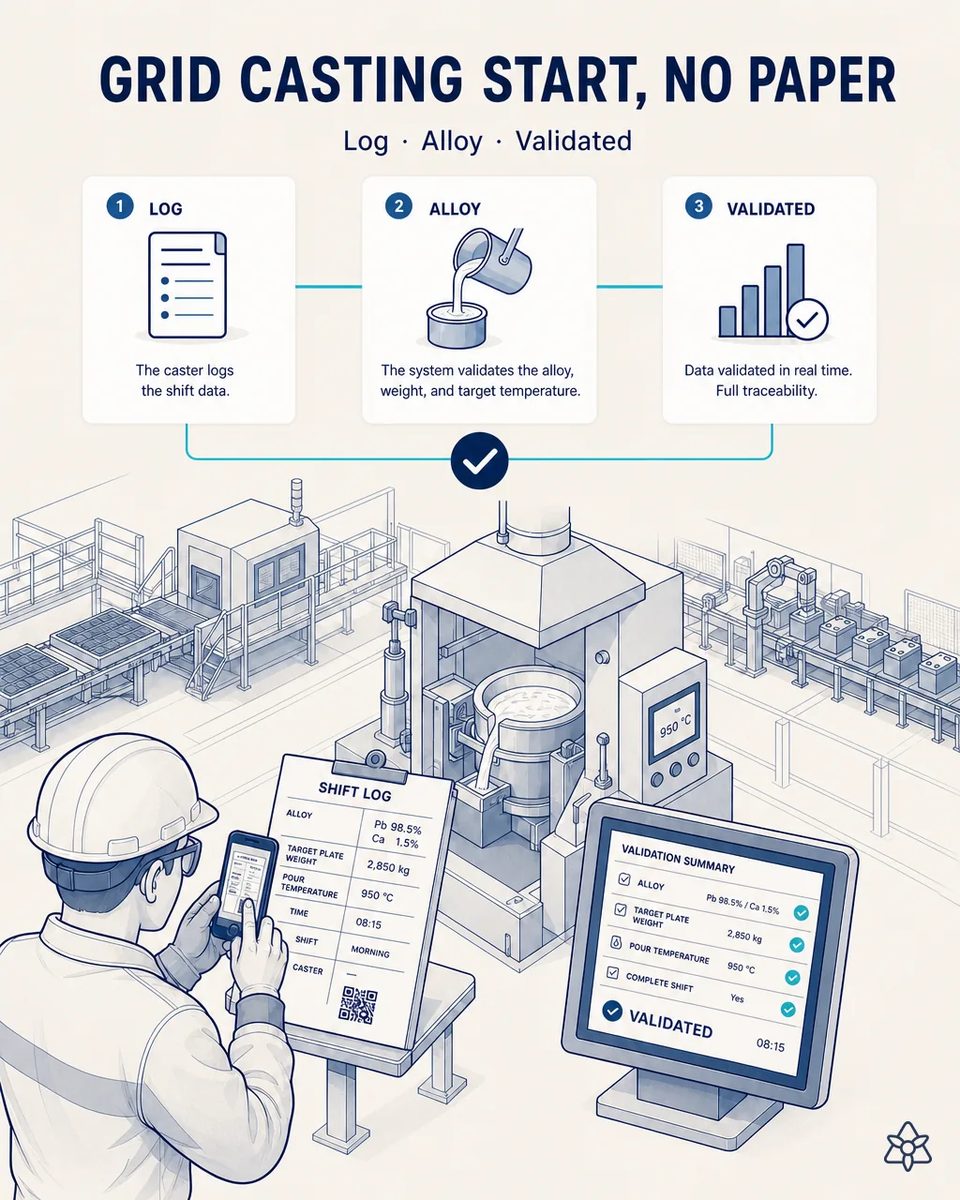
The first link of the battery's traceability sits in a folder.
Grid casting is the first traceability link of the whole battery — if alloy or plate weight get logged wrong, the defect isn't caught until final test or, worse, until warranty. Paper logs can sit undigitized for hours, and when a non-conformance shows up weeks later, nobody can reliably reconstruct the alloy or pour temperature of that lot.
- Every shift, the grid caster starts with a paper log: lead-calcium alloy, target plate weight, pour temperature, book mold in use and the grid lot number. All of it handwritten, often with a correction in the margin when the pot temperature had to be adjusted.
- That sheet is the traceability origin of every plate that will later be pasted, cured, formed and welded into a battery, yet it stays undigitized for hours. Pasting and curing records exist too, but they all hang from a casting lot that is not yet queryable.
- A wrong alloy or a plate weight off target is not caught at casting: it surfaces at final high-rate discharge test or, worse, as a warranty claim months later. By then the grids have been pasted, cured, formed and shipped inside thousands of batteries.
- When a non-conformance shows up weeks after the pour, nobody can reliably reconstruct which alloy or which pot temperature that grid lot came from. The answer ends up being an estimate, and the containment is drawn wider than it needs to be.
Connect in photo mode — the grid caster keeps the same log he fills in today.
Connect photo mode. The caster photographs the log with his phone at shift start, no new app, no habit change. An anchored model recognizes the log's layout and extracts alloy, weight, temperature and lot in seconds, landing in iLEAN's central memory before the pour even finishes.
Nothing changes at the caster: same sheet, same pen, one photo at shift start. What changes is that the grid lot already exists in central memory before the first rack of grids leaves for the pasting line. It is usually the first case approved, precisely because it asks nothing of the person at the pot.
The grid casting log on paper versus captured at the pot
| Aspect | Today, on paper | With iLEAN Connect |
|---|---|---|
| Grid lot in the system | Hours after the pour, if transcribed | Zero-second latency, before the pour ends |
| Lead-calcium alloy per lot | Handwritten, hard to query | Structured field tied to the grid lot |
| Target plate weight and pour temperature | A number in a folder | History queryable by caster and shift |
| Tracing a low-CCA complaint back to casting | Hunting through binders | One lookup by grid lot |
| Casting supervisor's transcription time | Every shift, by hand | Recovered |
| Grid caster's routine | — | Unchanged: one phone photo |
Hours of latency between pour and digital record → zero-second. Manual reconstruction on a non-conformance → instant lookup by grid lot.
Impact estimate — to be validated with your numbers.
The block below is an estimate to be validated against your plant's actual data. We put it forward so the committee has an order of magnitude; we refine it during the assessment.
- Estimated payback 4-9 months, depending on daily grid lot volume.
- Most of the return comes from the casting supervisor's transcription time, recovered every single shift.
- From hours of latency between pour and digital record down to zero-second.
- And a non-conformance stops being a manual reconstruction: it becomes an instant lookup by grid lot.
Estimated payback 4-9 months depending on daily lot volume, mostly recovering the casting supervisor's transcription time. *Figure to validate*.
And the fair question from the production manager
“What if it misreads the alloy or the plate weight?” — reading fields from a log with a fixed layout is an anchored task, where the best models drop below 1.5% error [1]. On top of that, each value is checked against its physical range for that alloy and grid type, and the casting supervisor confirms the summary before it reaches the ERP.
[1] OpenAI paper "Why Language Models Hallucinate", 2025 — on the reliability of AI in anchored tasks.
What people ask about digitizing the grid casting log
Does the grid caster need a new app on his phone?
No. He photographs the log he already fills in, with the phone he already carries. The value is precisely that his routine at the melting pot does not change. Adoption on the casting floor depends on that, more than on any feature of the system.
Can it read handwritten alloy codes and plate weights?
Yes. The model recognizes the layout of your log and reads handwriting field by field. Any value with low confidence is flagged so the supervisor confirms it instead of guessing. Over time, the corrections the supervisor makes also teach the model the handwriting quirks of each caster.
What happens when the caster switches book molds mid-shift?
A second photo of the annotated log is enough. The mold change becomes its own event, tied to the grid lot that follows it, so the traceability chain stays continuous. That matters when a lot of grids later shows growth or corrosion issues and you need to know which mold produced them.
How does a grid lot connect to the finished battery?
The grid lot captured here is the first link. Pasting, curing and formation records then hang from it, which is what lets you go from a warranty return back to a casting shift. Without that first link, every later record floats without an origin, however well it is kept.
Do we need the ERP connected before the first casting shift?
No. The grid casting log lands in iLEAN's central memory from the first shift, and the push to the ERP is connected once the value has been shown. Most plants prefer to see a few weeks of grid lots in the system before touching the ERP side.
More cases from this series
- Zero critical defects, fully traced4 coordinated verification rings — ERP, marking, Edge vision and evidence pack — against the critical…
- The audit dossier that builds itselfEvery critical change generates a pre/post photo, log and sign-off. Agents builds the audit dossier by…
- The serial marker that no longer gets hand-typedThe ERP publishes lot, date and model straight to the marker via API. Lot change = one tap, not manual…
- What the line lead knows now stays on recordThe line lead dictates an incident while walking the floor; iLEAN structures it and replies in seconds,…
- The lab Excel sheet that's already in the ERPILEAN reads the lab's quality Excel sheet and pushes it to the ERP after human validation. Up to -80% on…
- The delivery note that no longer blocks the truckPhotograph the delivery note and the pallet label: iLEAN extracts lot and quantity and pushes them to…
Bring a real grid casting shift log from your plant to the demo.
We work on your plant's real data, not ours. Assessment with no commitment.
Request estimated ROI within 48h ‹ See all cases of automotive batteries See automotive