The lab Excel sheet that's already in the ERP
The lab supervisor fills out an Excel sheet every shift with acid density, CCA, capacity and internal resistance. That sheet lives in a folder the ERP never sees. iLEAN Connect absorbs it in real time and, after validation, pushes it into the ERP automatically.
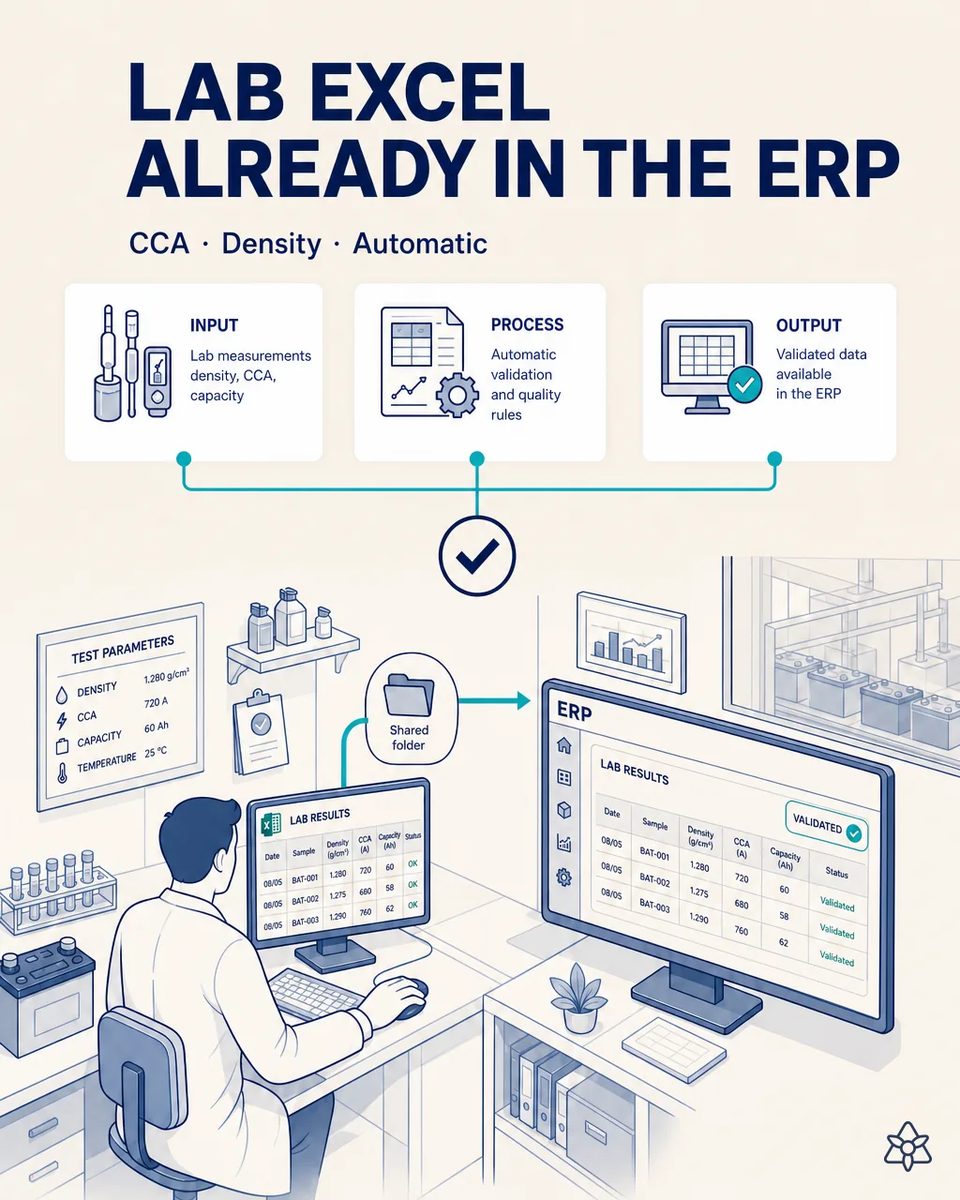
The battery lab lives in a spreadsheet the ERP never sees.
Two parallel worlds — the real Excel (live test data) and the official ERP (data transcribed weeks late by someone who spends meaningful time each month copy-pasting and making mistakes in data a customer OEM may later audit).
- Every shift, the lab supervisor fills in a spreadsheet with electrolyte density, CCA, reserve capacity and internal resistance for the sampled batteries. Sometimes cold-cranking and capacity results come from different benches and are merged by hand.
- That sheet sits in a shared folder. The official ERP holds a transcribed version that runs weeks behind the real test data. Anyone looking for a lot's test results in the ERP sees an incomplete picture.
- Someone spends meaningful time each month copying and pasting cells, and copying errors land in data an OEM may later audit. Those errors tend to surface in front of a customer, which is the worst place to find them.
- Two parallel worlds, and the one the customer audits is the one that is out of date. And the person copying is usually the most qualified one in the lab. It also lets quality compare CCA and capacity trends across battery models without opening a single spreadsheet.
Connect in listen-inward mode — it watches the lab's shared folder, not the technician.
Connect "listen inward" mode — it watches the shared folder (not the person), reads the delta when the file is saved, parses it with an anchored LLM, validates on screen, and pushes it to the ERP via API.
The lab keeps its spreadsheet exactly as it is. When the file is saved, the new rows are read, checked on screen and pushed to the ERP, so the CCA history the OEM asks for is already there on the day they ask. The lab supervisor recovers the hours spent copying, and the ERP stops being the place where test data goes to age.
The battery lab spreadsheet today versus connected to the ERP
| Aspect | Today | With iLEAN Connect |
|---|---|---|
| Gap between lab test and ERP record | Weeks | Zero-second, after validation |
| Electrolyte density and CCA per sample | In a sheet nobody else queries | In the ERP, by lot and date |
| Monthly copy-paste time | Hours of a lab supervisor | Zero |
| Transcription errors in audited data | Found when the OEM asks | Eliminated at the source |
| Spreadsheet format | Must be respected | Read as it is, even when it changes |
| Quality and lab module seats | One per person who types | Only those who validate |
Weeks of lag → zero-second. Monthly transcription time → zero.
Impact estimate — to be validated against your ERP invoice.
The block below is an estimate to be validated against your plant's actual data. We put it forward so the committee has an order of magnitude; we refine it during the assessment.
- 💰 CFO angle: the ERP bills per named user. People who log in only to type lab results no longer need a seat: typically a 50-80% reduction in quality and lab module licenses.
- Estimated payback 4-9 months on top of that recurring saving.
- From weeks of lag to zero-second, and monthly transcription time down to zero. The lab supervisor gets those hours back for analysis and for supporting the formation line.
- And the CCA and capacity history requested in an OEM review stops being rebuilt by hand.
CFO angle — typical 50-80% reduction in quality/lab-module licenses, plus estimated 4-9 month payback. *Figure to validate*.
And the fair question from the production manager
“Our lab spreadsheet has been edited by several people for years — will it cope?” — that is the expected case: parsing does not rely on fixed cell positions, it interprets columns, units and margin notes as they are. It is an anchored task, where the best models drop below 1.5% error [1], and the lab supervisor validates on screen before anything is pushed to the ERP.
[1] OpenAI paper "Why Language Models Hallucinate", 2025 — on the reliability of AI in anchored tasks.
What people ask about pushing the battery lab sheet to the ERP
Do we have to standardize the lab spreadsheet first?
No, and it is better not to. Asking the lab to change its sheet is the quickest way for the project to stall. iLEAN reads the one you use today. New columns or a renamed tab are absorbed without asking the lab to do anything differently.
Which battery tests can it carry into the ERP?
Whatever the sheet holds: electrolyte density, open circuit voltage, CCA, reserve capacity, internal resistance, high-rate discharge. If it is a column, it can become a field. Each value keeps its unit and its sample reference, so nothing is mixed up between battery models.
How real is the license reduction?
It depends on your ERP contract, which is why we estimate it against last year's invoice. The logic is that anyone who logs in only to type results stops needing a seat. We run the numbers against the real invoice before anyone signs anything.
Does it track what the lab technicians do?
No. It watches the shared folder and reads the file when it is saved. There is no record of who opens what or for how long. The lab works exactly as it did, and nobody feels watched over their shoulder.
Does it help with PPAP or an OEM quality review?
Yes, it is one of the biggest time savers there: the test history the customer asks for is already in the ERP, by lot and date, instead of being rebuilt against the clock. It also removes the risk of a copied value contradicting the original sheet in front of the customer.
More cases from this series
- Zero critical defects, fully traced4 coordinated verification rings — ERP, marking, Edge vision and evidence pack — against the critical…
- The audit dossier that builds itselfEvery critical change generates a pre/post photo, log and sign-off. Agents builds the audit dossier by…
- The serial marker that no longer gets hand-typedThe ERP publishes lot, date and model straight to the marker via API. Lot change = one tap, not manual…
- Grid casting start, no paperThe grid casting shift log gets photographed with a phone and lands in the central system at zero-second…
- What the line lead knows now stays on recordThe line lead dictates an incident while walking the floor; iLEAN structures it and replies in seconds,…
- The delivery note that no longer blocks the truckPhotograph the delivery note and the pallet label: iLEAN extracts lot and quantity and pushes them to…
Bring your quality-module ERP invoice and we will run the real numbers with you.
We work on your plant's real data, not ours. Assessment with no commitment.
Request estimated ROI within 48h ‹ See all cases of automotive batteries See automotive