No start until everything checks out
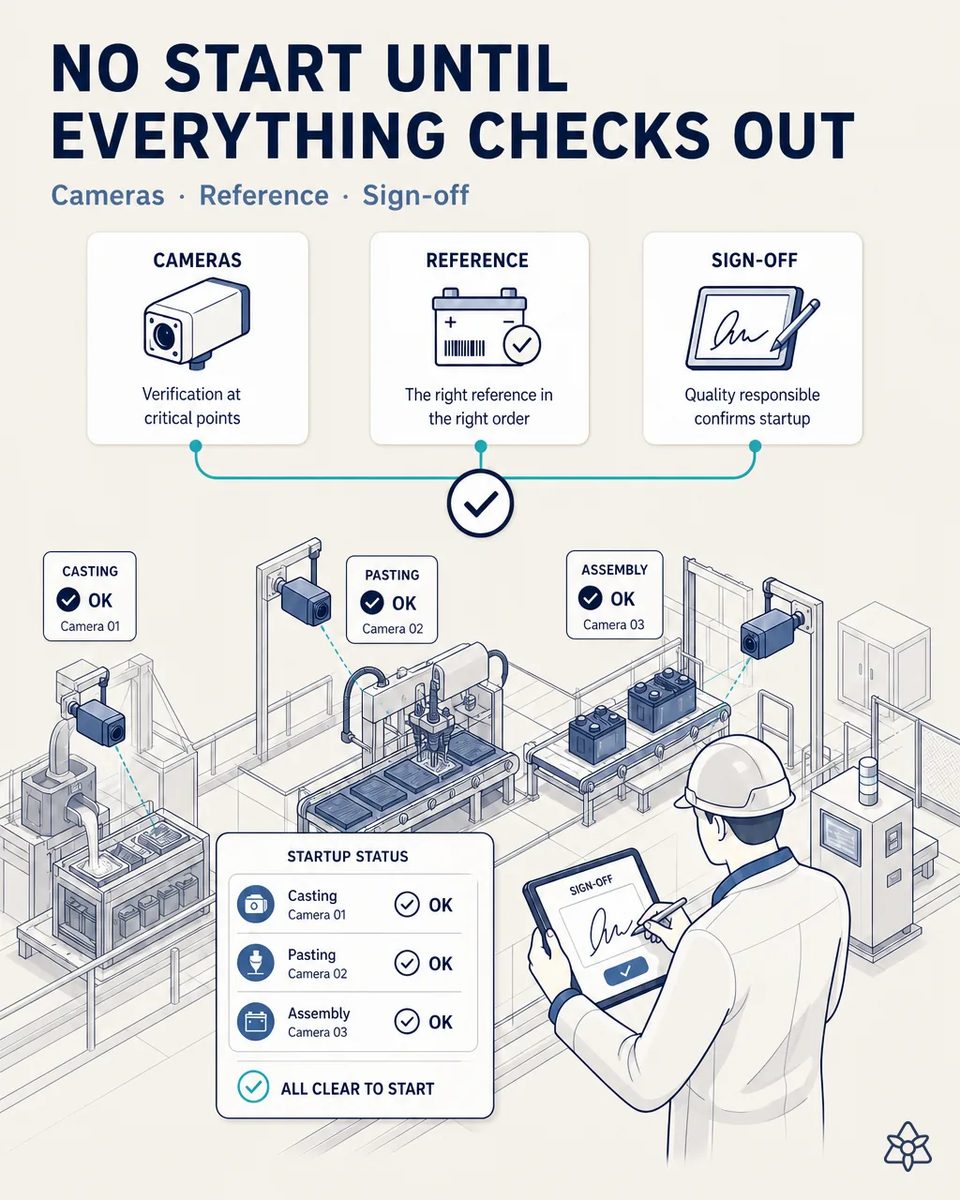
An alloy changeover or a battery-model change requires thorough preparation before restart. Today it relies on a human sign-off with no objective visual evidence. With iLEAN Edge, fixed cameras at every critical point compare the current state to a reference state and won't allow startup without the OK.
The restart after an alloy changeover rests on a blind signature.
Starting the first lot wrong after an alloy or format change can contaminate the entire shift's production, and today the only safeguard is a blind sign-off.
- Changing the grid alloy or the battery model means purging the melting pot, swapping book molds, adjusting the paster and changing assembly tooling. Each of those steps has its own checklist, and each one is done under pressure to restart quickly. Book mold swaps, paster gap adjustments and assembly tooling are all done by different people at the same time.
- Today the restart depends on a human sign-off with no objective visual evidence that each point is really ready. Everybody wants the line back up, which is exactly when steps get assumed rather than checked.
- If the first lot starts wrong, the wrong alloy or the wrong grid can contaminate the whole shift's production before anyone notices. Lead-calcium and lead-antimony grids mixed in a run cause problems that only show up in the field.
- And when that happens, the sign-off sheet proves only that someone signed, not what they saw. That is a weak position to defend in front of an OEM asking how the mix-up happened.
Edge with JIDOKA AI — no start until every camera says ready.
Edge + JIDOKA AI. Industrial cameras with CNNs trained to recognize "ready vs. incorrect state" at every critical point (casting, pasting, assembly). Startup is blocked until every camera is OK and quality signs off based on that visual evidence.
The quality lead still signs, but now he signs on images: casting, pasting and assembly each show their state against the reference. If any camera does not confirm, the line simply does not start. The restart takes the same time when everything is right, and stops only when something is not.
Alloy changeover restart today versus validated by camera
| Aspect | Today | With iLEAN Edge |
|---|---|---|
| Basis for the restart sign-off | A blind signature | Visual evidence per critical point |
| Book mold and pot state at casting | Checked by eye, if checked | Compared with the reference image |
| Paster set for the new grid | Assumed ready | Confirmed by camera |
| Assembly tooling for the new model | Discovered at first unit | Verified before startup |
| Startup with an incorrect state | Possible | Blocked by JIDOKA AI |
| Risk to the shift's first lot | Contamination of the run | Caught before the first grid |
Blind sign-off with lot-contamination risk → sign-off based on visual evidence per critical point.
Impact estimate — to be validated with your numbers.
The block below is an estimate to be validated against your plant's actual data. We put it forward so the committee has an order of magnitude; we refine it during the assessment.
- No fixed payback range: we do not set one because it varies with how often you change alloy or model. The range would hinge on two numbers that only your plant has.
- The return comes from avoided startup scrap: the first lot after a changeover stops being the risky one. One contaminated shift avoided can be worth more than the cameras themselves.
- The restart sign-off moves from a blind signature to evidence per critical point. That is a stronger position in front of an OEM asking how a restart was approved.
- We estimate it with your changeover log and the scrap of your last bad restarts, before committing. So the figure you see is yours, not a generic estimate.
Payback varies with changeover frequency and avoided startup scrap. *Figure to validate*.
And the fair question from the production manager
“A camera saying ready does not mean the alloy is right.” — true, and that is not what it claims. It checks the visible state at each critical point against a reference image, which is an anchored task where the best models drop below 1.5% error [1]. The alloy itself is confirmed by the casting log and the ERP; the camera closes the gap a paper sign-off leaves open. Each restart then keeps its images and signature on record.
[1] OpenAI paper "Why Language Models Hallucinate", 2025 — on the reliability of AI in anchored tasks.
What people ask about camera validation of alloy changeovers
Which points of the line get a camera?
The ones where a changeover can go wrong without anyone seeing it: typically the casting station, the paster and the assembly tooling. We map them with you before installing anything. Cameras are placed so they do not interfere with tooling changes or with safety access.
Who defines the reference state for each alloy or model?
Your process engineers, by capturing the correct state once per alloy and battery model. That reference is what each camera compares against at every restart. When a reference changes, it is updated with the same approval you use for any process change.
Does JIDOKA AI stop the line on its own?
It blocks the startup while a camera does not confirm. The quality lead still signs the restart, but on visual evidence instead of a blank form. Every restart leaves its images and signature on record, which also feeds the evidence pack.
Does the camera check slow down an alloy changeover?
Not if the line is ready: the check takes seconds. It only adds time when something is wrong, which is exactly when you want the time spent. Teams often find the checklist itself gets shorter, because the cameras cover the visual items.
Why is there no payback range for alloy changeover validation?
Because it depends almost entirely on how often you change alloy or model and on the scrap of past bad restarts. We prefer to estimate it with your figures. What we can say upfront is where the risk sits and how the cameras would close it.
More cases from this series
- Zero critical defects, fully traced4 coordinated verification rings — ERP, marking, Edge vision and evidence pack — against the critical…
- The audit dossier that builds itselfEvery critical change generates a pre/post photo, log and sign-off. Agents builds the audit dossier by…
- The serial marker that no longer gets hand-typedThe ERP publishes lot, date and model straight to the marker via API. Lot change = one tap, not manual…
- Grid casting start, no paperThe grid casting shift log gets photographed with a phone and lands in the central system at zero-second…
- What the line lead knows now stays on recordThe line lead dictates an incident while walking the floor; iLEAN structures it and replies in seconds,…
- The lab Excel sheet that's already in the ERPILEAN reads the lab's quality Excel sheet and pushes it to the ERP after human validation. Up to -80% on…
Map your critical alloy changeover points with us.
We work on your plant's real data, not ours. Assessment with no commitment.
Request estimated ROI within 48h ‹ See all cases of automotive batteries See automotive