The line doesn't start without a camera green light
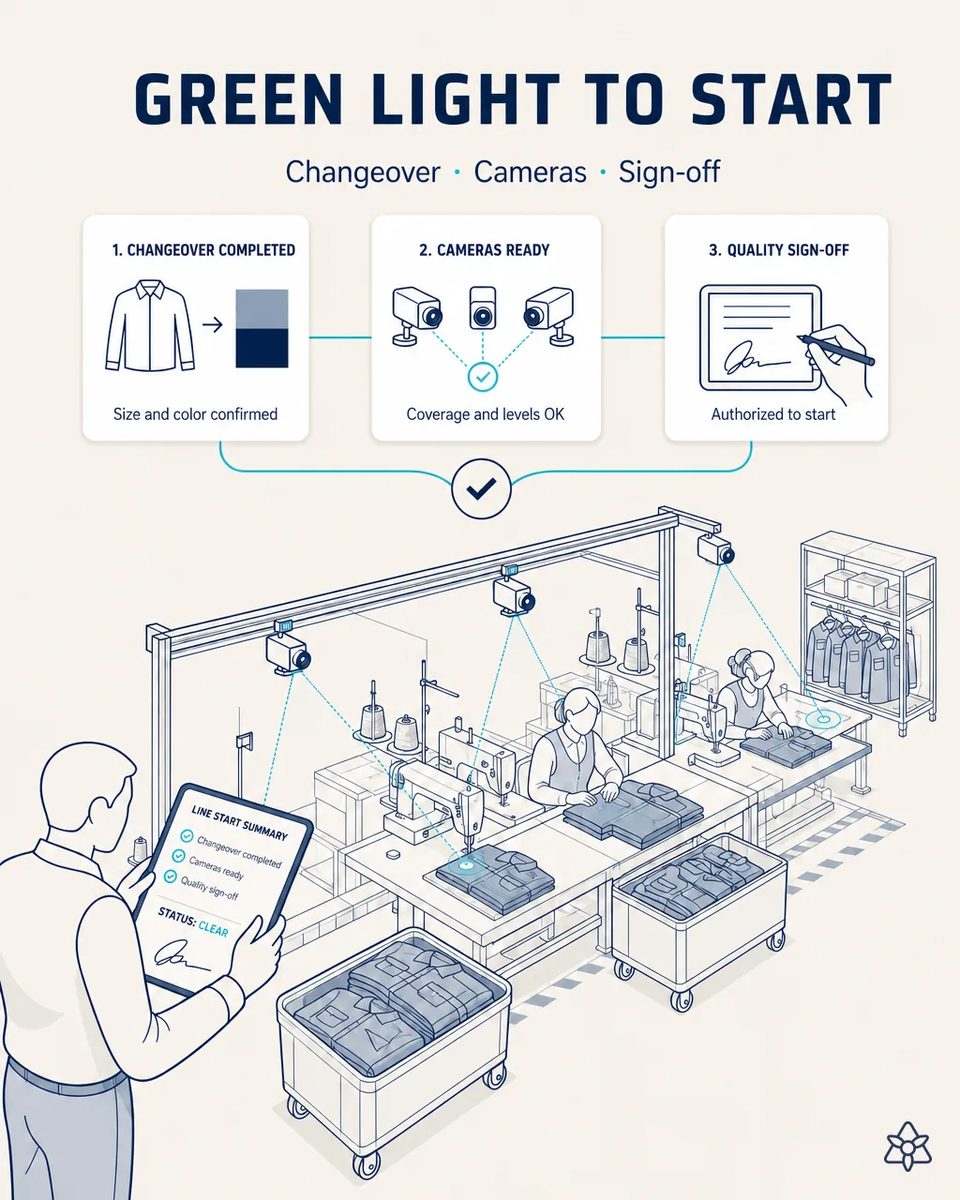
Every size-color changeover requires verifying no piece or bundle from the previous reference is still mixed in. With iLEAN Edge, fixed cameras compare the current state against the reference state, and JIDOKA AI blocks startup until it's clear.
The changeover is signed on someone's word.
today the changeover sign-off rests on a human's word with no structured visual evidence, and one leftover bundle can contaminate an entire customer order.
- Every size-color changeover requires checking that no piece or bundle of the previous reference is still on a station, a cart or under a machine. On a sewing line with dozens of stations, that is a lot of places to look in a hurry.
- Today that check rests on a human's word, with no structured visual evidence behind the sign-off.
- One leftover bundle of the previous color or size is enough to contaminate an entire customer order. And it is usually discovered by the customer, when the carton is opened.
- And on made-to-order corporate uniforms, with many short runs, changeovers multiply and so does the exposure. Each changeover is a new chance for one bundle to stay where it should not.
Edge with JIDOKA AI — the line waits for every camera's green light.
Edge + JIDOKA AI. Industrial cameras with CNNs trained to recognize "line clear vs. residual bundle". The line doesn't start until every camera confirms and quality signs off backed by visual evidence.
The cameras compare each station with its reference state and quality signs off on that evidence. What changes is not who decides, but what the sign-off rests on. A sign-off backed by images is quick to give and hard to dispute later, by the plant or by the customer.
Today's changeover versus the camera-cleared changeover
| Aspect | Today | With iLEAN Edge |
|---|---|---|
| Changeover sign-off | A person's word | Backed by images at every critical point |
| Leftover bundle from the previous reference | Found at packing, or by the customer | Detected before startup |
| Startup | When someone says so | When every camera confirms |
| Evidence after the fact | None | Before/after images per changeover |
| Short made-to-order runs | More changeovers, more risk | More changeovers, same check |
| Doubtful case | — | Escalated to quality |
blind sign-off with mix-up risk → sign-off backed by visual evidence at every critical point.
Impact estimate — to be validated with your changeover calendar.
The block below is an estimate to be validated against your plant's actual data. We put it forward so the committee has an order of magnitude; we refine it during the assessment.
- Payback varies with the number of changeovers per shift, so we do not fix a range here: we estimate it with your changeover calendar.
- The value is protecting high-value customer programs that carry contractual penalties for spec non-compliance. One avoided penalty can be worth more than the whole installation.
- The sign-off moves from blind to backed by visual evidence at every critical point. Quality signs on what it sees, not on what it is told.
- And the leftover bundle is caught at the station, not in a mixed carton. And the evidence of every changeover is captured once and reused in audits.
protects high-value customer programs with contractual penalties for spec non-compliance, payback varies with changeovers per shift. *Estimate to validate*.
And the fair question from the production manager
“What if a camera blocks startup for no reason?” — that is the right objection, because a changeover sits on the line's critical path. Recognizing a clear station against one with a residual bundle, at a known spot, is an anchored task, where the best models drop below 1.5% error [1]. And when the doubt is the model's, JIDOKA AI does not block silently: it escalates to quality, who decides on the image. The line waits for a person, not for a model.
[1] OpenAI paper "Why Language Models Hallucinate", 2025 — on the reliability of AI in anchored tasks.
What people ask about camera-cleared changeovers
What exactly do the cameras look for?
Pieces, bundles or garments of the previous reference on stations, carts and under machines. The critical points are defined at commissioning with your line leads. Each point has its reference image of the station clear, taken once and reused at every changeover.
Can it tell two sizes of the same color apart?
Where the difference is not visible, it relies on the bundle ticket and the label; where it is, such as a shade change, the camera sees it directly. The cameras do not replace the bundle ticket; they confirm that nothing outside it is left on the line.
Does it slow the changeover down?
The check takes seconds once the line is cleared. What slows changeovers today is double-checking by hand for lack of evidence. With the images, the sign-off is quick because it is backed, not because it is rushed.
Can startup be forced in a rush?
An exception can be signed by quality and is recorded as such. What cannot happen is a startup with no trace of who allowed it. Those exceptions are visible later, which tends to make them rare.
Does the evidence serve for audits?
Yes: the before/after images of every changeover are what the evidence pack organizes into the audit dossier. The same images serve production, quality and the auditor, captured only once.
More cases from this series
- The audit dossier organizes itselfEvery critical changeover generates its own auditable dossier. Agents organizes it by standard.…
- The flagship system against size-color mix-upsConnect + Edge + Agents coordinated protect every shipment against mislabeled size/color mixes. Zero…
- The bundle ticket enters the system with one photoOne photo of the bundle ticket at the cutting table gets it into the central system instantly. Zero lost…
- Digitize your vintage cutter without touching the panelAn external camera reads the automatic cutter's panel without touching it. Cutting history digitized…
- The efficiency spreadsheet stops living apart from the ERPConnect absorbs the line-efficiency spreadsheet and syncs it to the ERP. Up to 80% savings on…
- The fabric delivery note gets digitized with one photoOne photo of the delivery note and roll labels digitizes fabric receiving. Full dye-lot-to-garment…
Tell us how many size-color changeovers your lines run per shift.
We work on your plant's real data, not ours. Assessment with no commitment.
Request estimated ROI within 48h ‹ See all cases of workwear See apparel