The Edge camera that inspects 100% of your garments
At sewing-line pace, the human eye tires and lets a crooked seam, a bad buttonhole or a stain slip through. Edge iLEAN places a camera over the final inspection table and infers in milliseconds per garment.
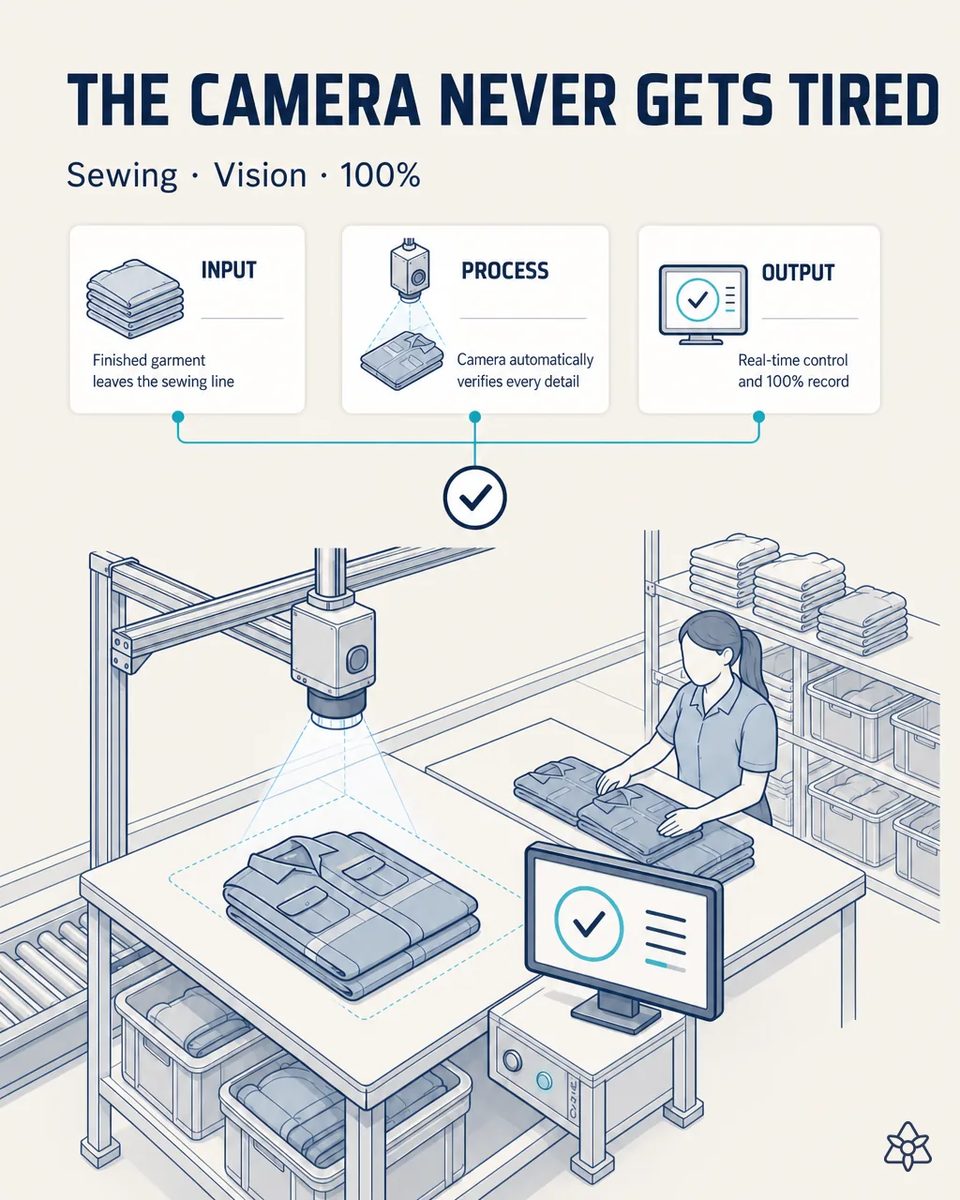
At line cadence, the eye that inspects is the first thing to tire.
100% human visual control is impossible at real line cadence, especially on long shifts. Sample-based inspection leaves gaps.
- A crooked seam, a skipped stitch, a bad buttonhole, a stain or a misplaced reflective tape: each is small, and each is a program complaint. On high-visibility garments, a tape off position can also take the garment out of its EN ISO 20471 class.
- 100% human visual control is impossible at real line cadence, especially at the end of a long shift. The inspector who is sharp at the start of the shift is not the same one eight hours later.
- So plants sample 1-2% of garments, and everything between samples ships on trust. On a uniform program with thousands of identical garments, that trust is exactly what the customer is paying for.
- Second-quality garments found by the customer cost far more than the ones found at the inspection table. They cost the garment, the shipping, the replacement and part of the customer's trust.
Edge — local vision trained on your own styles, no cloud dependency.
Edge — local CNN vision, no cloud dependency. The model is trained on good/bad examples of the plant's actual style. Defective garments are pulled before folding and packing.
The model is trained on good and bad examples of the plant's actual styles, not on a generic garment. A navy coverall and a high-visibility jacket are learned as what they are. Defective garments are pulled before folding and packing, with the defect type and the image attached, which is the last point where pulling one is still cheap. After that point, every defect costs a carton opened, a program complaint or a return.
Sampled inspection versus Edge vision
| Aspect | Visual inspection | With iLEAN Edge |
|---|---|---|
| Coverage | 1-2% sample | 100% of garments |
| Late-shift fatigue | Lets borderline defects through | Constant at cadence |
| Where the defect is caught | At the customer | Before folding and packing |
| Inference | — | Local, milliseconds per garment |
| Borderline seam | Judged in a hurry | Escalated to the inspector |
| Defect record | A tally on paper | Per garment, style and line |
1-2% sampling → 100% garment coverage. Program complaints for visual defects → drastically reduced.
Impact estimate — to be validated against your current second-quality ratio.
The block below is an estimate to be validated against your plant's actual data. We put it forward so the committee has an order of magnitude; we refine it during the assessment.
- Estimated payback 5-12 months, depending on your current second-quality ratio.
- Coverage goes from a 1-2% sample to 100% of garments. Not a bigger sample: every single garment that reaches the inspection table.
- Program complaints for visual defects drastically reduced. Customer programs measure suppliers on exactly those complaints.
- And defects are recorded per style and line, which tells sewing where they originate. That record is what lets a line lead fix the operation instead of only rejecting the garment.
estimated 5-12 month payback depending on the current second-quality ratio. *Estimate to validate*.
And the fair question from the production manager
“What if it pulls good garments?” — the false reject is the real risk of any vision system, which is why the model is trained on your own styles and that table's lighting. Classifying known defect types on a known garment is an anchored task, because the catalog of defects for each style is short and repetitive, where the best models drop below 1.5% error [1]. And borderline garments are not discarded: they go to the inspector, and every decision feeds training. The inspector keeps the last word on every garment the model is not sure about.
[1] OpenAI paper "Why Language Models Hallucinate", 2025 — on the reliability of AI in anchored tasks.
What people ask about camera inspection of sewn garments
Which defects does it catch?
Those trained for your styles: crooked or open seams, skipped stitches, bad buttonholes, stains and misplaced reflective tape on high-visibility garments. Each defect type is added only once there are real examples of it from your production.
Does it need the cloud?
No. Inference runs locally next to the inspection table, so it does not depend on the plant network to keep up with cadence. Each garment is resolved in milliseconds, so the inspection table keeps the pace of the line.
How many garments are needed to train it?
Fewer than expected per style, as long as they are real good and bad garments from your production under your lighting. New styles are added as they come into production, starting from what the model already knows about similar garments.
Does it work with dark fabrics like navy coveralls?
Lighting is designed for the fabrics you run. Dark fabrics and reflective tape are exactly the cases tuned at commissioning. The reflective tape is a known challenge for any camera, which is why its lighting is designed specifically.
Does it replace the inspectors?
No. It takes the repetitive look off them and sends them the doubtful garments, which is where their judgment is worth most. The inspectors' decisions on doubtful garments are what keep improving the model over time.
More cases from this series
- The audit dossier organizes itselfEvery critical changeover generates its own auditable dossier. Agents organizes it by standard.…
- The flagship system against size-color mix-upsConnect + Edge + Agents coordinated protect every shipment against mislabeled size/color mixes. Zero…
- The bundle ticket enters the system with one photoOne photo of the bundle ticket at the cutting table gets it into the central system instantly. Zero lost…
- Digitize your vintage cutter without touching the panelAn external camera reads the automatic cutter's panel without touching it. Cutting history digitized…
- The efficiency spreadsheet stops living apart from the ERPConnect absorbs the line-efficiency spreadsheet and syncs it to the ERP. Up to 80% savings on…
- The fabric delivery note gets digitized with one photoOne photo of the delivery note and roll labels digitizes fabric receiving. Full dye-lot-to-garment…
Tell us your second-quality ratio and what percentage of garments you inspect today.
We work on your plant's real data, not ours. Assessment with no commitment.
Request estimated ROI within 48h ‹ See all cases of workwear See apparel