The label coder stops depending on manual typing
The coder that prints the size-color-lot label has an API but is isolated from the ERP — every order change means hand-typing the spec. With iLEAN, the coder gets stitched bidirectionally to the ERP.
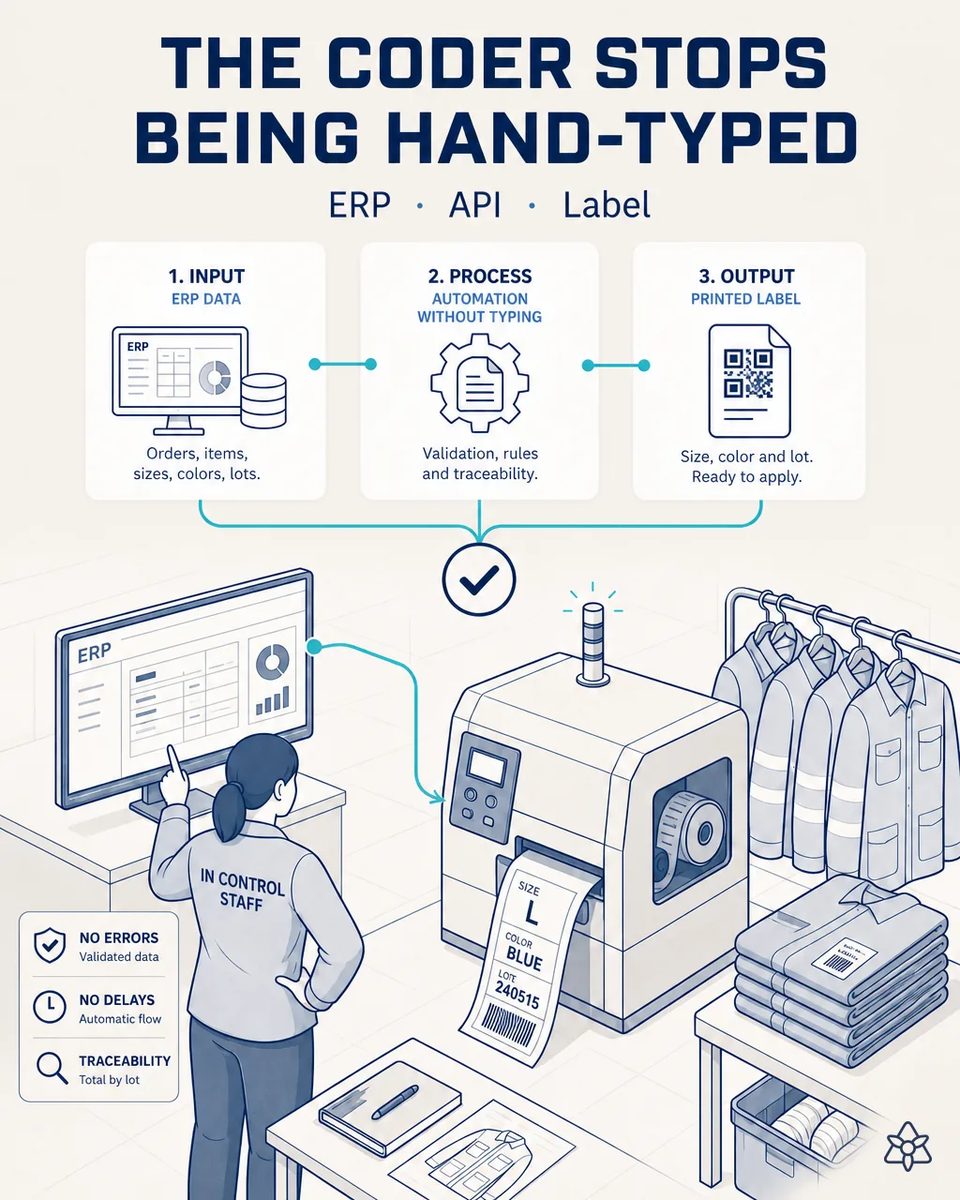
The last physical step before the customer depends on a keyboard.
the coder is the last physical step before a bundle enters sewing or a carton ships to a customer. One typing error in size, color or lot turns into a return.
- The coder prints the size-color-lot label that goes on the bundle before sewing or on the carton before shipping. It is the last physical step before the customer.
- It has an API, but it sits isolated from the ERP, so every order change means hand-typing the spec. On a day with many short orders, that is dozens of specs typed under time pressure.
- One wrong keystroke turns an XL into an L or a navy into a royal blue, and the label is printed with full confidence. The label looks perfect; only the content is wrong, and nobody downstream questions a printed label.
- Some of those monthly typing errors become returns, and on a uniform program a mislabeled carton is a complaint about the whole shipment.
Connect stitches the ERP and the coder — the spec publishes itself.
Connect stitches the ERP and the coder together via API. When the ERP marks a cutting order's start, the spec is published automatically to the coder — an order change is one tap, not typing.
When the ERP marks the start of a cutting order, the spec is published to the coder automatically. An order change becomes one tap instead of a typing job, and the coder does not have to be replaced to get there. The keyboard disappears from the last step before the customer, which is exactly where it was most dangerous.
The typed coder versus the coder stitched to the ERP
| Aspect | Today | With iLEAN Connect |
|---|---|---|
| Where the spec comes from | Typed at the coder | Published by the ERP via API |
| Order change | Retype size, color and lot | One tap |
| Typing errors per month | Several, some tied to returns | Zero of human origin |
| Mislabeled size or color | Found by the customer | Not printed |
| The coder | — | Kept, not replaced |
| What the label proves | What someone typed | What the ERP holds for that order |
monthly typing errors (some tied to returns) → zero human-origin labeling errors.
Impact estimate — to be validated against your return history.
The block below is an estimate to be validated against your plant's actual data. We put it forward so the committee has an order of magnitude; we refine it during the assessment.
- Estimated payback 3-6 months, the fastest of the Connect cases in this matrix.
- Drastic reduction in the risk of returns from mislabeled size or color. On a uniform program, a single avoided return can pay for the integration.
- Human-origin labeling errors go to zero. The errors that remain, if any, are traceable to their source in the ERP.
- And there is no machine to replace: the existing coder's API is what gets used. The integration is one of the shortest projects in the matrix, which is why its payback comes first.
fast 3-6 month payback, drastic reduction in the risk of returns from mislabeled size/color. *Estimate to validate*.
And the fair question from the production manager
“And if the ERP holds the wrong spec?” — then the coder would print it faithfully, which is why the spec it receives is one a person already validated upstream. Moving a size-color-lot spec field to field between two APIs is the most anchored task in this matrix, where the best models drop below 1.5% error [1] — and here there is not even a reading involved, only a structured handoff logged order by order. If the ERP is wrong, the log shows where the error was born, which today is impossible.
[1] OpenAI paper "Why Language Models Hallucinate", 2025 — on the reliability of AI in anchored tasks.
What people ask about stitching the coder to the ERP in workwear sewing
Do we have to replace the coder in workwear sewing?
No. If it has an API, which most current coders do, it is stitched to the ERP as it is. Where it does not, a small interface box can usually bridge it, which is checked before committing to anything.
What exactly does the ERP send?
The spec of the active cutting order: style, size, color and lot, plus any customer-program field that has to appear on the label. Program-specific fields such as an employee name or a department code travel the same way, without retyping.
What happens on an order change mid-shift?
The ERP marks the new order and the coder receives its spec. The operator confirms with one tap instead of retyping. The previous spec is closed and logged, so it is clear which labels belong to which order.
Can the operator still print by hand in an exception?
Yes, and that print is logged as manual with its author, so it is visible later if a carton is questioned. Exceptions stay possible; what disappears is the anonymous one.
Is it bidirectional?
Yes: the coder reports back what it printed and when, so the ERP knows which labels exist for each order. That closes the loop between what was planned and what was physically labeled.
More cases from this series
- The audit dossier organizes itselfEvery critical changeover generates its own auditable dossier. Agents organizes it by standard.…
- The flagship system against size-color mix-upsConnect + Edge + Agents coordinated protect every shipment against mislabeled size/color mixes. Zero…
- The bundle ticket enters the system with one photoOne photo of the bundle ticket at the cutting table gets it into the central system instantly. Zero lost…
- Digitize your vintage cutter without touching the panelAn external camera reads the automatic cutter's panel without touching it. Cutting history digitized…
- The efficiency spreadsheet stops living apart from the ERPConnect absorbs the line-efficiency spreadsheet and syncs it to the ERP. Up to 80% savings on…
- The fabric delivery note gets digitized with one photoOne photo of the delivery note and roll labels digitizes fabric receiving. Full dye-lot-to-garment…
Tell us how many mislabel returns you had last year and what each one cost.
We work on your plant's real data, not ours. Assessment with no commitment.
Request estimated ROI within 48h ‹ See all cases of workwear See apparel