The headset that turns supervisors into a data source
The line supervisor walks the floor all shift with hands full. Nobody can ask them anything because they can't type. With iLEAN Connect headset mode, they dictate while walking, and the AI structures, saves and replies with support within seconds.
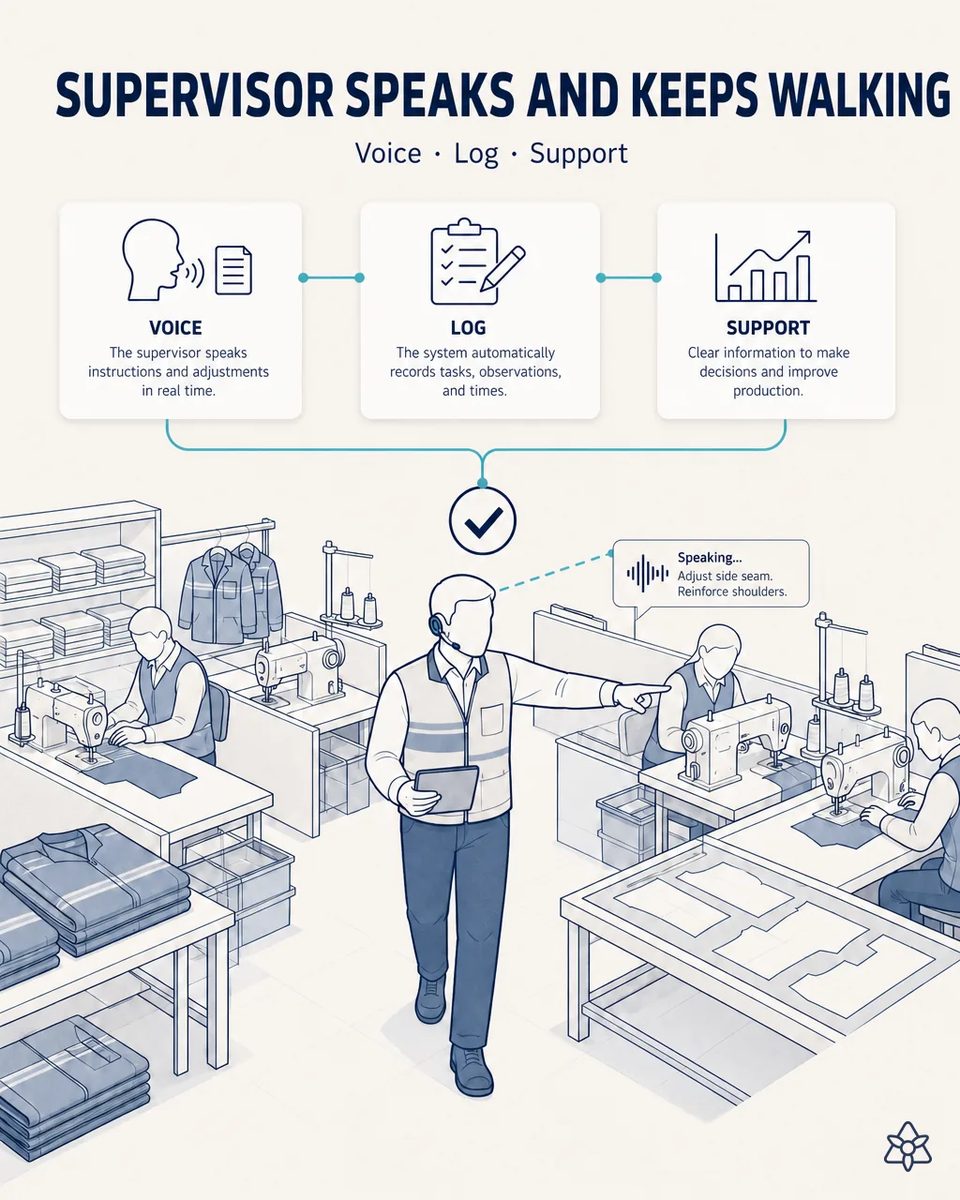
The sewing floor's best data source cannot type.
critical sewing-floor knowledge lives in the line supervisor's head and never reaches the system.
- The line supervisor knows which operation is the bottleneck today, which operator needs help with the side seam, which machine skips stitches after lunch.
- They walk the floor all shift with hands full — bundles, garments, a tablet — and nobody can ask them anything because they cannot stop to type. Recording means walking back to an office that is far from the line.
- That knowledge dies at the end of the shift, or survives as a two-minute handover in the aisle.
- So the efficiency data in the system shows that a line dropped, but never why. And the same problem gets solved again next week by someone else, with no memory of the first time.
Connect in voice mode — a custom wake-word and the supervisor keeps walking.
Connect voice mode with a custom wake-word. The LLM structures the dictation as an incident linked to the active station/line/shift and replies by voice or push to the line lead's tablet.
The supervisor speaks to the system when they choose, without stopping and without a keyboard, the way they would talk to a colleague. The dictation becomes an incident tied to station, line and shift, and it lands next to the live line-efficiency data instead of in someone's memory. Over a few months, that becomes the history of each line: which operation fails, when, and what fixed it last time.
Today's floor round versus the dictated round
| Aspect | Today | With iLEAN Connect |
|---|---|---|
| Floor knowledge | Dies at shift's end | In the system in real time |
| Why a line dropped | Unknown in the efficiency report | Linked to the efficiency data |
| Supervisor's effort | Stop and type, or don't record | Speak while walking |
| Shift handover | Two minutes in the aisle | A structured summary per line |
| Reply to the supervisor | — | By voice or push to the line lead's tablet |
| Operators' conversation in workwear sewing | — | Not recorded |
knowledge that dies at shift's end → enters the system in real time and cross-references live line-efficiency data.
An enabling piece — no payback of its own, and stated as such.
The block below is an estimate to be validated against your plant's actual data. We put it forward so the committee has an order of magnitude; we refine it during the assessment.
- No standalone payback: we do not put a range on this one, because its value depends on what your continuous-improvement program does with it. It is validated with your continuous-improvement lead.
- It is strategic value: the enabler that feeds continuous-improvement programs with the why behind the numbers.
- Floor knowledge that died at the end of the shift starts entering the system in real time.
- And it cross-references live line-efficiency data, so a drop has a cause attached. Over time, the same symptoms on the same operations stop being anecdotes and show up as patterns.
strategic value, an enabler for continuous-improvement programs. *Estimate to validate* with the continuous-improvement lead.
And the fair question from the production manager
“Is this a way to monitor the line?” — no: iLEAN listens to the supervisor, only after the wake-word, and only to what they choose to dictate; the operators' conversation is not recorded. Structuring a dictation into station, line, shift and symptom is an anchored task — the stations and lines exist in your records — where the best models drop below 1.5% error [1]. And the supervisor sees the structured incident and can correct it before it is saved.
[1] OpenAI paper "Why Language Models Hallucinate", 2025 — on the reliability of AI in anchored tasks.
What people ask about the line supervisor's headset
Does it work over the noise of a sewing floor?
That is the design condition. The headset is built for industrial noise and recognition is trained on sewing vocabulary: side seam, hem, buttonhole, bartack, bundle. It is tuned at commissioning with the words your own supervisors use for operations and defects.
Does the supervisor have to learn commands?
Only the wake-word. After that they speak naturally and iLEAN structures station, line, shift and symptom. If something is missing, such as which station, the system asks back before saving the incident.
What does the supervisor get back in workwear sewing?
A short reply by voice, or a push to the line lead's tablet when the incident needs someone else to act. A maintenance call for a machine skipping stitches, for instance, goes straight to whoever fixes it.
Can it tell us why line efficiency dropped yesterday afternoon?
That is the point of linking dictation to the efficiency data: the drop and the supervisor's note sit on the same line and the same hour. That is the context the efficiency report has always lacked when it reaches the morning meeting.
Why doesn't this case carry a payback figure?
Because its return shows up in what continuous improvement achieves with the data, not in the case itself. We prefer to say so rather than invent a number. What can be measured is how many incidents enter the system that never did before.
More cases from this series
- The audit dossier organizes itselfEvery critical changeover generates its own auditable dossier. Agents organizes it by standard.…
- The flagship system against size-color mix-upsConnect + Edge + Agents coordinated protect every shipment against mislabeled size/color mixes. Zero…
- The bundle ticket enters the system with one photoOne photo of the bundle ticket at the cutting table gets it into the central system instantly. Zero lost…
- Digitize your vintage cutter without touching the panelAn external camera reads the automatic cutter's panel without touching it. Cutting history digitized…
- The efficiency spreadsheet stops living apart from the ERPConnect absorbs the line-efficiency spreadsheet and syncs it to the ERP. Up to 80% savings on…
- The fabric delivery note gets digitized with one photoOne photo of the delivery note and roll labels digitizes fabric receiving. Full dye-lot-to-garment…
Tell us what your line supervisors know that your efficiency report never shows.
We work on your plant's real data, not ours. Assessment with no commitment.
Request estimated ROI within 48h ‹ See all cases of workwear See apparel