Broiler chicken — Welfair welfare is earned every day, and the audit collapses if the data isn't there.
A Welfair rating in broiler is not decided on audit day — it is decided every day in every house, and the audit only confirms what already happened. iLEAN Tracer documents the objective welfare indicators of every batch (stocking density, environment, mortality, gait score, footpad dermatitis, enrichment) across multiple farms, stitches them against the Welfair protocol and hands the vet and the technical director a signed per-batch dossier. The one who signs is still a person.
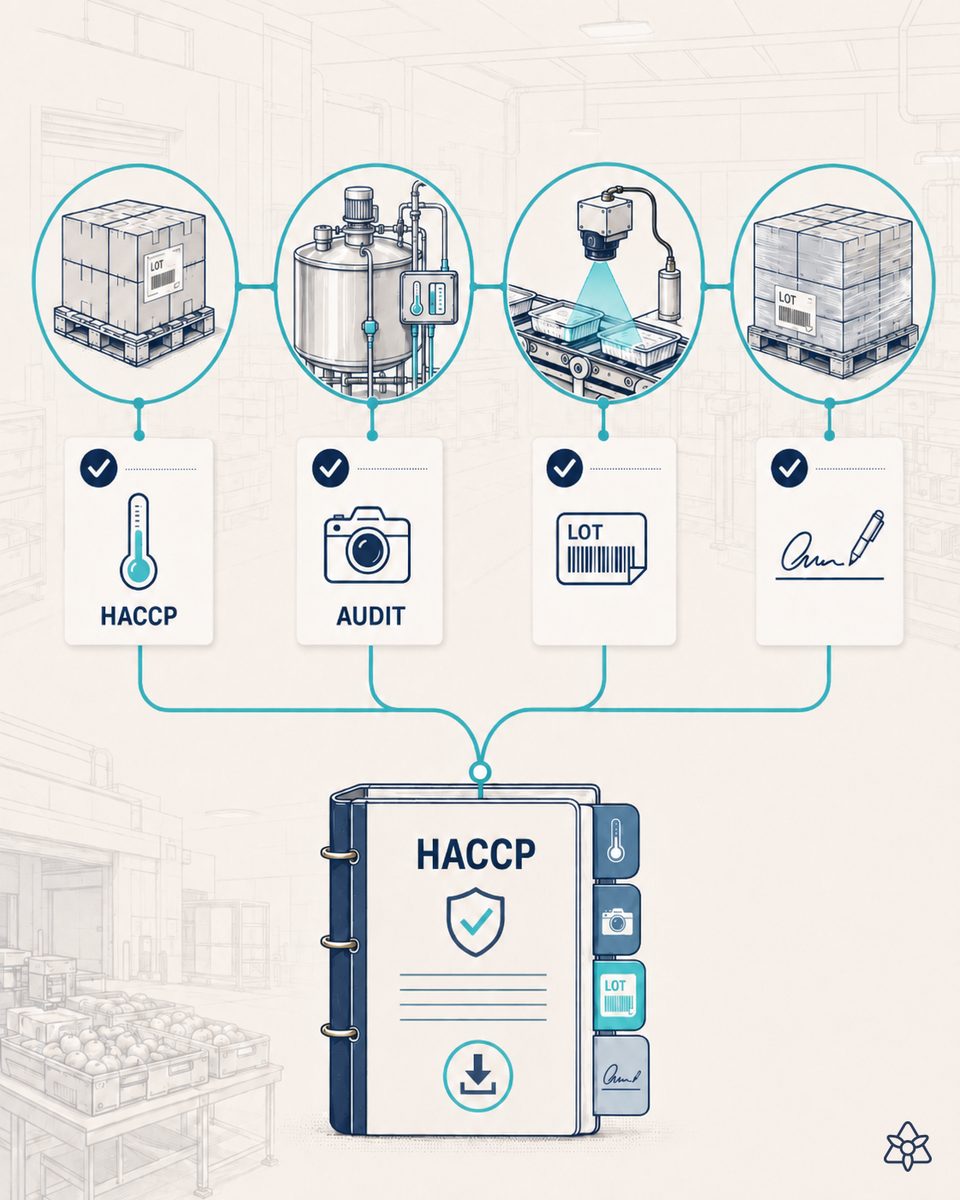
Welfare happens every single day, the data lives across 40 farms, and the dossier is rebuilt the day before.
A poultry integrator working with several dozen family farms faces the same pattern in every batch:
- The environmental sensor in the house records temperature, humidity, ammonia and CO₂ locally; very often it never even reaches the ERP.
- The feed scale is connected to the feed manufacturer's system, not the integrator's.
- The grower writes down daily mortality, observations and any management event in a notebook or a messaging-app thread.
- The integrator's vet visits the house once or twice per batch — and the photo taken on their phone is seen by nobody until it lands in the ERP.
- The processing plant contributes live weight, transport mortality and post-mortem inspection findings (footpad dermatitis, hock burn) in yet another system.
On Welfair audit day, someone at the integrator rebuilds five spreadsheets by cross-checking phone calls, messaging-app photos and paper tickets — only to discover, far too often, that the data now needed was never recorded. The classic system works 99% of the time. That 1% is what loses the rating, and with it a retail channel.
iLEAN Tracer doesn't add one more system for the grower — it seals the cracks between the ones you already have.
The problem in broiler is not a lack of data: the environmental sensors, the feed scale, the grower's notebook, the vet's phone and the processing plant's ERP all have the information. The problem is that it lives in five heterogeneous islands, spread across dozens of farms, and on audit day nobody has time to cross-check them. Tracer is the filler that closes those gaps, without asking you to change your ERP, your sensors or the feed manufacturer's system.
Edge samples vision in the house. Connect captures sensors, scales and notebooks. The agent stitches the five events per batch against the Welfair protocol and signs the dossier. The person validates.
The three iLEAN pieces applied to multi-farm broiler welfare:
- Edge — a terminal with vision (CNN) in the house for periodic sampling: real stocking density, flock gait (gait score), presence and use of environmental enrichment, mortality hotspots. It works without a network — on a farm, connectivity comes and goes, and Edge keeps recording and processing on the power from the panel.
- Connect — captures the environmental sensors via API or serial port, the feed scale tickets (printed ticket → photo → data), the grower's notebook (photo + transcribed voice) and the vet's messages. And it captures on the side whatever arrives as a retailer email or an integrator technical note.
- Agent — stitches the indicators per house and per batch against the Welfair protocol, flags deviations while they can still be corrected (not at the end of the batch) and generates the auditor-ready welfare dossier per farm and per batch. If an indicator drifts, it raises the flag to the vet and the technical director before the batch closes.
Manual Welfair documentation vs. a per-batch dossier with iLEAN Tracer
| Aspect | Sensors + notebooks + messaging apps | With iLEAN Tracer |
|---|---|---|
| Welfair indicators per batch | Rebuilt the day before the audit | Live throughout the batch, per house |
| Detection of welfare deviations | At batch close or at the processing plant | While they can still be corrected on farm |
| Multi-farm coverage | Limited to the vet's visits | Continuous, with vision sampling and sensors |
| Dossier for the Welfair auditor | Five spreadsheets rebuilt by hand | Per-farm, per-batch dossier, signed |
| Passport to the retailer's shelf | The integrator's summary sheet | Indexable per-batch dossier, with signed data |
| Workload on the grower | Notebook + apps that duplicate work | Their usual notes, collected by Connect |
Impact estimate for your plant — to be validated with your numbers.
The block below is an estimate to be validated with the specific data from your farms and your batches. We set it out so the committee has an order of magnitude; we refine it during the diagnostic.
- Poultry integrator with 30-80 family farms, standard and/or slow-growing broiler, European retailers demanding Welfair or an equivalent as a condition of channel access.
- Tracer pilot on 3-5 pilot farms (environmental sensors + Edge for vision sampling + Connect against the integrator's ERP, the feed scale and the grower's notebook + Welfair agent). First value expected within a few weeks.
- Indicative payback between 5 and 9 months, depending on the number of batches per farm per year and the cost of a documented Welfair incident in recent years.
- The hard lever is a single batch held on the shelf, avoided + the reduction in vet time spent rebuilding spreadsheets (which goes back into field management). Expected reduction in audit time ≥ 30%.
And the technical director's reasonable doubt
«What if the AI gets it wrong and gives me a badly measured stocking density?» — hallucination is a problem of free generation, not of anchored tasks. In tasks where the AI limits itself to counting and to recontextualising data from a sensor into a dossier, the best models brought the error below 1.5%[1]. And even so, the dossier only goes out with a human signature: the vet and the technical director validate before anything reaches the Welfair auditor.
[1] OpenAI paper «Why Language Models Hallucinate», 2025 — on the reliability of AI in anchored tasks.
What people ask about Welfair welfare in broiler chicken
What does the Welfair / Welfare Quality protocol require in broiler chicken?
Welfair (an IRTA/INRAE certification based on Welfare Quality®) assesses broiler welfare across four principles — feeding, housing, health and behaviour — with objective indicators: stocking density, litter quality, cumulative mortality, gait score, footpad dermatitis, hock burn and the presence of environmental enrichment. The audit is carried out farm by farm, and the rating travels with the batch all the way to the retailer's shelf. Tracer does not reinvent the protocol: all it does is stop the data getting lost between the farm, the integrator and the processing plant.
Why does Welfair documentation fail on audit day?
Because the data lives on different farms — the environmental sensor in one house, the feed scale in another, daily mortality in the grower's notebook, live weight on the processing plant ticket. On audit day, someone at the integrator rebuilds spreadsheets by cross-checking phone calls, messaging-app photos and paper tickets. The classic system works 99% of the time — and that 1% is what loses the rating, and with it a retailer.
How does Tracer document Welfair indicators across multiple farms?
Connect captures the environmental sensors (temperature, humidity, ammonia, CO₂), the feed scale, the intermediate weighings and the grower's notebook — whether they arrive via a modern API, a printed ticket or a photo. Edge in the house runs vision sampling (stocking density, flock gait, presence of enrichment). An agent cross-checks everything against the Welfair protocol and generates, per farm and per batch, a welfare dossier with the objective indicators signed off. The vet and the technical director sign; nothing reaches a retailer without a human signature.
Does Tracer replace the poultry integrator's vet?
No. Tracer is the logbook the vet never had — the reality of every house, in real time, without having to drive around 40 farms with a notebook and a camera. It gives back the time that today goes into rebuilding spreadsheets so it can be spent on what only the vet can do: decide, train the grower, adjust management. The integrator's technical director stops discovering a problem at the end of the batch — they see it while it is still manageable.
What does it cost to get started with Tracer in a poultry integrator?
The order of magnitude of a Tracer pilot in a poultry integrator is close to that of any Tracer pilot in a plant: environmental sensors in one house + one Edge terminal for vision sampling + integration with the integrator's ERP and the feed scale + annual licence. A reasonable payback to present to the committee is a matter of several months — the hard lever is a single batch held on the shelf because of a Welfair incident, where losing a retail channel weighs more than the whole investment. We ask for your farm and batch data and send you the estimated ROI within 48h, using your numbers, not ours.
More cases in ilean tracer
- CAR-T against B-cell lymphoma — the cell is the patient and the window cannot be repeated.iLEAN Tracer syncs apheresis, cell bank and infusion in CAR-T against B-cell lymphoma — the critical…
- The ISCC mass balance is not reconciled at month end: it is reconciled tanker by tanker.iLEAN Tracer captures every tanker load and unload with its delivery note and keeps the ISCC mass…
- Unit-of-use blister in hospital dispensing — a bedside medication error is not an incident, it is a preventable adverse event.iLEAN Tracer secures the unit-of-use blister in hospital dispensing with bedside patient-medication…
- A PDO wheel is not one link in a batch — it is a unique asset with its own history.iLEAN Tracer assigns a code to every PDO cheese wheel on the rind itself and rebuilds its sanitary and…
- A cosmetic cream batch is a tree — and hand-drawn trees break at the first complaint.iLEAN Tracer builds the full genealogy of a cosmetic cream batch: master mixes, pH adjustments, bulk and…
- The drying-house batch groups thousands of pieces that share no history — and one problem puts them all on hold.iLEAN Tracer assigns an ID to every cured ham from salting to labeling and rebuilds its full history…
Tell us your case and within 48h we'll send you the estimated ROI of Tracer for your multi-farm broiler integrator.
We work on the real data from your farms and your batches, not on ours. Diagnostic with no commitment.
Request estimated ROI in 48h See Tracer