Unit-of-use blister in hospital dispensing — a bedside medication error is not an incident, it is a preventable adverse event.
Patient ↔ dose traceability in hospital dispensing is the last line of defence against medication error. iLEAN Tracer cross-checks the patient wristband, the unit-of-use blister and the active prescription in the HIS right at the bedside — if there is a mismatch (patient, dose, allergy, time window), the system holds the administration and raises an alert. The nurse validates — the system does not administer for her.
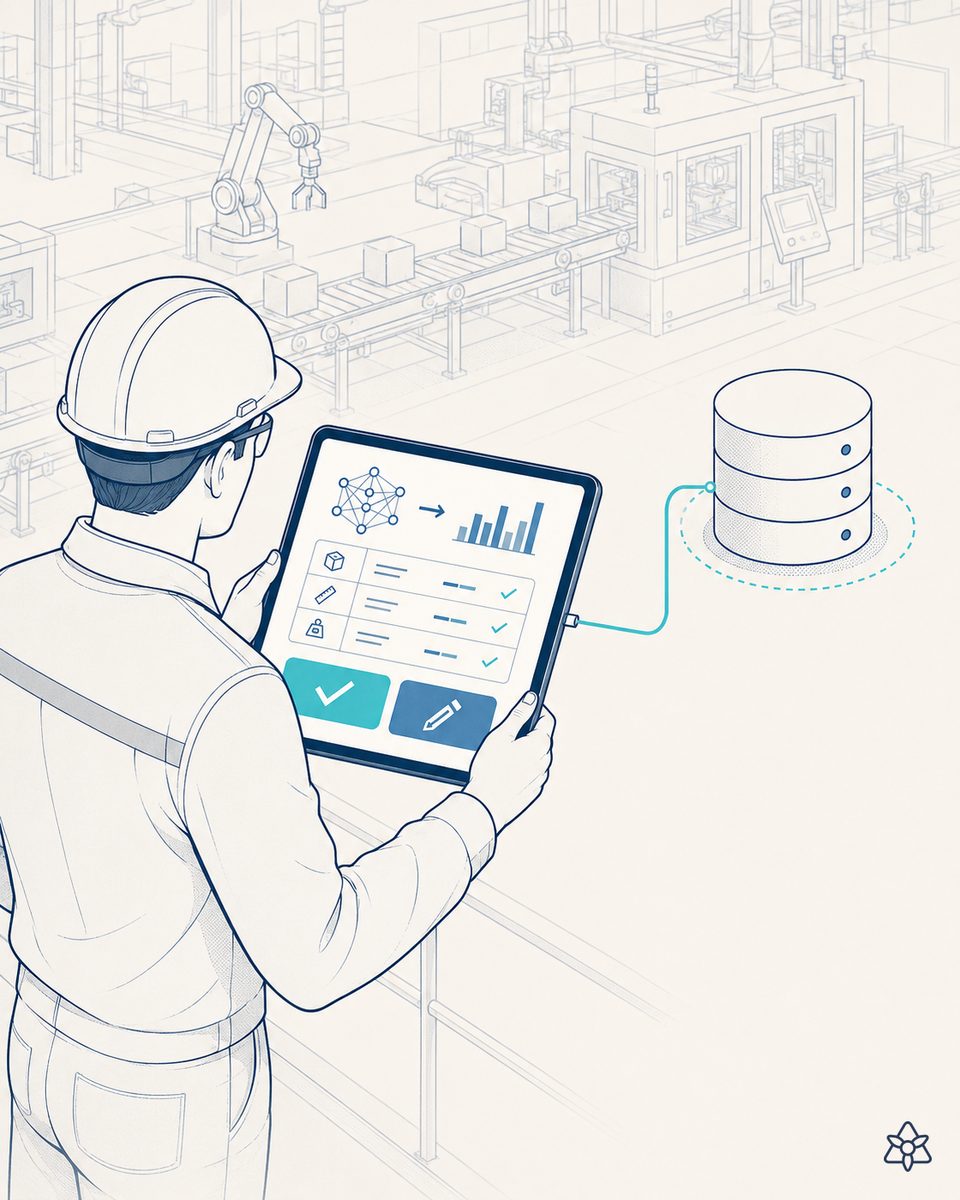
The medication error is not born in the blister — it is born in the cross-check nobody makes in real time.
In a modern inpatient ward, dispensing oral medication touches at least three systems and three people:
- The hospital pharmacy department — repackages unit-of-use blisters with the patient information, dose and time window.
- The HIS and e-prescribing — living in systems such as Cerner, Epic, SAP IS-H or a European vertical package. They know what was prescribed, when and for whom.
- The nurse at the bedside — with the patient wristband in front of her, the blister in her hand and, until recently, a printed sheet with the shift schedule.
The classic problem is not bad practice: it is the cross-check of three realities that rarely happen at second zero. The blister that came from pharmacy left correct, but the patient changed room; the prescription was modified after a specialist's review and the printed plan went stale; the allergy was documented in the record but never reached the blister. The classic system (paper + eye + checklist) works the vast majority of the time — and the remaining minority is what ends in a documented near-miss, a reported wrong administration or, at worst, a preventable adverse event. Granular patient ↔ dose ↔ moment traceability is the last net.
iLEAN Tracer is not a new HIS — it seals the gap between pharmacy, prescription and the bedside.
Patient-medication verification is not a problem of new technology: the HIS knows the prescription, the blister carries the DataMatrix, the wristband identifies the patient. The problem is that those three data points are not cross-checked in real time at the critical moment. iLEAN Tracer is the piece of the IRIS category that seals that gap — without asking you to change the HIS, the e-prescribing system or the pharmacy repackaging station.
Edge sees the wristband and the blister. Connect reads HIS and prescription wherever they live. The agent cross-checks patient + dose + allergy + window. The nurse signs — the system does not administer for her.
How the work is split between the iLEAN pieces for this case:
- Edge — the tablet/reader the nurse already uses, with vision and scanner. Reads the wristband and the blister DataMatrix in seconds. Works without network: if the inpatient ward loses WiFi, Edge keeps verifying against the last cached prescription and syncs when it comes back.
- Connect — captures the active prescription from the HIS (HL7/FHIR), the list of documented allergies, the nursing shift plan and blister traceability from the pharmacy repackaging station. It also captures what arrives from outside (a prescription change sent by the specialist as a message, a patient transfer between rooms) at second zero.
- Tracer agent — cross-checks patient + blister + prescription + allergy + time window. On a mismatch it holds the administration and alerts the nurse through the tablet and, where applicable, the on-call pharmacist. The nurse validates and signs; the administration never records itself.
Classic verification vs. patient-medication verification with iLEAN Tracer
| Aspect | Medication cart + checklist | With iLEAN Tracer |
|---|---|---|
| Patient identification | Bed + name + eye | Wristband scanned, cross-checked with HIS |
| Dose identification | Blister label | Unit-of-use DataMatrix cross-checked with prescription |
| Documented allergy | Clinical record on another screen | Cross-checked automatically, held on a match |
| Prescription change | Verbal handover / stale paper | Connect captures the change at second zero |
| Time window | Estimated by shift | Validated by the agent, signed |
| Operation without network | n/a | Edge keeps verifying with local cache |
Impact estimate for your plant — to be validated with your numbers.
The block below is an estimate to be validated with the department's actual data. We put it forward so the committee has an order of magnitude; we refine it during the diagnostic.
- Hospital with a pharmacy department that repackages unit-of-use blisters, HIS and e-prescribing live, one or two pilot inpatient wards.
- Tracer pilot on one ward (tablets/readers already in use + HIS integration via HL7/FHIR + integration with the repackaging station). First expected value in a few weeks: the first administration held on a mismatch (transferred patient, modified prescription).
- Indicative payback between 4 and 9 months, depending on the documented frequency of near-misses and the average cost associated with a preventable medication adverse event.
- Expected reduction in documented medication near-misses of ≥ 30% in the first year. The hard lever is a single preventable adverse event held — the clinical metric and the human cost outweigh the licence by a wide margin.
And the fair doubt of the hospital pharmacy manager
«What if the AI gets it wrong and blocks a valid administration?» — hallucination is a problem of free generation, not of anchored tasks. Cross-checking wristband + blister + prescription + allergy is exactly an anchored task, where the best models brought error below 1.5% [1]. And even so, nothing critical is administered on its own: Tracer holds and the nurse validates. The three iLEAN security rings are designed precisely so that identifiable clinical data is only acted upon after validation with a signed identity — GDPR and medical confidentiality included.
[1] OpenAI paper "Why Language Models Hallucinate", 2025 — on the reliability of AI in anchored tasks.
What people ask about unit-of-use blisters in hospitals
What is a unit-of-use blister in hospital dispensing?
A unit-of-use blister is the minimum pack labelled with everything needed to administer one dose to one specific patient — patient identification code, active ingredient, dose, route, date and time window, prescriber identity. It replaces the classic medication cart with loose doses and the practice of manually repackaging in the pharmacy department. Granular patient↔dose traceability is the pillar for reducing medication errors, still one of the most documented causes of preventable adverse events in European hospitals.
How does iLEAN Tracer verify the patient-medication match at the bedside?
Tracer cross-checks three data points at the moment of administration: the patient code (wristband, badge), the unit-of-use blister (DataMatrix with active ingredient + dose + batch + prescription identifier) and the active prescription in the HIS / electronic health record. The nurse scans wristband and blister with the tablet or the reader; the agent confirms the match in milliseconds and records the administration. If there is a mismatch — wrong patient, wrong dose, documented allergy, time window out of sequence — the system holds the administration and raises an alert. The nurse validates — the system does not administer for her.
Do we have to replace the hospital HIS or the e-prescribing system?
No. iLEAN Tracer lives alongside, not inside. It reads the active prescription through whatever integration the HIS already has (HL7, FHIR, proprietary API) and sends the administration confirmation back through the same channel. If the pharmacy department repackages unit-of-use blisters, Tracer integrates that repackaging station (Tosho, Baxter, Swisslog, Omnicell or whichever) under the same IRIS filler principle. You throw nothing away: you fill the gaps between hospital pharmacy, the HIS and the moment of administration at the bedside.
What about patient privacy (GDPR, medical confidentiality)?
It is a hard constraint, not a nice-to-have. iLEAN applies the three security rings with progressive trust: identifiable clinical data lives in the inner ring (the hospital OT network, isolated), the agent that cross-checks patient-medication lives in the intermediate ring with validation, and bedside event capture (badge, scan) passes through signed validation before touching the HIS. The revocation unit is the hospital (asymmetric key per installation). It complies with GDPR and with clinical frameworks on data minimisation and user identity in critical events.
What does patient-medication verification with iLEAN Tracer cost in a hospital?
The order of magnitude of a Tracer pilot in a hospital department is close to that of any Edge+Connect+Agent pilot in clinical pharma — tablet/reader per administration point, integration with HIS and e-prescribing, library of signed events. Reasonable payback sits in the range of several months; the hard lever is a single wrong administration avoided with clinical consequence — the human and legal cost of a preventable adverse event weighs far more than the licence. Send us the department's data and we return the estimated ROI in 48h.
More cases in ilean tracer
- Allogeneic TCR-T — one donor, several doses, several patients and a single custody chain.iLEAN Tracer keeps the custody chain of an allogeneic TCR-T donor with several recipients — one batch,…
- CAR-T against B-cell lymphoma — the cell is the patient and the window cannot be repeated.iLEAN Tracer syncs apheresis, cell bank and infusion in CAR-T against B-cell lymphoma — the critical…
- The ISCC mass balance is not reconciled at month end: it is reconciled tanker by tanker.iLEAN Tracer captures every tanker load and unload with its delivery note and keeps the ISCC mass…
- Broiler chicken — Welfair welfare is earned every day, and the audit collapses if the data isn't there.iLEAN Tracer documents the Welfair welfare of every broiler chicken batch with multi-farm metrics —…
- A PDO wheel is not one link in a batch — it is a unique asset with its own history.iLEAN Tracer assigns a code to every PDO cheese wheel on the rind itself and rebuilds its sanitary and…
- A cosmetic cream batch is a tree — and hand-drawn trees break at the first complaint.iLEAN Tracer builds the full genealogy of a cosmetic cream batch: master mixes, pH adjustments, bulk and…
Tell us about your case and in 48h we'll send you the estimated ROI of this AI project for your hospital department.
We work on the department's real data, not on ours. Diagnostic with no commitment.
Request estimated ROI in 48h See iLEAN Tracer