The ISCC mass balance is not reconciled at month end: it is reconciled tanker by tanker.
ISCC requires you to prove that the sustainable volume leaving your tank does not exceed what came in, with the documentary chain of every tanker behind it. iLEAN Tracer captures every load and every unload in the moment — photo of the delivery note, sustainability declaration, density and point of origin —, keeps the balance live per tank and period, and compiles the ISCC dossier with the evidence of every movement. A person validates the doubtful movements.
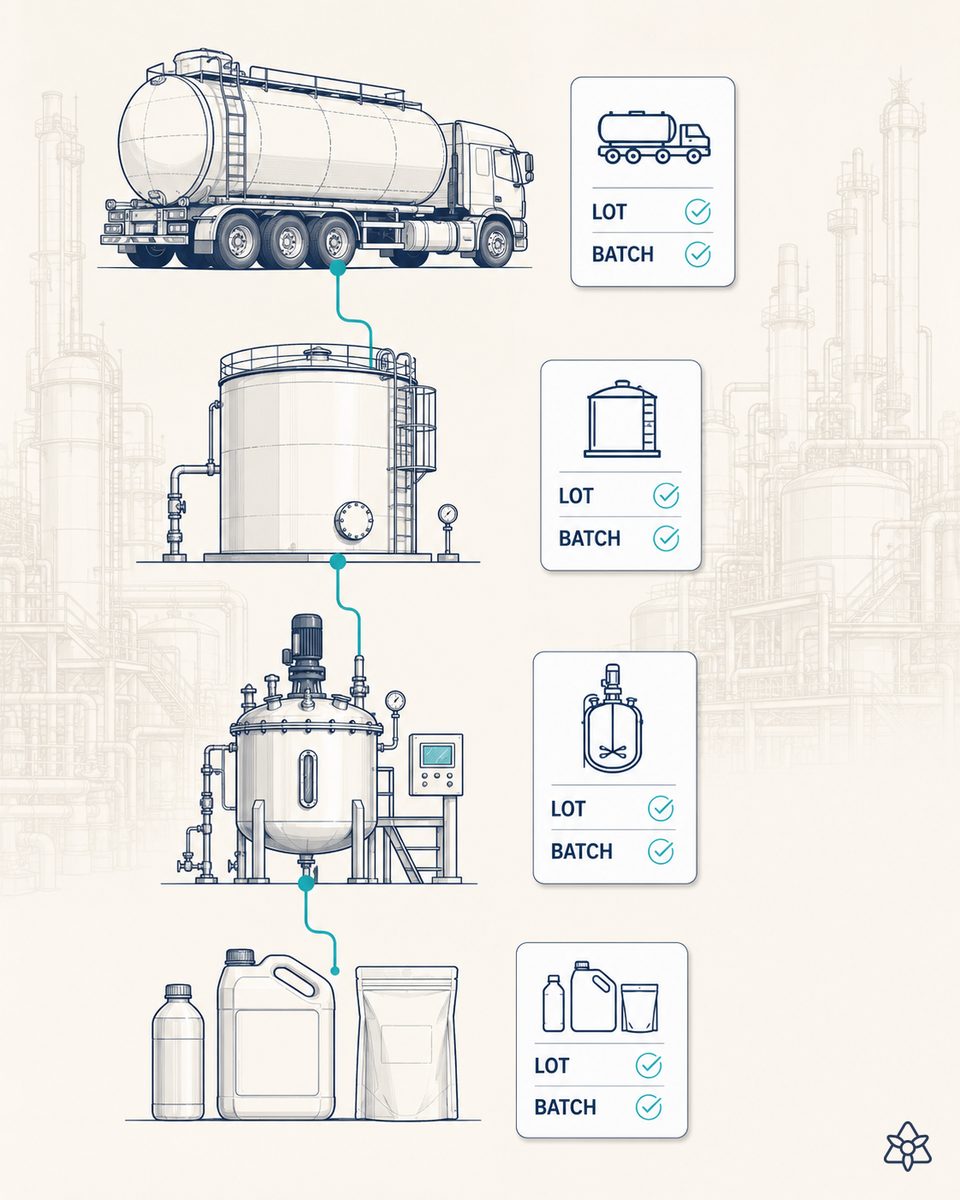
The balance lives in a spreadsheet only one person understands.
In most biodiesel and blending plants, the real circuit is this: the tanker comes in, the weighbridge operator files the delivery note in a folder, someone writes the volume on a sheet, and at month end the sustainability manager sits down to reconcile sustainable inflows and outflows tank by tank. They rebuild densities, hunt for missing sustainability declarations, call the supplier about a loading-point detail and adjust until the balance closes.
- The close: two or three days a month of an expensive person's time reconstructing movements that already happened, with the information scattered between weighbridge, ERP, supplier email and a folder of scans. When a data point is missing, the truck left three weeks ago and there is no one left to ask.
- The accounting risk: if an outbound movement was issued as sustainable against a balance that was not actually there, it is not discovered in the moment — it is discovered at the close, or worse, in the audit. Redoing declarations already delivered to a customer is a commercial problem, not just an administrative one.
- The ISCC audit: the auditor does not audit the tank, they audit the documentary traceability. They pick an outbound movement at random and want to see the inbound movements that support it, with their sustainability declaration, their feedstock and their origin. If that has to be reconstructed, it gets reconstructed over the weeks before they arrive.
The spreadsheet works most of the time. The problem is that it only works backwards — when you can no longer correct anything, only justify it.
iLEAN Tracer is the filler between the weighbridge, the tank farm and the ISCC dossier.
The plant already has almost all the data — the problem is that each data point lives on an island: the weighbridge with the weight, the delivery note on paper inside the truck cab, the sustainability declaration in the purchasing inbox, the tank level in the SCADA and the balance in a spreadsheet. iLEAN Tracer does not ask you to change anything. It sits on top and joins what already exists around each tanker movement.
Connect captures the delivery note with the truck still in the yard. Edge cross-references weighbridge and tank. The agent keeps the balance live. The person validates the doubtful movements — never the other way round.
The iLEAN pieces applied to the ISCC mass balance per tanker:
- Connect at weighbridge and yard — the operator photographs the delivery note and the sustainability declaration from the terminal or a phone. The system extracts license plate, supplier, document number, feedstock, volume, density, temperature and loading point, and requests on the spot whatever is missing. A data point requested with the truck in front of you costs thirty seconds; the same data point three weeks later costs a call to the supplier and a week of waiting.
- Edge at the transfer point — cross-references the weighbridge ticket, the flow-meter reading and the destination tank against the open order, and closes the movement with its evidence. If the connection to the ERP drops, the Edge keeps recording locally and syncs when the network comes back: a tank farm cannot depend on coverage to release a truck.
- Mass-balance agent — maintains, for each tank and each period, sustainable inflows, issued outflows, available balance and volume-to-mass conversions using the declared density. It flags the movement that would push the balance negative before the outbound document is issued, proposes the allocation when the tank combines feedstocks with different profiles, and leaves the ISCC dossier compiled with the evidence attached to each entry. Anything doubtful is raised for a person to validate and sign.
Mass balance in a spreadsheet vs. a live balance with iLEAN Tracer
| Aspect | ISCC mass balance in a spreadsheet | With iLEAN Tracer |
|---|---|---|
| Moment of capture | After the fact, at the monthly close | At the movement, with the truck in the yard |
| Evidence per tanker | Delivery note in a folder, declaration in email | Photo, extracted data and signature on the entry |
| State of the sustainable balance | Known at month end | Live per tank and period, in the moment |
| Outbound that would go negative | Caught while reconciling, already issued | Flagged before the document is issued |
| Volume-to-mass conversion | Density estimated or redone by hand | Density declared per load, documented |
| ISCC audit preparation | Weeks of documentary reconstruction | Dossier compiled, reverse traceability ready |
| Operation without network in the yard | n/a | Edge records locally and syncs later |
Impact estimate for your plant — to be validated with your numbers.
The block below is an estimate to be validated with the specific data of your plant. We put it forward so the committee has an order of magnitude; we refine it during the diagnostic.
- Plant with several ISCC-certified tanks and dozens of tanker movements per week between loading and unloading. Documentary capture at weighbridge and yard + a live balance per tank as a pilot.
- First value expected within a few weeks: the first period close done on movements already captured, with no reconstruction, with the evidence attached to each entry.
- Indicative payback between 4 and 9 months, depending on the number of movements, the hours the monthly close consumes today and the effort spent preparing the ISCC audit.
- Hard levers: monthly close days eliminated by not reconciling the balance in a spreadsheet; weeks of audit preparation replaced by an already-compiled dossier; incomplete sustainability declarations caught in the yard, not at the close.
And the sustainability manager's reasonable doubt
“What if the AI misreads a delivery note and throws my balance off?” — hallucination is a problem of free generation, not of anchored tasks. In tasks where the AI merely extracts a data point that is written on a document and cross-references it with the order and the weighbridge ticket, the best models brought error below 1.5% [1]. And even so, what is critical is never decided alone: when the extracted data does not match the order, the weighing or the tank balance, the movement is raised as doubtful and a person validates it before it enters the balance. The agent proposes, the person signs.
[1] OpenAI paper “Why Language Models Hallucinate”, 2025 — on the reliability of AI in anchored tasks.
What people ask about the ISCC mass balance per tanker
What exactly does ISCC certification require in the mass balance?
ISCC allows sustainable and conventional product to mix physically in the same tank, but requires that the accounting never mix: over a defined period, the sustainable volume going out cannot exceed what came in, and every inbound movement must be backed by a supplier sustainability declaration with its feedstock, its origin and its emission values. The balance is kept per storage point and per period, with documented conversions between liters and metric tons based on density and temperature. What gets audited is not the tank: it is the documentary chain behind every entry in the balance.
How is each tanker captured at loading and unloading?
At the moment of the movement, not afterwards. The weighbridge or tank-farm operator takes a photo of the delivery note and the sustainability declaration with the terminal; iLEAN Tracer reads the license plate, delivery note number, supplier, feedstock, volume, density, temperature and loading point, and cross-references it with the order and the weighbridge reading. Whatever the document does not carry is requested at that instant, with the truck still in the yard, which is the only moment when it can be corrected. The entry is closed with photo, time, destination tank and the person who validated it.
How does a live mass balance per tank and period work?
Every validated movement hits the balance the moment it happens, not at month end. For each tank and each period, the system maintains sustainable inflows, sustainable outflows, available balance and physical stock, with volume-to-mass conversions made using the declared density of each load. If an outbound movement would push the sustainable balance negative, the system flags it before the outbound document is issued, not once the month is already closed. The close stops being a three-day reconstruction in a spreadsheet and becomes a review of the movements that were flagged as doubtful.
What happens when the tank mixes sustainable and conventional product?
That is exactly what the mass balance allows and what the system models. Physically the tank is a single blend; in the accounting there is a sustainable balance with its feedstock, its origin and its associated emission value. When a tanker leaves, a decision is made on how much of that outbound volume is issued as sustainable against the available balance, and that decision is recorded with its justification. If the blend combines feedstocks with different profiles, the agent proposes the allocation consistent with the balance and with the scheme's rules, and the person validates it before the declaration is issued to the customer.
What does the ISCC auditor see when they arrive at the plant?
They see the dossier already compiled: the period's balance per tank, and behind every entry the movement that generated it — scanned delivery note, supplier sustainability declaration, weighbridge ticket, density, loading point, time and the signature of whoever validated it. When they ask for the reverse traceability of a specific outbound movement, the chain back to the inbound movements that support it is already built, not reconstructed in front of them. The practical difference is no longer spending weeks preparing the audit and answering in the room with the evidence on screen.
More cases in ilean tracer
- Heat lot per aluminum sub-coil — losing the melt is not an administrative slip, it is product without a certificate.How iLEAN Tracer keeps the heat lot per sub-coil when an aluminum pallet is slit for several customers,…
- Allogeneic TCR-T — one donor, several doses, several patients and a single custody chain.iLEAN Tracer keeps the custody chain of an allogeneic TCR-T donor with several recipients — one batch,…
- CAR-T against B-cell lymphoma — the cell is the patient and the window cannot be repeated.iLEAN Tracer syncs apheresis, cell bank and infusion in CAR-T against B-cell lymphoma — the critical…
- Unit-of-use blister in hospital dispensing — a bedside medication error is not an incident, it is a preventable adverse event.iLEAN Tracer secures the unit-of-use blister in hospital dispensing with bedside patient-medication…
- Broiler chicken — Welfair welfare is earned every day, and the audit collapses if the data isn't there.iLEAN Tracer documents the Welfair welfare of every broiler chicken batch with multi-farm metrics —…
- A PDO wheel is not one link in a batch — it is a unique asset with its own history.iLEAN Tracer assigns a code to every PDO cheese wheel on the rind itself and rebuilds its sanitary and…
Tell us your case and in 48h we'll send you the estimated ROI of iLEAN Tracer for your ISCC mass balance.
We work on your plant's real data, not ours. Diagnostic with no commitment.
Request estimated ROI in 48h See Tracer