Analog panel capture on the pasteurizer — the CCP that lives on a needle, now in the system.
The old pasteurizer has no digital output — the HACCP CCPs for temperature and pressure are written down by hand by the operator. iLEAN Connect captures a photo of the panel every minute, reads the needles and ingests the record as continuous data. A person signs the batch closure; the CCP is never left without a trace.
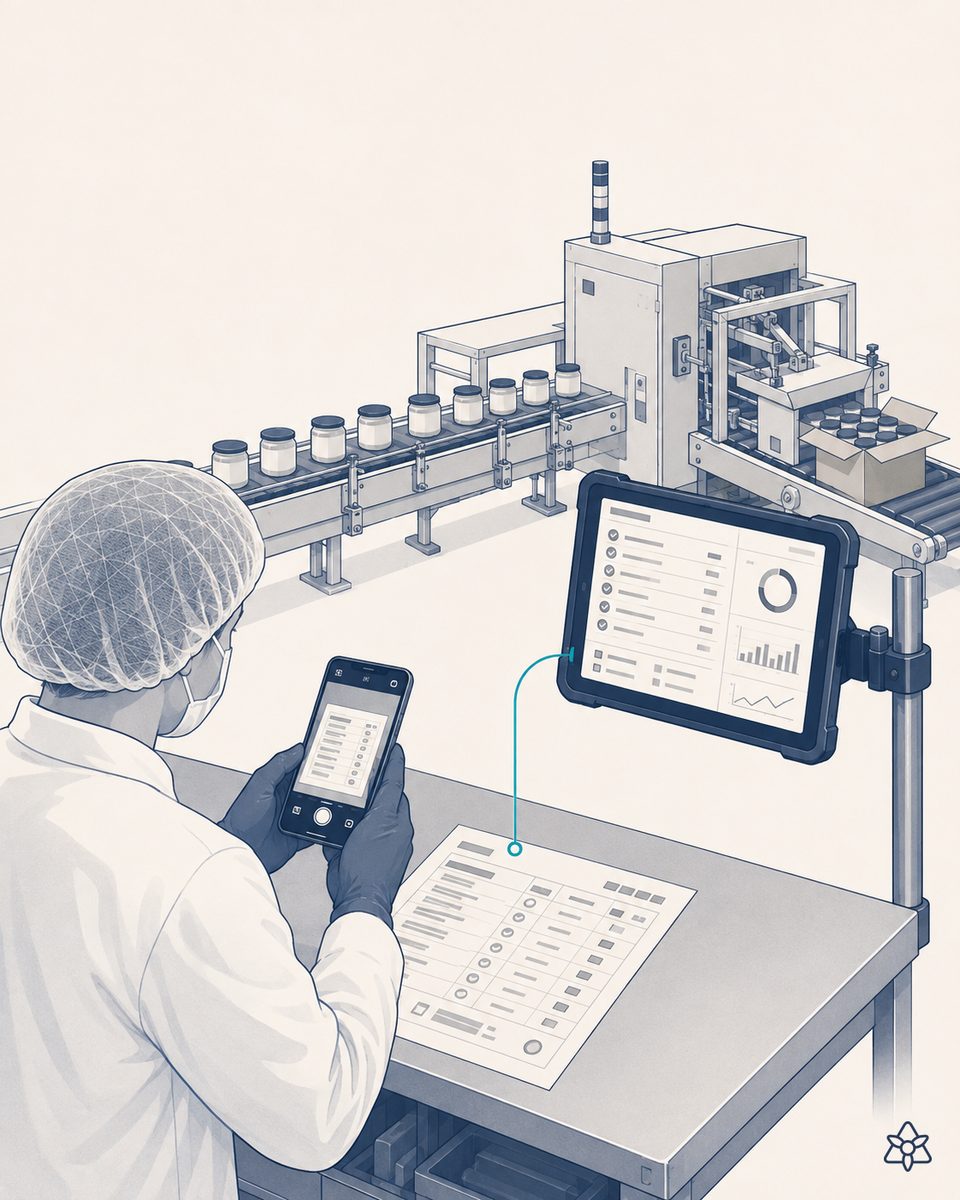
A machine that works perfectly — and a CCP that lives on a paper sheet.
The HTST pasteurizer in many dairy plants has been doing its job for twenty years or more. We replace it with a new one the day it breaks, not before. The problem is not the machine: the problem is the data. The HACCP CCP for pasteurization temperature and differential pressure lives on two needles — a pressure gauge and a thermometer — that the operator writes down every half hour on a sheet taped to the panel.
Three consequences that hurt when the auditor arrives:
- A discrete record where the standard asks for continuity: between two manual readings there are thirty minutes in which the CCP is invisible to the system, even if the operator really was watching.
- Weak traceability: the sheet is filled in by a person — if on audit day the handwriting is hard to read or a page is missing, the batch is left hanging.
- "I'm not integrating that machine because it costs more than it's worth": instrumenting the pasteurizer with 4-20 mA transmitters and wiring it to the SCADA is a serious project, with equipment downtime and certification. That is why nobody does it.
And this is where the rules of the game change.
iLEAN does not change the pasteurizer — it puts a camera in front of it.
The excuse "I'm not integrating it because it costs more than it's worth" has expired. If there is one thing AI does exceptionally well, it is recontextualising information from one format to another — reading a needle on a fixed scale and depositing the value in a system field. That is the manual capture tier Connect offers for machines without digital output: a camera in front, periodic reading, data in the system. It is the filler between the old equipment that keeps working and the HACCP plan that demands a continuous record.
Connect reads the needle. The Agents validate the CCP curve. The quality manager signs the batch closure. The pasteurizer is still the same one it always was — the data, however, is not.
The iLEAN pieces applied to the pasteurizer's analog panel:
- Connect (manual capture tier) — a fixed bracket with a camera (or an industrial tablet) facing the panel, capturing every 30-60 s. An anchored network recognises the needle position on the scale and delivers temperature and pressure as structured data. Without stopping the machine. Without touching the control settings.
- Middle ring — the data enters the outer ring fast; a pool of Agents validates that the curve makes physical sense (no impossible jumps), applies the thresholds of the customer's HACCP plan and packages the signed record for the critical system.
- Agents + Central (evidence pack) — at batch closure, the Agents prepare the CCP curve, the deviations and the corrective actions taken. The quality manager validates the curve and signs; the trace stays in the system with name, time and batch. An IFS/BRC auditor gets a coherent dossier — with no automatic attribution.
Handwritten sheet vs. continuous capture with iLEAN
| Aspect | Manual reading + paper sheet | With iLEAN Connect (manual capture tier) |
|---|---|---|
| CCP frequency | Every 30 min, if the operator is there | Every 30-60 s, continuously |
| Touching the machine | No (but data is missing) | No — just a camera in front of it |
| Installation cost and lead time | Zero — and a huge blind spot | Low — bracket + camera + integration |
| Deviation detection | Whenever someone spots it on the sheet | Immediately, with an alert to the manager |
| Quality manager sign-off | At the end of the shift, on paper | At batch closure, on the curve |
| Evidence pack for the auditor | Rebuilt from a scanned sheet | Curve + panel photo + signature, automatic |
Impact estimate for your plant — to be validated with your numbers.
The block below is an estimate to be validated with the actual data of your plant. We put it forward so the committee has an order of magnitude; we refine it during the diagnostic.
- A cheese plant with an HTST pasteurizer without digital output, a panel with analog pressure gauge and thermometer, and the HACCP CCP on a paper sheet today.
- Connect pilot on one pasteurizer (bracket + camera + integration with the customer's HACCP plan + automatic evidence pack). First value expected within a few weeks.
- Indicative payback between 4 and 9 months, depending on the hours per shift spent today on manual record-keeping and the cost of a batch held back for insufficient traceability.
- Reduction in time spent on manual record-keeping ≥ 30%. The underlying lever is not the hours saved: it is closing the batch file without surprises.
And the quality manager's reasonable doubt
"What if the AI misreads the needle one day and enters a made-up temperature?" — hallucination is a problem of free generation, not of anchored tasks. Reading the position of a needle on a fixed scale is exactly what AI does best; the leading models brought the error below 1.5%[1] on this kind of task. And even so, the middle ring validates the curve against the physical range, and the quality manager signs at closure. There is no record without a signature.
[1] OpenAI paper "Why Language Models Hallucinate", 2025 — on the reliability of AI in anchored tasks.
What people ask about analog panel capture on a pasteurizer
Does Connect really read analog needles reliably enough for HACCP?
Yes, within the tolerance margins of the panel itself. It is an anchored task (recognising a needle position on a fixed scale), not creative generation, and that is why reliability is high. Validation happens during the immersion phase, cross-checking the Connect reading against the operator's reading over several shifts until the margin is closed.
What is the advantage over buying a 4-20 mA transmitter and wiring it to the SCADA?
Cost and speed. A transmitter on an old pasteurizer means touching the equipment, stopping production and certifying the change. Connect does not touch the machine — it puts a camera in front of it. When the time comes to replace the pasteurizer, instrumented data will still be the right path; in the meantime, the CCP is logged continuously.
How often is the image captured?
Configurable according to the CCP. On HTST pasteurization, every 30-60 seconds more than covers the dynamics of the process. The frequency is decided during the immersion phase, based on the thresholds already defined in the customer's HACCP plan.
What happens if the camera gets dirty or loses its framing?
Connect detects it. A drop in contrast, a shift of the panel's fixed marker, different lighting — all of it triggers an alert to the maintenance manager long before the data stops being usable. The line never goes blind without somebody knowing.
How is this record signed off for the auditor?
Connect generates the record, but a person signs it. At batch closure, the quality manager validates the CCP curve and signs the file — the trace stays in the system with their name, time and batch. The three rings guarantee the auditor receives traceable evidence and not an automatic attribution.
More cases in ilean connect
- Windows NT screen in pharma packaging — read the HMI without touching the machine.iLEAN Connect reads the Windows NT HMI of a pharma packaging line by vision and pushes counts to your…
- Fill out the work order on paper. Your AI agents do the rest.Free printable work order form. Your techs fill it in by hand, snap a photo, and an AI agent reads it,…
- The chemical tank has a good pressure gauge — and its reading lives in a shift notebook.iLEAN Connect reads the analog pressure gauge of a chemical tank with a fixed camera and emits the…
- A ceramic tile that warps in the kiln is scrap — and the blame lies with the curve nobody cross-checked against the thermocouples.A fixed camera reads the analog panel of the Sacmi ceramic kiln; iLEAN Connect cross-checks…
- The aerospace OEM's CSR arrives as a 200-page Word file — and the plant reads it as a per-batch verifiable checklist.iLEAN Connect reads the aerospace OEM's Word CSR and turns it into a per-batch verifiable checklist on…
- API CoA email parser — from the supplier PDF to the batch record without retyping.iLEAN Connect captures the API CoA PDF arriving by email, extracts the specs and posts them to the…
Tell us about your case and within 48h we'll send you the estimated ROI of this AI project for your pasteurizer.
We work on the real data of your plant, not on ours. Diagnostic with no strings attached.
Request estimated ROI within 48h See iLEAN Connect