A ceramic tile that warps in the kiln is scrap — and the blame lies with the curve nobody cross-checked against the thermocouples.
The panel of the Sacmi ceramic kiln is still analog, and nobody is going to retrofit it while the line keeps producing good tile. But the day the curve drifts and nobody cross-checks it against the thermocouples in real time, a whole kiln load comes out as scrap. iLEAN Connect puts a fixed camera in front of the panel, reads the curve the way a person reads it, and an agent cross-checks it against the thermocouples to anticipate the warping with margin. A person signs off the correction — the kiln never applies it alone.
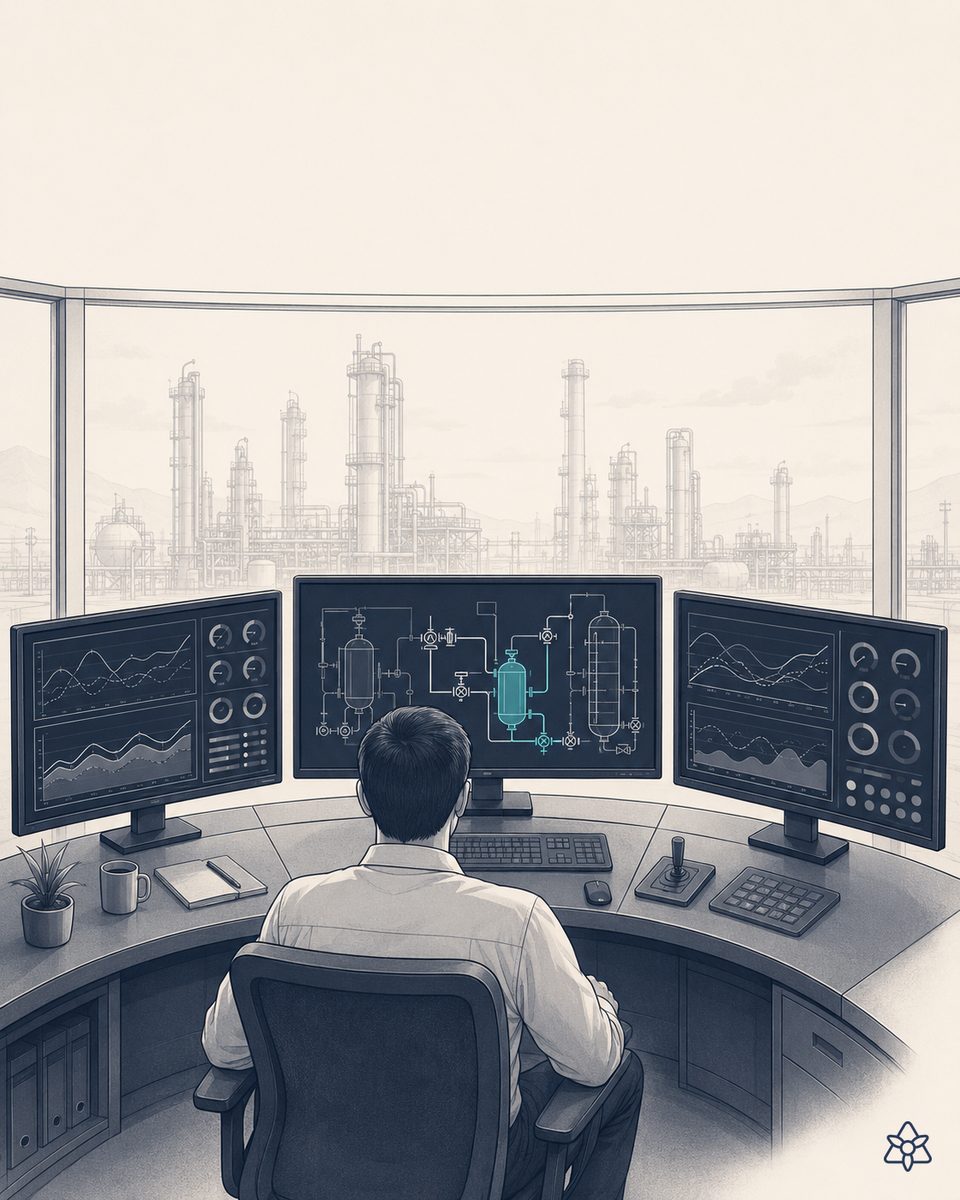
The kiln runs fine until a new format changes the stresses — and nobody was cross-checking the panel curve against the thermocouples.
A Sacmi ceramic kiln is one of those assets that costs hundreds of thousands of euros, lasts for decades and runs on an analog panel the firing manager reads at a glance. As long as the catalogue is stable and the curve is dialled in, the line produces good tile. The day a new size, a different glaze or a body with another expansion coefficient comes in, the balance breaks — and the tile leaves the kiln with internal stress that shows up later (when it hits the water in the polisher, when it is bevelled) as edge curl, crowning or a dished centre.
- The kiln curve and the thermocouples live in different systems. The kiln panel belongs to the firing manager; the thermocouples sit in the SCADA or in an add-on IoT layer. Nobody cross-checks them in real time.
- The defect only shows up later. By the time the tile reaches the polisher, the kiln load is already fired. A large-format tile cannot be reworked: it is scrap.
- The firing manager's knowledge walks out with him. He knows how to read the panel and anticipate — but that know-how never enters any system, and the day he retires, half the plant leaves with him.
This is not a kiln retrofit problem. Integrating the panel was always more expensive than the data. That has expired. AI changes the arithmetic: today the panel is read the way a person reads it and cross-checked against the thermocouples without touching the kiln control.
iLEAN does not ask you to retrofit the kiln — it puts a camera in front of the panel and cross-checks the thermocouples you already have.
Connect is the filler between the firing manager's trade and the loose data in the SCADA. It does not demolish the kiln or replace the panel: it fills the gap the SCADA left exposed. The capture grade is tuned to the specific kiln — manual with a fixed camera if the panel is purely analog, intermediate if it has an isolated digital output that can be read without touching the control.
The camera reads the panel. Connect captures the thermocouples. The agent cross-checks, learns the pattern and flags the deviation with margin. A person signs off the correction — the kiln still belongs to the trade.
The iLEAN pieces applied to the Sacmi ceramic kiln:
- Connect (manual grade) — fixed camera facing the analog panel. Cyclic capture of the curve exactly as the firing manager sees it. If the kiln has a small digital output, however old, Connect reads that too (intermediate grade). No control retrofit required.
- Connect (listening outward) — it hooks whatever falls around the kiln: the firing manager's WhatsApp message announcing the format change, the lab email with the new body composition, the forgotten spreadsheet holding the parameters used the last time with that glaze. Everything enters the system at second zero.
- Agents — they cross-check panel curve, thermocouples, batch in progress and composition. They learn the pattern of the tiles that came out right and of the ones that came out warped. They warn the firing manager with margin — the correction is signed off by a person. And when the batch closes, the evidence pack is already built for the audit and for the lab.
Panel alone + loose thermocouples vs. live cross-check with Connect
| Aspect | Panel + SCADA, unlinked | With iLEAN Connect + Agents |
|---|---|---|
| Reading the kiln panel | Firing manager, at a glance | Fixed camera, cyclic capture |
| Cross-check with thermocouples | Manual, after the fact | Automatic and live |
| Detecting the warping | At the polisher, when it is already scrap | Anticipated, with margin to correct |
| Format change / new body | Trial and error, kiln load by kiln load | Cross-checked against the history of good tile |
| Isolation of the kiln control | Respected because nothing is integrated | Respected — a camera is not an OT network |
| Firing manager's knowledge | In his head | Captured as a usable pattern |
Impact estimate for your plant — to be validated with your numbers.
The block below is an estimate to be validated with the actual data of your plant. We lay it out so the committee has an order of magnitude; we refine it during the diagnostic.
- Ceramic plant with a Sacmi kiln and an analog panel, large formats prone to warping, thermocouples already wired to the SCADA or to IoT.
- Connect pilot (fixed camera facing the panel + thermocouple reading + anticipation agent with a history of good and warped tile). First value expected within a few weeks: the first format change already enters the system with the curve captured.
- Indicative payback between 4 and 9 months, depending on how often kiln loads with documented warping occurred in recent years and the average cost of a scrapped large-format tile.
- Reduction of warping scrap of ≥ 30%. The hard lever is a single kiln load saved — it pays for the pilot, and the brand damage avoided weighs more in the medium term.
And the firing manager's fair objection
"What if the AI misreads the panel and raises an alert when it shouldn't?" — hallucination is a problem of free generation, not of anchored tasks. Reading a curve off the panel and comparing it against a history of patterns is an anchored task: the best models have pushed the error below 1.5%[1]. And even so, nothing critical is decided alone: the agent warns, it does not act. The curve correction is signed off by the firing manager — the trade still belongs to the trade.
[1] OpenAI paper "Why Language Models Hallucinate", 2025 — on the reliability of AI in anchored tasks.
What people ask about Sacmi ceramic kiln panel capture
Why is the Sacmi kiln panel still analog?
Because that kiln costs several hundred thousand euros, has been in production for decades, delivers good tile, and a control retrofit is not justified as long as the firing curve stays predictable. The excuse of not integrating the old machine because it costs more than the data was reasonable for a long time. AI changed that equation: today the panel reading is captured the way a person reads it — with a fixed camera — and cross-checked against the thermocouples without touching the kiln.
How do you anticipate ceramic tile warping before it happens?
By cross-checking three things that until now lived apart: the firing curve on the Sacmi kiln panel (captured by camera), the thermocouples in each zone (via SCADA or IoT) and the batches with their body composition and size. AI learns the pattern of the tiles that came out right and the pattern of the ones that came out warped, and flags the deviation with enough margin to correct the curve — before the defect is born. A person signs off the correction; the system never applies it alone.
Is it safe with respect to the kiln OT network isolation policy?
Yes. There is no network protocol talking to the kiln panel: the camera sees the panel the way a person sees it. The thermocouples are read through whatever path already exists (SCADA, IoT) without touching the kiln control. The cross-check happens in ring 3 (the power ring), and if it has to travel back to the inner ring it does so through a signed file drop. The kiln isolation is respected in full.
What if the operator changes the curve manually without telling anyone?
Connect sees the panel and records it. The manual curve is captured as evidence, tied to the kiln batch in progress. The agent does not replace the firing manager's judgement: it assists it. If the manual curve breaks the pattern of the tiles that came out right, the agent flags it, it does not impose. A person signs off — the decision still belongs to the trade.
What does a camera plus cross-checked thermocouples on a ceramic kiln cost?
The order of magnitude of a Connect pilot on a ceramic kiln is close to any Connect pilot in a vintage plant: fixed camera facing the panel + integration with the thermocouple output (SCADA or IoT) + anticipation agent. The reasonable payback to present to the committee is a matter of months — the hard lever is a single kiln load saved from warping. We ask for your plant data and send you the estimated ROI in 48h, with your numbers, not ours.
More cases in ilean connect
- Fill out the work order on paper. Your AI agents do the rest.Free printable work order form. Your techs fill it in by hand, snap a photo, and an AI agent reads it,…
- The chemical tank has a good pressure gauge — and its reading lives in a shift notebook.iLEAN Connect reads the analog pressure gauge of a chemical tank with a fixed camera and emits the…
- Analog panel capture on the pasteurizer — the CCP that lives on a needle, now in the system.iLEAN Connect reads the pasteurizer's analog panel from a photo — temperature and pressure needles — and…
- The aerospace OEM's CSR arrives as a 200-page Word file — and the plant reads it as a per-batch verifiable checklist.iLEAN Connect reads the aerospace OEM's Word CSR and turns it into a per-batch verifiable checklist on…
- API CoA email parser — from the supplier PDF to the batch record without retyping.iLEAN Connect captures the API CoA PDF arriving by email, extracts the specs and posts them to the…
- The supplier SDS arrives in German and sits in an inbox until someone translates it.iLEAN Connect intercepts the supplier SDS in German or Italian, recontextualises it into English and…
Tell us your case and within 48h we'll send you the estimated ROI of this AI project for your ceramic kiln.
We work on the real data of your plant, not on ours. Diagnostic with no commitment.
Request estimated ROI in 48h See iLEAN Connect