The defect that defines your pellet is tiny: it has to be seen early
The defect that defines the quality of a recycled pellet is visual and it is tiny. Black specks, which are degraded or charred material shedding off the screw or the screen changer. Gels, which are poorly melted or incompatible polymer. Excess fines. And colour drift between the start and the end of a batch.
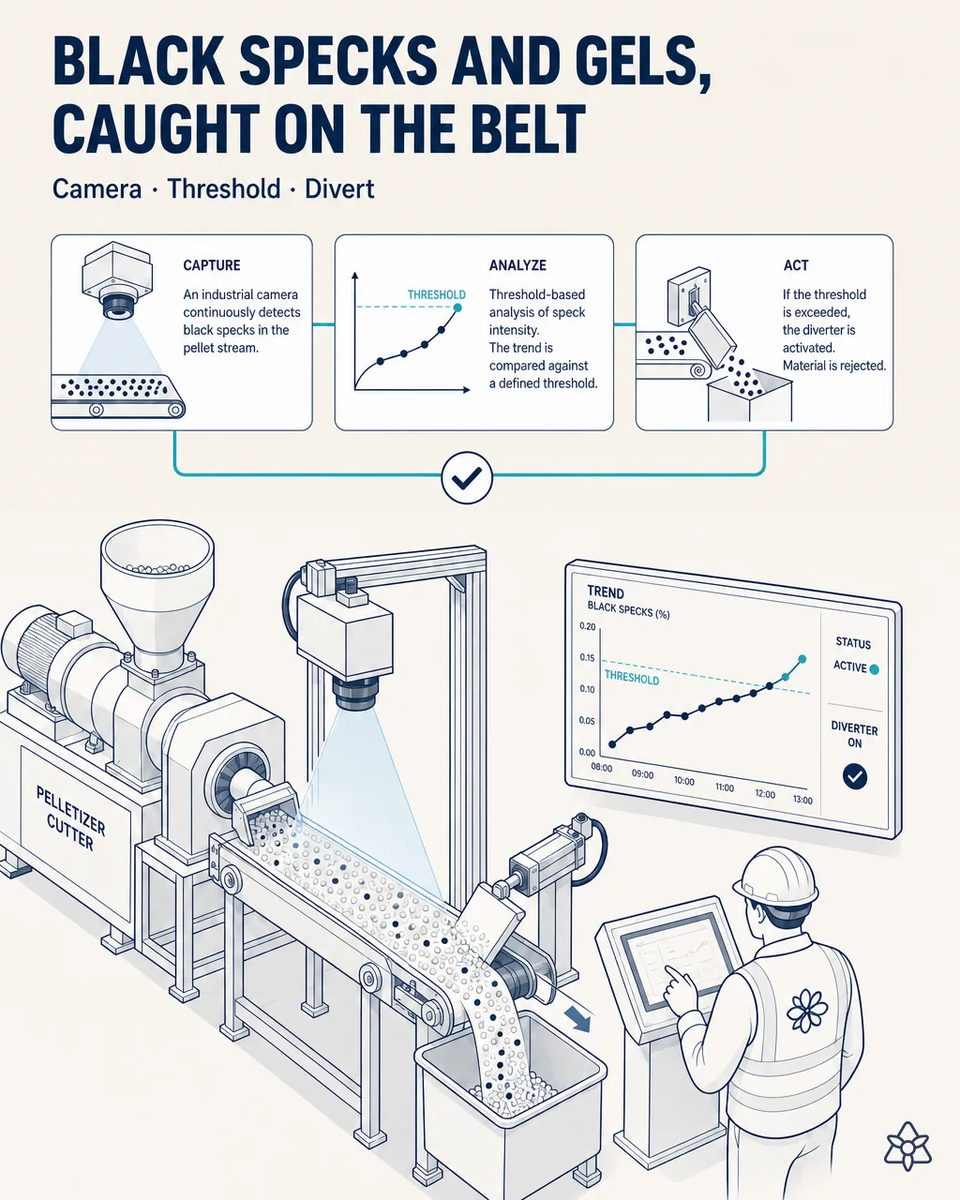
Hundreds of kilos can go by between one sample and the next.
At the pelletiser's real throughput, control is done by sampling: somebody takes a handful every so often and looks at it on a white tray. Hundreds of kilos can pass between samples, and the outcome depends on fatigue and on the light at that workstation. Whatever slips through goes into the big-bag, the big-bag onto the truck, and the truck to the customer.
- At the pelletiser's real rate, control is by sampling: somebody takes a handful now and then and looks at it on a white tray.
- Hundreds of kilos can go by between one sample and the next.
- The result depends on tiredness and on the light at that station.
- What gets through goes into the big bag, the big bag onto the truck and the truck to the customer.
Edge on the belt, with local inference — and two outputs, not one.
Edge puts an overhead industrial camera above the belt at the cutter outlet, and a second one over the extruded profile. Inference runs locally, on a GPU at the line: no images to the cloud, because at this throughput the latency, the cost and the bandwidth would never allow it. The model is trained on good and bad samples of this plant's specific grade. And it has two outputs, not one. The first is reactive: it diverts out-of-spec material before it reaches the big-bag. The second is the one that actually changes the outcome: the trend curve of defect density. Because black specks appear progressively. Caught early, a purge or a filter change is enough. Caught at the end, the whole batch is gone. That is the conceptual jump: from reacting to pre-empting. The camera is not there to catch the defect, it is there to warn that the process is drifting while it can still be corrected with a five-minute purge instead of with a downgraded batch.
The first output is reactive: it diverts out-of-spec material before it reaches the big bag. The second is the one that changes the business: the defect rate becomes a process signal, not a final verdict.
Pellet control, before and after
| Aspect | Today | With iLEAN Edge |
|---|---|---|
| Coverage of the control | 1-2% sampling | Continuous over the flow |
| Between one sample and the next | Hundreds of kilos unlooked at | Nothing goes by unlooked at |
| What the result depends on | Tiredness and station lighting | The model, the same at hour six |
| What happens to the defect | Caught at the end, if at all | Diverted before the big bag |
| The defect rate | A final verdict | A live process signal |
| Dependence on network or cloud | — | None: GPU at the line |
Impact estimate — to validate against your numbers.
The block below is an estimate to be validated against your plant's actual data. We put it forward so the committee has an order of magnitude; we refine it during the assessment.
- Estimated payback 5-12 months, directly proportional to your current rework and grade-downgrade rate.
- From 1-2% sampling to continuous control of the flow.
- Less out-of-spec material reaching the big bag, which is where it stops being cheap to recover.
- And a continuous process signal that does not exist today: defect rate by batch and by shift.
Payback 5-12 months · from 1-2% sampling to continuous control of the flow. Estimated payback is five to twelve months and it depends directly on the current rate of rework and grade downgrading. It is a direct cut in yield loss, which in this business is margin, plus a cut in customer complaints. An estimate to validate against the kilos reprocessed per month today. Conservative ranges, an estimate to validate against the plant's real data.
And the fair question from the production manager
"How many bad samples does it need to be trained?" — fewer than feared, because the model is trained on good and bad samples of this plant's specific grade, not a generic catalogue. And it does not decide alone: it diverts on a threshold, and the person sets the threshold.
[1] OpenAI paper "Why Language Models Hallucinate", 2025 — on the reliability of AI in anchored tasks.
What people ask about vision control of the pellet
Does it slow the line rate?
No: inference runs locally, on a GPU at the line, in milliseconds. That is why it is not a cloud solution: at this rate the latency, cost and bandwidth would not allow it.
Does it catch gels and colour too?
Yes, and in practice colour is what avoids the most arguments with the customer, because it is the first thing they look at when they open the big bag.
We run many different grades. Do we train one by one?
It is trained per grade, starting with the highest volume and most complained-about. Covering a few usually covers most of the risk.
What happens when a new grade comes in?
Until it has a model, that grade carries on as today, with sampling. The system does not block production for a material it does not know.
Does it replace the lab?
No. The lab measures properties; Edge looks at appearance continuously. What it adds is that between one analysis and the next there is no longer nothing.
More cases from this series
- When the file is the product, the file is not improvisedEvery certified destruction and critical changeover builds its own evidentiary dossier, ordered by…
- Find out here, not on the customer's lineFour verification rings from bale to big-bag, automatic release lock and live mass balance per batch and…
- The pellet batch is born traced, not on a sheet that gets lostPelletising order and blend sheet captured by photo: the pellet batch exists in the central system at…
- One wrong keystroke can no longer stop the customer's linePolymer, grade, batch and certificate travel from the ERP to the printer with no keying, and no…
- The twenty-year-old pelletiser starts to talkCamera and OCR on the proprietary panel: the extruder process curve is digitised batch by batch without…
- Shift-floor judgement stops dying at the end of the shiftThe shift lead dictates while walking the floor; iLEAN structures it, ties it to the batch and answers…
Tell us how much rework and grade downgrade you have per month today.
We work on your plant's real data, not ours. Assessment with no commitment.
Request estimated ROI within 48h ‹ See all cases of plastics recycling See plastics