Two taps: the human gate that makes everything else signable
This is the piece that separates iLEAN from an autonomous AI agent. Nothing iLEAN captures crosses into the central system without a human having seen it first. It is not a configuration option: it is the architecture. And it is also the answer to the only objection that genuinely stalls these projects.
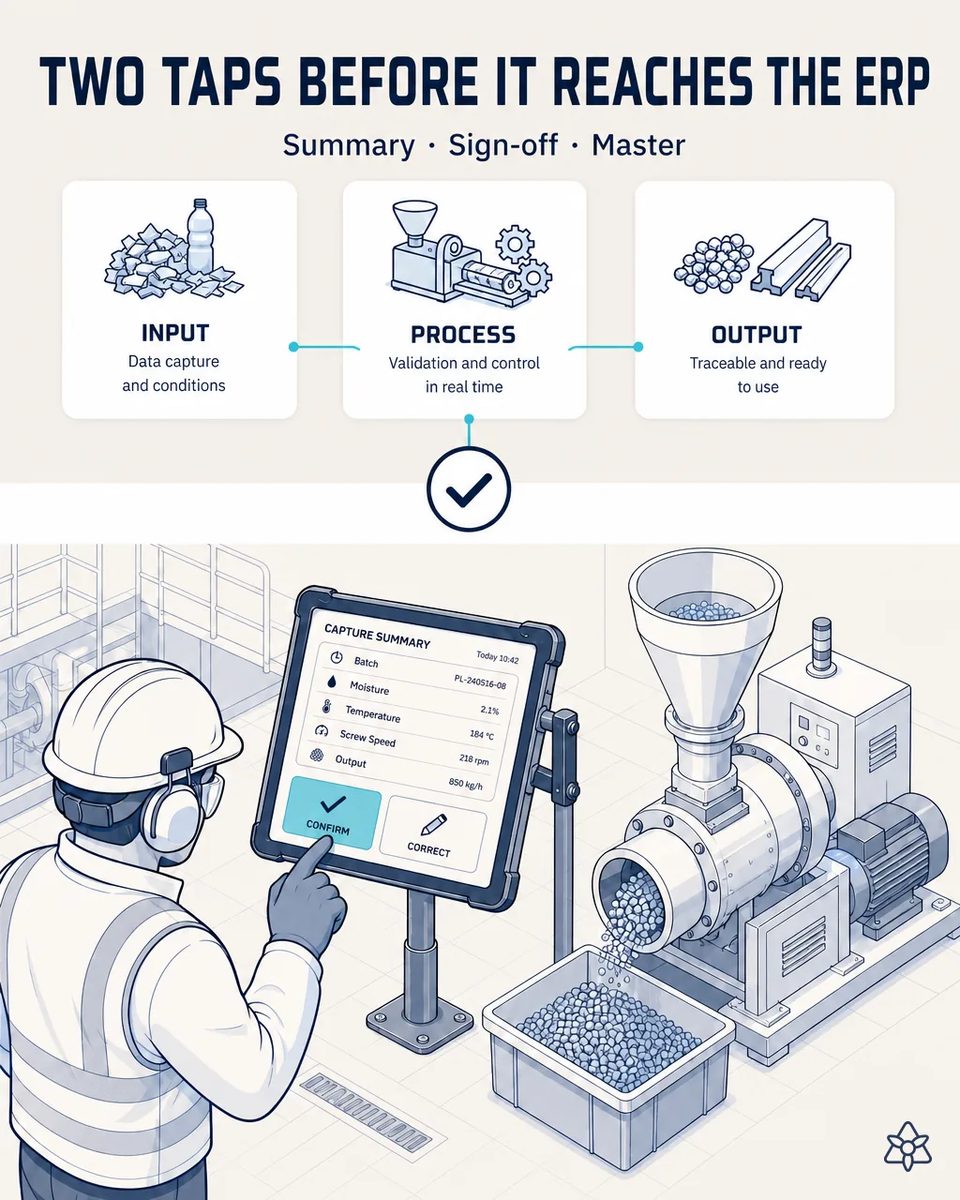
The blocker is never technical. It is the well-founded fear that AI writes on its own.
Because the brake is never technical. It is the entirely reasonable fear that the AI will push data in on its own and someone will then have to clean up the ERP master. But at the same time the operator does not want to type either, and with gloves on, even less. Both things are needed at once: effortless capture and real human control.
- The entirely well-founded fear that AI will enter data by itself and somebody will then have to clean the ERP master.
- But at the same time the operator does not want to type either, and with gloves on even less.
- Both things are needed at once: effortless capture and real human control.
- Any solution that adds administrative work to the day is abandoned within weeks, and the plant goes back to the parallel spreadsheet.
An interface designed to validate, not to capture.
It takes the form of an industrial tablet beside the pelletiser and another at goods-in. When iLEAN reads the blend sheet, when it reads the extruder panel, when it parses the broker's message, all of it shows up there as a two-second visual summary with its confidence level. The operator confirms with two taps: accept, or correct before it goes in. The interface is designed to validate, not to capture. That distinction is everything: validating takes two seconds and needs no training, capturing takes minutes and needs an ERP licence. And in a plant where safety is a hard line, two taps on a fixed tablet are two taps nobody takes with their hands where they should not be.
That distinction is everything: validating takes two seconds and needs no training; capturing takes minutes and does. Which is why one is still alive in month six and the other is not.
Data entry into the ERP, before and after
| Aspect | Today | With iLEAN Connect |
|---|---|---|
| Who validates critical data | Whoever types it, if anyone | The operator, in two seconds |
| What the operator is asked to do | Capture: minutes and training | Validate: two taps, no training |
| With gloves on | Not viable | Designed for exactly that |
| Confidence level of what was captured | Not visible | Shown with the summary |
| What happens to the correction | Corrected and forgotten | Stored, and it tunes the anchored model |
| Plant trust in the system | Fragile: the parallel spreadsheet appears | It holds, because the signature is theirs |
Impact estimate — an enabling piece, and it is worth saying so.
The block below is an estimate to be validated against your plant's actual data. We put it forward so the committee has an order of magnitude; we refine it during the assessment.
- This case does not monetise directly and we are not going to pretend it does.
- Its value is strategic and it is the largest of the set: without early human verification, the other eleven are not signable.
- It is what turns "the AI captured this" into a record with an author, a timestamp and a signature.
- And it is what stops the plant from keeping the parallel spreadsheet, which is where these projects die.
Enabling piece · without early human verification the other eleven never get signed off. This example does not monetise directly and we are not going to pretend otherwise. Its value is strategic, and it is the largest in the pool: without early human verification the other eleven pieces never get signed off in committee. It is the condition that turns an AI promise into a system an operations director can defend. Conservative ranges, an estimate to validate against the plant's real data.
And the fair question from the production manager
"If a person has to look at it anyway, what do we gain?" — looking is not typing. What they get is a two-second summary with its confidence level, and the anchored extraction work is already done [1]. You go from transcribing to confirming. And the data lands in seconds instead of at shift close.
[1] OpenAI paper "Why Language Models Hallucinate", 2025 — on the reliability of AI in anchored tasks.
What people ask about early human verification
Does it slow the line down?
It is two taps on a summary designed to be read with gloves on from a metre away. The seconds it adds are measured against what a wrong figure in the ERP master costs.
Who should validate: the operator or the lead?
It depends on the data. What the operator handles, he validates; anything going to a quality master is better signed by the role that already owns it today.
Can validation be skipped when there is pressure?
No, and that is the point. What can be tuned is which fields require it: asking for a signature on everything ends with people signing out of habit, which is worse than not asking.
Do the corrections do anything?
Yes, they are stored and feed the tuning of the anchored model. The fields corrected most in the first weeks are the ones tuned first, and the validation load drops on its own.
Why does it have no payback of its own?
Because its return is the other eleven's. It is the piece that makes what was captured signable and auditable; without it, the rest does not stand up in front of a customer or an auditor.
More cases from this series
- When the file is the product, the file is not improvisedEvery certified destruction and critical changeover builds its own evidentiary dossier, ordered by…
- Find out here, not on the customer's lineFour verification rings from bale to big-bag, automatic release lock and live mass balance per batch and…
- The pellet batch is born traced, not on a sheet that gets lostPelletising order and blend sheet captured by photo: the pellet batch exists in the central system at…
- One wrong keystroke can no longer stop the customer's linePolymer, grade, batch and certificate travel from the ERP to the printer with no keying, and no…
- The twenty-year-old pelletiser starts to talkCamera and OCR on the proprietary panel: the extruder process curve is digitised batch by batch without…
- Shift-floor judgement stops dying at the end of the shiftThe shift lead dictates while walking the floor; iLEAN structures it, ties it to the batch and answers…
Tell us what would have to be true for you to let a system write to your ERP.
We work on your plant's real data, not ours. Assessment with no commitment.
Request estimated ROI within 48h ‹ See all cases of plastics recycling See plastics