The warning that arrives too late stops arriving too late
In recycling, raw material quality gets negotiated through informal messaging with collectors and brokers. The critical warning almost never comes through the official channel. It comes as a message: half of the load we sent you is carrying more label than usual. Or, a truck fell through, the polyethylene arrives tomorrow.
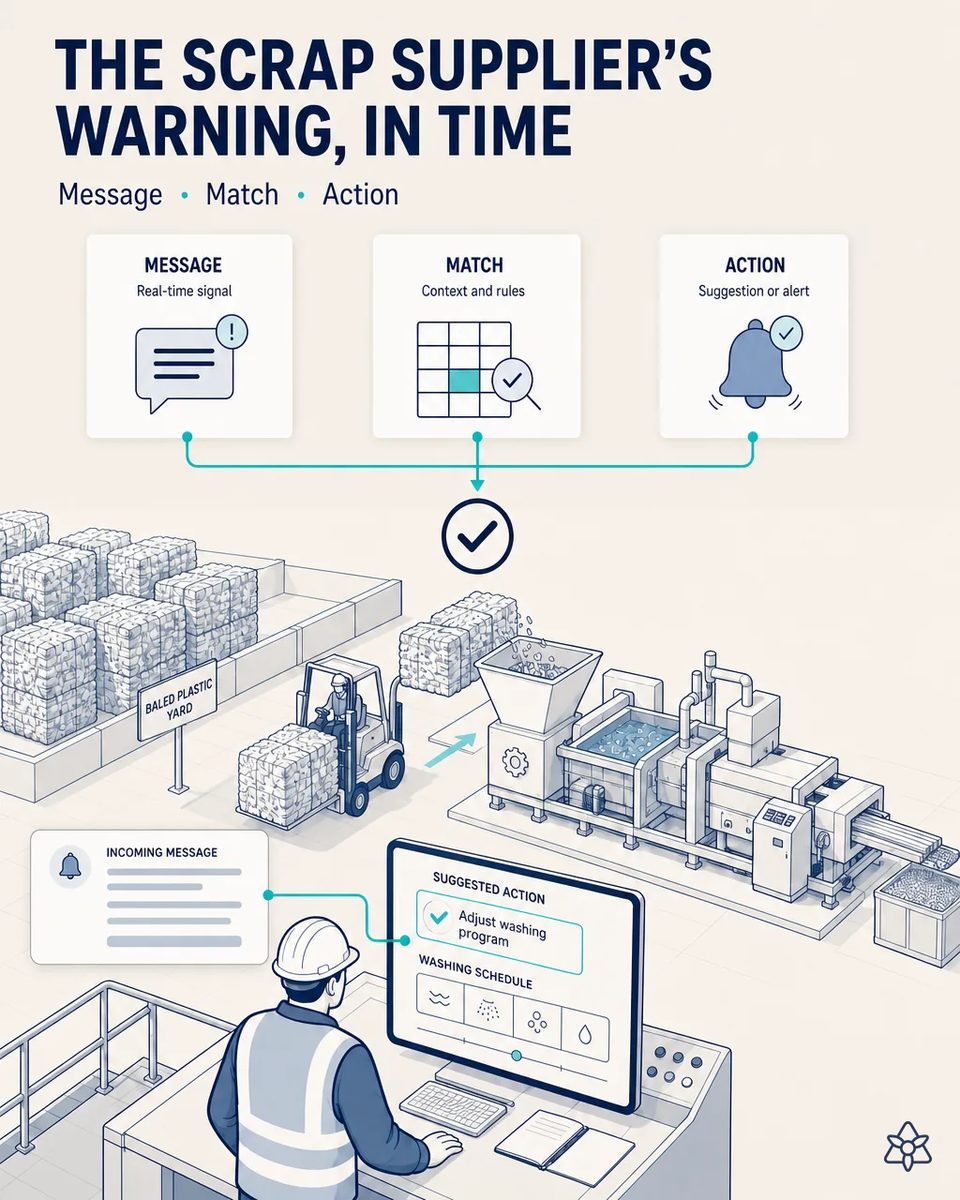
Two to four hours of latency. Exactly the hours when the decision still mattered.
That message lands on the personal phone of one person in purchasing, who reads it when they can. By then the bales are already in the yard, or the washing line has already run out of material to process. Typical latency is two to four hours, and those are precisely the hours in which the decision would still have been worth something.
- The message lands on one specific person's phone in purchasing, read when they can.
- By then the bales are already in the yard, or the washing line has already run out of material.
- Typical latency is two to four hours.
- Which are exactly the hours when the decision was still worth something: set aside, pull forward, resequence.
Connect on silent copy — and it returns an action, not an alert.
Connect in chaotic-sources mode puts iLEAN silently in copy: a dedicated mailbox and a business messaging number, live around the clock. The moment the message arrives, the system extracts intent, entities and quantity, and cross-checks them against the live washing and pelletising schedule. And here is the difference that matters: iLEAN does not return an alert, it returns an action. It does not say you have a new message. It says set aside that supplier's bales for lab inspection, and pull the polypropylene order forward so the washing line does not run dry. The decision still belongs to the shift lead, but it gets made with the action already drafted in front of them.
It does not say "you have a message". It says "set that supplier's bales aside for lab inspection and pull forward the washing order for the next batch".
The broker alert, before and after
| Aspect | Today | With iLEAN Connect |
|---|---|---|
| Who sees it | One person, when they open their phone | The right role, as it lands |
| Latency to reaction | 2-4 hours | Seconds |
| Cross-check with the washing schedule | In someone's head, if there is time | Automatic |
| What reaches the owner | The whole message | The suggested action, with its reasoning |
| Weekends and night shift | Nobody reads it | Read all the same |
| Who decides | The person | The person |
Impact estimate — to validate against your numbers.
The block below is an estimate to be validated against your plant's actual data. We put it forward so the committee has an order of magnitude; we refine it during the assessment.
- Estimated payback 3-7 months, directly proportional to how often critical alerts arrive.
- From 2-4 h of human latency to a concrete action in seconds.
- Fewer washing-line stoppages from running out of material to process.
- And fewer bad bales entering the process, which is the cost that later shows up disguised as rework.
Payback 3-7 months · from 2-4 h of human latency to a concrete action in seconds. Estimated payback is three to seven months and it scales directly with how often critical warnings arrive. Two expensive things get avoided: line stoppages for lack of material, and contaminated batches caused by a doubtful bale entering the grinder because nobody had read the warning. An estimate to validate. Conservative ranges, an estimate to validate against the plant's real data.
And the fair question from the production manager
"Is the AI going to reply to our suppliers?" — no. It does not write, does not answer and confirms nothing outwards. Extracting intent and entities from a message already in front of it is an anchored task [1]; what it does with that is prepare the decision and put it in front of the right role.
[1] OpenAI paper "Why Language Models Hallucinate", 2025 — on the reliability of AI in anchored tasks.
What people ask about scrap supplier alerts
Do you need access to purchasing's phone or mail?
No. It works on a dedicated mailbox and a company messaging number that the relevant traffic is forwarded to. Nobody's personal account is involved.
Our brokers write on WhatsApp, with no format at all.
That is the normal case, which is why the mode is called chaotic sources. Messaging, email and PDF attachments are treated the same: what matters is the extracted entity, not the wrapper.
What does it do when an alert has no impact?
It says so, and that counts. A good share of today's cost is that somebody has to read thirty messages to find the two that matter.
What if it gets the urgency wrong?
It comes with the suggested action and the original message one click away, so the reasoning is visible. If it under-classifies, the message still shows up as it does today: nothing is lost.
Does it connect to the production schedule?
Yes, and that is what gives it value: without cross-referencing against the live washing and pelletising schedule, an alert is just a structured message.
More cases from this series
- When the file is the product, the file is not improvisedEvery certified destruction and critical changeover builds its own evidentiary dossier, ordered by…
- Find out here, not on the customer's lineFour verification rings from bale to big-bag, automatic release lock and live mass balance per batch and…
- The pellet batch is born traced, not on a sheet that gets lostPelletising order and blend sheet captured by photo: the pellet batch exists in the central system at…
- One wrong keystroke can no longer stop the customer's linePolymer, grade, batch and certificate travel from the ERP to the printer with no keying, and no…
- The twenty-year-old pelletiser starts to talkCamera and OCR on the proprietary panel: the extruder process curve is digitised batch by batch without…
- Shift-floor judgement stops dying at the end of the shiftThe shift lead dictates while walking the floor; iLEAN structures it, ties it to the batch and answers…
Tell us how long it takes you today to react to an alert from your brokers.
We work on your plant's real data, not ours. Assessment with no commitment.
Request estimated ROI within 48h ‹ See all cases of plastics recycling See plastics