The blister defect ejected in line with Edge — 100% cavity control at real rate
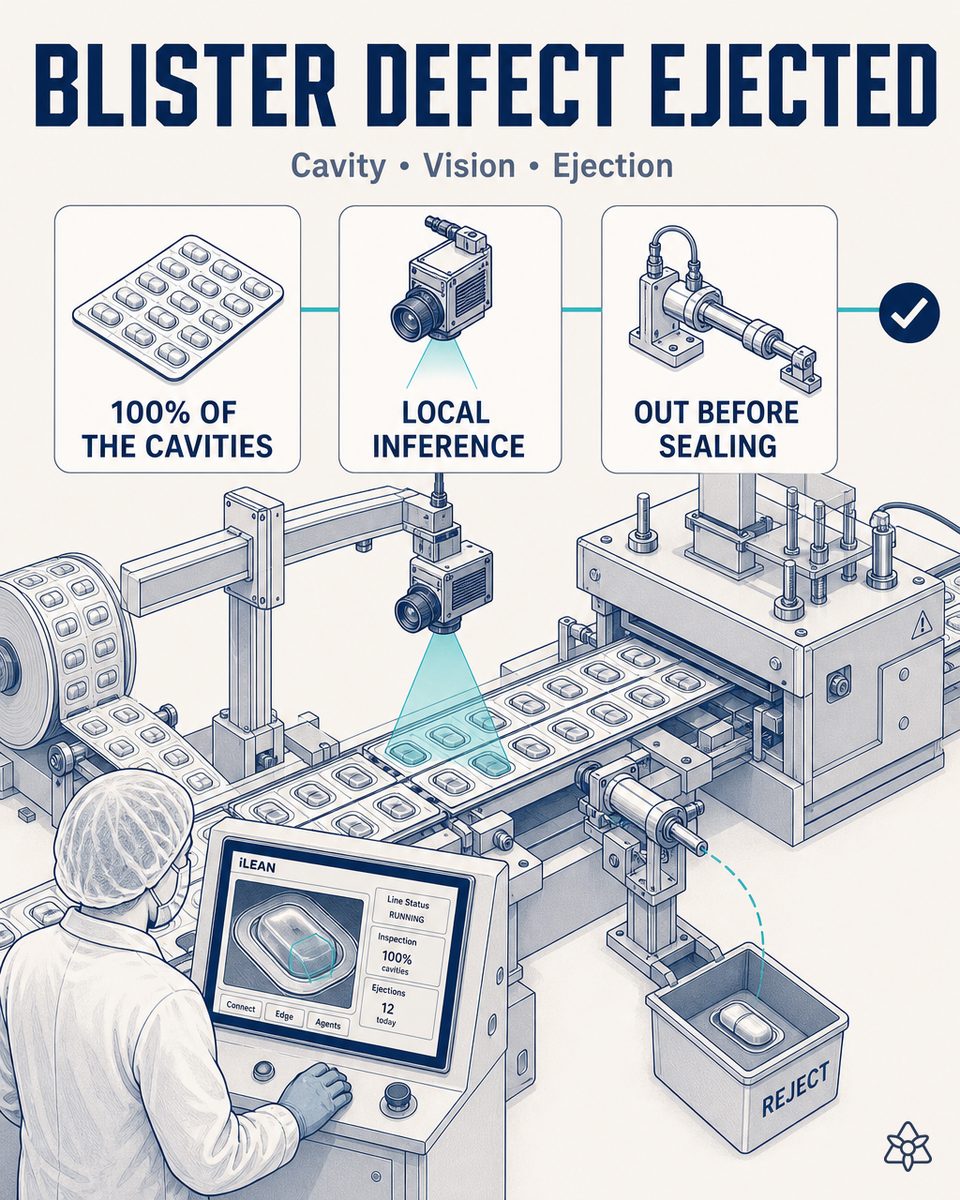
At a pharma blistering line's real rate — 12,000-24,000 tablets/hour — the human eye fails. iLEAN Edge places an overhead industrial camera on the line, infers in milliseconds per cavity with a local CNN and ejects empty cavities, broken tablets, inverted tablets or badly printed codes before the blister closes. It also applies to semi-solid filling in tubes or bottles.
100% human visual control is impossible at real rate.
In a hormonal pharmaceutical plant, the blistering line moves between 12,000 and 24,000 tablets/hour. At that rate, asking a person to visually check every cavity is not demanding: it is physically impossible. What exists in practice is a QC sampling inspection, and sampling has two structural problems.
- It leaves gaps — QC checks a minimal fraction of the produced cavities. The empty cavity, the broken tablet, the inverted tablet or the badly printed code slip through exactly in the percentage nobody looks at.
- It arrives late — when sampling detects the defect, the line has been producing for hours with the defect latent. Everything manufactured between the last good sample and the bad one falls under suspicion, with the review and rework that drags along.
The consequence is not a lost blister: it is claims, nonconformities to investigate and document and, in the worst case, product recalls from the market. In hormonal pharma, where the correct dose in every cavity is non-negotiable, the cost of the defect leaving the plant shoots far above the scrap's cost.
iLEAN Edge — an overhead camera, a local CNN and ejection before the blister closes.
The problem is not one of judgment — the quality manager knows perfectly what a defective cavity is — it is one of rate and sustained attention, exactly where machine vision wins. iLEAN Edge replicates the veteran inspector's judgment at the blistering machine's speed, cavity by cavity, without fatigue.
Edge sees every cavity before the sealing station. The local CNN tells apart an empty cavity, a broken tablet, an inverted tablet and a badly printed code. The physical ejection takes it off the line before the blister closes. It works with no network and without sending a single image to the cloud. Every ejection is timestamp-signed, traceable to the batch record.
iLEAN's specific piece for a hormonal blistering line:
- Edge — a physical terminal with an overhead industrial camera installed on the blistering line, before the sealing station. It carries a CNN trained with good and bad examples of the customer's specific product. It inspects empty cavity, broken tablet, inverted tablet and a badly printed batch or expiry code. Inference is local, with no image sent to the cloud: on detecting a defect it triggers the physical ejection before the blister closes. The same scheme applies to semi-solid filling in tubes or bottles.
- Connect — captures the work order and the batch in progress, whether from the ERP, the MES or the electronic batch record. Every Edge ejection is timestamp-signed and tied to the batch, so traceability to the batch record is automatic, not a manual reconstruction.
- Agent — lives in Central, crossing the Edge history (how many cavities ejected per hour, by defect type, by shift) with Connect's batch and order. If the empty cavity always spikes after a specific format change, it does not send an email at midnight: it presents the already-crossed hypothesis to the quality manager, who validates and decides.
QC sampling inspection vs. inspection with iLEAN Edge
| Aspect | QC sampling inspection | With iLEAN Edge on the line |
|---|---|---|
| Inspection coverage | A 1-2% sample of the cavities | 100% cavity control, at real rate |
| Empty cavity / broken tablet | Depends on landing right in the sample | A local CNN on every cavity, without exception |
| An inverted tablet in the pocket | Hard to spot in fast sampling | Detected and ejected before the blister closes |
| A badly printed batch/expiry code | Discovered late, sometimes at the customer | Detected in line, before the closure |
| Claims for visual defects | Spike after hours of latent defect | Drastic reduction (estimate to be validated) |
| Traceability to the batch record | Manual reconstruction, days later | Every ejection's record timestamp-signed, automatic |
Impact estimate for your plant — to be validated with your own numbers.
The block below is an estimate to be validated against your plant's actual data. We put it forward so the committee has an order of magnitude; we refine it during the assessment.
- Hormonal pharmaceutical plant with a blistering line at 12,000-24,000 tablets/hour, or semi-solid filling in tubes or bottles.
- Edge pilot on the blistering line — an overhead camera + physical ejection before the closure, with no machine construction work. First value expected within a few weeks.
- Indicative payback between 5 and 12 months, depending on the current scrap ratio and claim frequency. Estimate to be validated.
- Expected reduction of claims for visual defects: drastic on going from a 1-2% sample to 100% cavity control. (Estimate to be validated with your history.)
- The hard lever is one avoided nonconformity or recall: investigation, documentation, rework or destruction of the batch under suspicion. A single one pays for the pilot.
And the fair question from the quality manager
"What if the AI gets it wrong and lets an empty cavity through?" — hallucination is a problem of free generation, not of anchored tasks. In tasks where the AI merely classifies an image against known patterns (this cavity matches the "good" pattern or the "defect" pattern), the best models brought the error below 1.5% [1]. And even then, nothing is decided in a vacuum: the quality manager sees each shift's history, validates false positives in the Edge interface itself, and retraining enters through formal change control, with every model version documented and approved. The line does not stop while training happens. The person supplies the judgment; the machine keeps the cycle turning.
[1] OpenAI paper "Why Language Models Hallucinate", 2025 — on the reliability of AI in anchored tasks.
What people ask about hormonal blistering quality control with Edge
Which specific defects does iLEAN Edge detect in each blister cavity?
The defects the quality inspector would recognize instantly but that at the line's rate nobody can follow cavity by cavity: empty cavity, broken or cracked tablet, inverted tablet in the pocket and a badly printed or illegible batch code or expiry date. The overhead industrial camera covers the forming web before the sealing station, so the defect is ejected before the blister closes. The same scheme applies to semi-solid filling in tubes or bottles: an anomalous fill level, a badly threaded cap or defective printing.
At what real rate does Edge work without becoming the line's bottleneck?
At the blistering machine's own rate. With lines moving between 12,000 and 24,000 tablets/hour, the local CNN infers in milliseconds per cavity: the bottleneck is never the vision, it is the physical actuator. The defect signal reaches the ejection before the web enters the sealing station, so the bad cavity never gets closed inside a good blister. The line does not slow down; it simply stops letting the defect through.
How is the CNN trained on the plant's own product?
With real examples of the customer's specific product, not a generic library. The quality manager marks good cavities and cavities with each defect type — empty, broken tablet, inverted tablet, badly printed code — and the CNN learns the visual pattern of that tablet, that blister format and that forming material. When the plant changes format or presentation, it is retrained with the new samples and the new model version enters through the same change control circuit as any process change: documented, approved and traceable.
Does Edge work with no network? Is it an on-premise system?
Yes. Edge is a physical on-premise terminal with the CNN loaded in the device itself: inference is local and no product image goes to the cloud. If the plant loses WiFi, fiber or the cloud provider fails, Edge keeps inspecting every cavity and triggering the ejection with the electrical cabinet's power. The critical part — that an empty cavity or a broken tablet does not close inside the blister — cannot depend on connectivity. When the network returns, the signed ejection record uploads to cross with the batch record.
How is the CNN model versioned with the plant's GMP change control?
Every CNN model version passes through formal change control — it is pillar #5 of iLEAN's compliance contract. A retraining is not deployed hot: it is documented which samples were added, validated against a known cavity set, approved by quality and recorded which model version was active on each batch. Moreover, every ejection is timestamp-signed, so the batch record can reconstruct which defect was ejected, when and with which model version. At an audit, the answer is not an explanation: it is a record.
More cases from this series
- iLEAN in regulated industry — five compliance pillars by design5 compliance pillars making iLEAN deployable in regulated pharma: audit trail, ALCOA+, non-invasive,…
- A pre-inspection evidence pack for FDA, COFEPRIS and ANVISA — zero documentary reconstructionZero hours of pre-audit reconstruction. iLEAN Agents organizes photo, log and signature by certifying…
- From the supplier’s email to the concrete action with no human latencyiLEAN Connect listens to the API supplier’s email and WhatsApp, crosses them with active orders and…
- From the delivery note and the CoA to the ERP with a single photo — 50-70% fewer receiving licensesAPI receiving in 5 min. iLEAN digitizes the delivery note, the Certificate of Analysis and the GS1…
- Coder and serializer stitched to the ERP — zero serial mix-upsBatch, serial and aggregation from the ERP to the coder with no typing. Zero serial mix-ups, eliminating…
- Giving the qualified granulator’s panel life without requalifying the assetAn external camera reads the qualified panel’s curve without touching the GMP asset. Zero…
Keep the defect from leaving your line — we will send within 48h the estimated ROI of this AI project for your blistering line.
We work on your plant's real data, not ours. Assessment with no commitment.
Request estimated ROI within 48h ‹ See all 13 hormonal pharma cases See pharma