From the physical chemistry Excel to the LIMS and ERP with no transcription — 50-80% fewer QC licenses
In a pharma factory the physical chemistry lead fills an Excel every shift with potency, uniformity, hardness and dissolution that lives in a shared folder. iLEAN Connect watches the folder, absorbs each delta and, after the lab manager's validation, feeds it into the LIMS and ERP via API. Typical saving of 50-80% in LIMS/QC licenses — and a side lever to accelerate future technology transfers with live per-batch data.
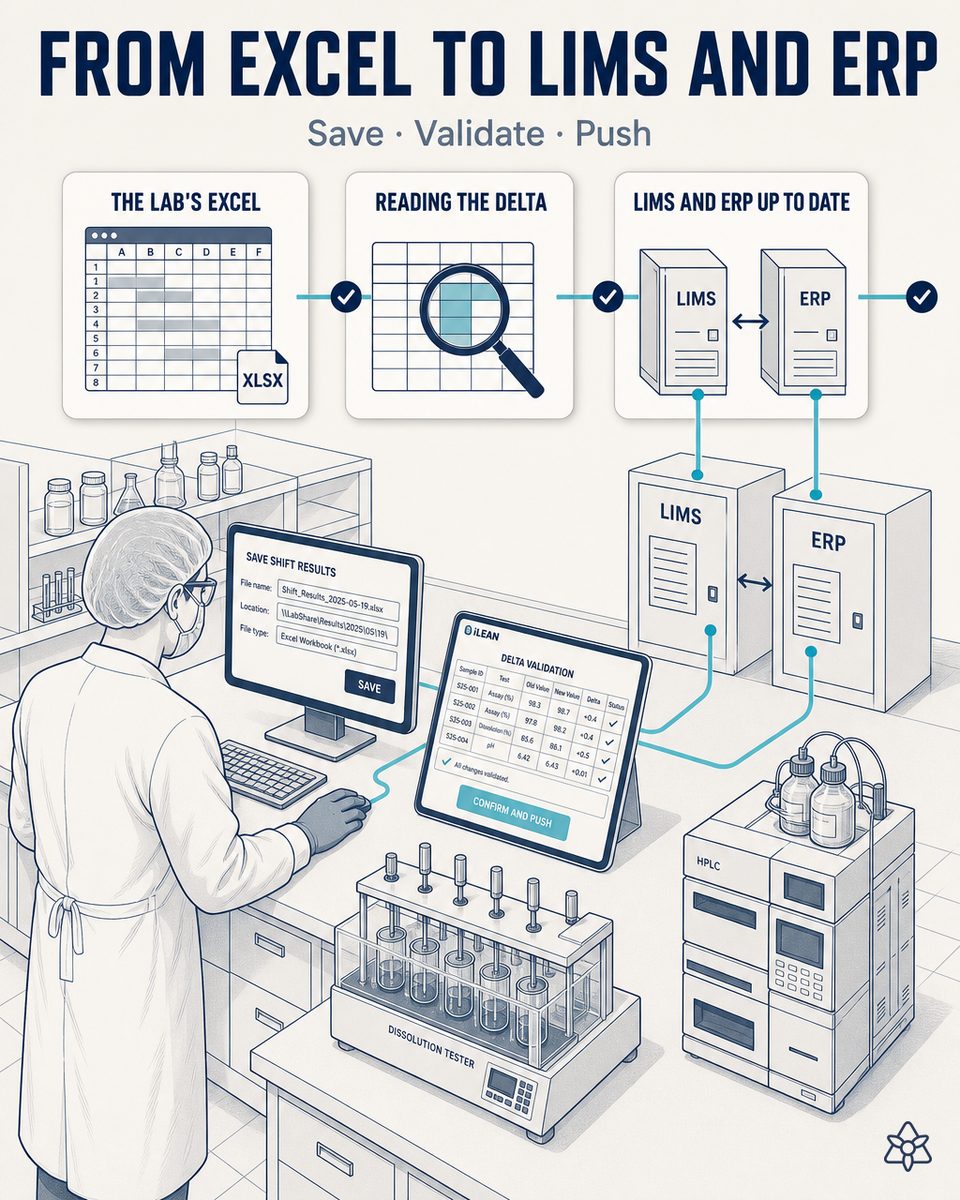
Two parallel worlds: physical chemistry's real Excel and the plant's official LIMS.
In a hormonal pharmaceutical factory, the physical chemistry laboratory keeps its own Excel: potency, content uniformity, hardness and dissolution of each batch, test by test. It is the data the laboratory really works with, updated to the minute in the shared folder. The official LIMS, meanwhile, receives those same results typed by hand by someone copying from the Excel into the system — hours or days later.
- Two parallel worlds — the real Excel with the live data and the official LIMS with data transcribed hours or days later. Meanwhile, the batch's release waits for that transcription: finished product stopped by a pending typing job.
- An FDA auditor with a divergent Excel and LIMS — when the inspection crosses the original sheet's result with the official record and they do not match in date or value, the divergence is a serious finding. And the usual defense — "it is in the Excel, it had not been transferred yet" — is exactly what the auditor does not want to hear.
- Technology transfer braked — at a site with an active technology transfer, the Excel-LIMS divergence is also the number one source of delay in validating new products: the receiving team cannot compare batches if the official data runs days behind the real data.
The cost is not only regulatory: it is licenses. For that typing to be possible, several analysts need a LIMS or ERP QC module license — not because they manage quality in the system, but because it is the only way to enter their own results.
Connect listens inward: it watches the folder, not the analyst.
The physical chemistry Excel does not need to disappear or change format. The data that already exists in that sheet needs to reach the LIMS and the ERP without anyone typing it again, and without the batch release waiting hours or days for the official system to reflect the laboratory's reality. That is what Connect is for.
Connect watches the shared folder where the laboratory saves its Excel — it does not watch the analyst filling it. When the file is saved, it reads the delta, presents it to the lab manager and, after their electronic signature, feeds it into the LIMS and ERP via API. The laboratory keeps working exactly as always.
How Connect operates on a hormonal pharma factory's physical chemistry Excel:
- Connect watches the folder, not the human — it points at the network location where physical chemistry saves each shift's Excel. It does not intervene while it is being filled, it times nobody: it only detects when the file has been saved.
- It reads the delta on save — as soon as the Excel is saved, Connect identifies which rows are new since the last feed (potency, uniformity, hardness, dissolution) and extracts them, without reprocessing the whole history each time.
- An LLM anchored to the real template — the model generates no free data: it recontextualizes exactly what is in the cell, column by column, against the laboratory's real template, its own columns and usual order included.
- A delta summary to the lab manager — before anything reaches the LIMS, the lab manager sees on their tablet a summary of what was read: they confirm or correct. The data does not enter alone.
- An electronic signature and an API feed — once signed, Connect writes the result directly into the LIMS and the ERP, with full traceability of who validated what and when. The Excel-LIMS misalignment is resolved by design, batch by batch.
Disconnected Excel and LIMS vs. Excel and LIMS with Connect in between
| Aspect | Disconnected Excel and LIMS | With Connect in between |
|---|---|---|
| The Excel-LIMS lag | Hours or days | Second zero, same shift |
| Manual transcription | An additional analyst typing results | Zero — an automatic API feed after the signature |
| An FDA auditor crosses Excel and LIMS | Divergence = a serious finding | Automatic per-batch alignment |
| The batch's release | Waits for someone to transcribe | Data in the LIMS on saving the Excel and signing |
| LIMS/QC licenses | One per analyst, only to type | 1 license — the validating lab manager's |
| Technology transfer | Validation delayed by out-of-date official data | Live per-batch data from day one |
Impact estimate for your plant — to be validated with your own numbers.
The block below is an estimate to be validated against your plant's actual data. We put it forward so the committee has an order of magnitude; we refine it during the assessment.
- Hormonal pharmaceutical factory with its own physical chemistry laboratory, an official LIMS and a corporate ERP, with per-user licenses in the QC module.
- If today several analysts hold a LIMS or QC module license only to be able to type their own results, with Connect the license of whoever validates and signs — the lab manager — is enough.
- Typical reduction of 50-80% in QC/LIMS module licenses, sustained year after year — not a one-off project saving, but a recurring cost that disappears from the contract. Estimate to be validated.
- Estimated payback between 4 and 9 months, counting Connect's setup on the laboratory folder and the anchoring to the real template. Estimate to be validated with your numbers.
- A side lever: with the physical chemistry data alive per batch in the LIMS from second zero, future technology transfers validate by comparing batches in the official system — without reconstructing historical Excels. That acceleration is not included in the license calculation.
And the fair question from the finance manager
"What if the LLM misreads an Excel cell and a wrong potency reaches the LIMS?" — hallucination is a problem of free generation, not of anchored tasks. In tasks where the AI limits itself to recontextualizing a specific data point from one medium to another (reading an Excel cell and moving it to the LIMS's corresponding field), the best models brought the error below 1.5% [1]. And even then, nothing critical is decided alone: Connect holds the feed until the lab manager signs on screen. The three safety rings are there precisely for this.
[1] OpenAI paper "Why Language Models Hallucinate", 2025 — on the reliability of AI in anchored tasks.
What people ask about moving the physical chemistry Excel to the LIMS and ERP with Connect
How does Connect watch the laboratory folder without changing the analyst's work?
Connect watches the shared folder where physical chemistry already saves its results Excel — it does not watch the analyst filling it. When the lead saves the file on closing the test (potency, content uniformity, hardness, dissolution), Connect detects the delta — only the rows new since the last feed — and reads it with an LLM anchored to the laboratory's real template. The analyst keeps filling exactly the same Excel as always, the same columns and the same shift habit; there is no new form to learn and no screen to install at the workstation.
What happens if the laboratory changes the physical chemistry Excel's template?
If the laboratory adds a column, renames a parameter or reorders the tabs, Connect does not break silently: the template-anchored LLM detects the variation and, if the change is ambiguous, flags it for the lab manager's review instead of feeding a misinterpreted value into the LIMS. A template adjustment requires no new integration or IT ticket — the reading is reconfigured, not the system's plumbing. For QA, the change is recorded: which template was active on each feed and from which batch it applies.
How is the real LIMS/QC license saving calculated?
The logic is one of license consumption, not hours: if today several physical chemistry analysts hold a LIMS or ERP QC module license only to be able to type their own results, with Connect it is enough for a single person — the lab manager validating and signing before the feed — to hold that license. In commercial LIMS and corporate ERP QC modules, where the per-user seat is among the contract's most expensive, that concentration typically means a 50-80% reduction in LIMS/QC licenses, sustained year after year. It is an estimate to be validated with your own license contract — which is why the first step is the savings simulator on your numbers.
What validation exists before the data enters the LIMS and the ERP?
No result reaches the LIMS or the ERP without first passing through the lab manager's screen: on their tablet they see a summary of the delta Connect read from the Excel, compare it with the original data and confirm with an electronic signature before the API feed fires. Connect does not write into the LIMS on its own — it prepares the data and leaves it ready to sign, and the person signs. Each feed is traced per batch: what was read, who validated it and when — exactly the record an FDA auditor expects to be able to cross-check.
Does it work with any LIMS and ERP?
Yes. Connect feeds the validated data via API, so it does not depend on a specific LIMS or ERP brand: it works the same with a commercial LIMS, a corporate ERP's QC module or a custom build, as long as it exposes an endpoint to write the batch's analytical result to. It does not replace your LIMS or migrate data — it automates the stretch a person does by hand today: reading the physical chemistry Excel and typing it into the official system.
More cases from this series
- iLEAN in regulated industry — five compliance pillars by design5 compliance pillars making iLEAN deployable in regulated pharma: audit trail, ALCOA+, non-invasive,…
- A pre-inspection evidence pack for FDA, COFEPRIS and ANVISA — zero documentary reconstructionZero hours of pre-audit reconstruction. iLEAN Agents organizes photo, log and signature by certifying…
- From the supplier’s email to the concrete action with no human latencyiLEAN Connect listens to the API supplier’s email and WhatsApp, crosses them with active orders and…
- From the delivery note and the CoA to the ERP with a single photo — 50-70% fewer receiving licensesAPI receiving in 5 min. iLEAN digitizes the delivery note, the Certificate of Analysis and the GS1…
- Coder and serializer stitched to the ERP — zero serial mix-upsBatch, serial and aggregation from the ERP to the coder with no typing. Zero serial mix-ups, eliminating…
- Giving the qualified granulator’s panel life without requalifying the assetAn external camera reads the qualified panel’s curve without touching the GMP asset. Zero…
Bring LIMS/QC licenses down without losing traceability — tell us your case and we will send the savings simulator within 48h.
We work on your plant's real data, not ours. Assessment with no commitment.
LIMS/QC license savings simulator ‹ See all 13 hormonal pharma cases See pharma