Paperless batch startup: MBR and log book at second zero
In a hormonal oral solid pharma factory every batch starts with a 40-to-60-page paper Master Batch Record and a line log book. Today they are transcribed late and by hand into the electronic batch record. iLEAN Connect captures the MBR and log book with a photo, extracts the fields with an anchored LLM and signs them with a 21 CFR Part 11 timestamp in central memory at second zero, without changing the SOP.
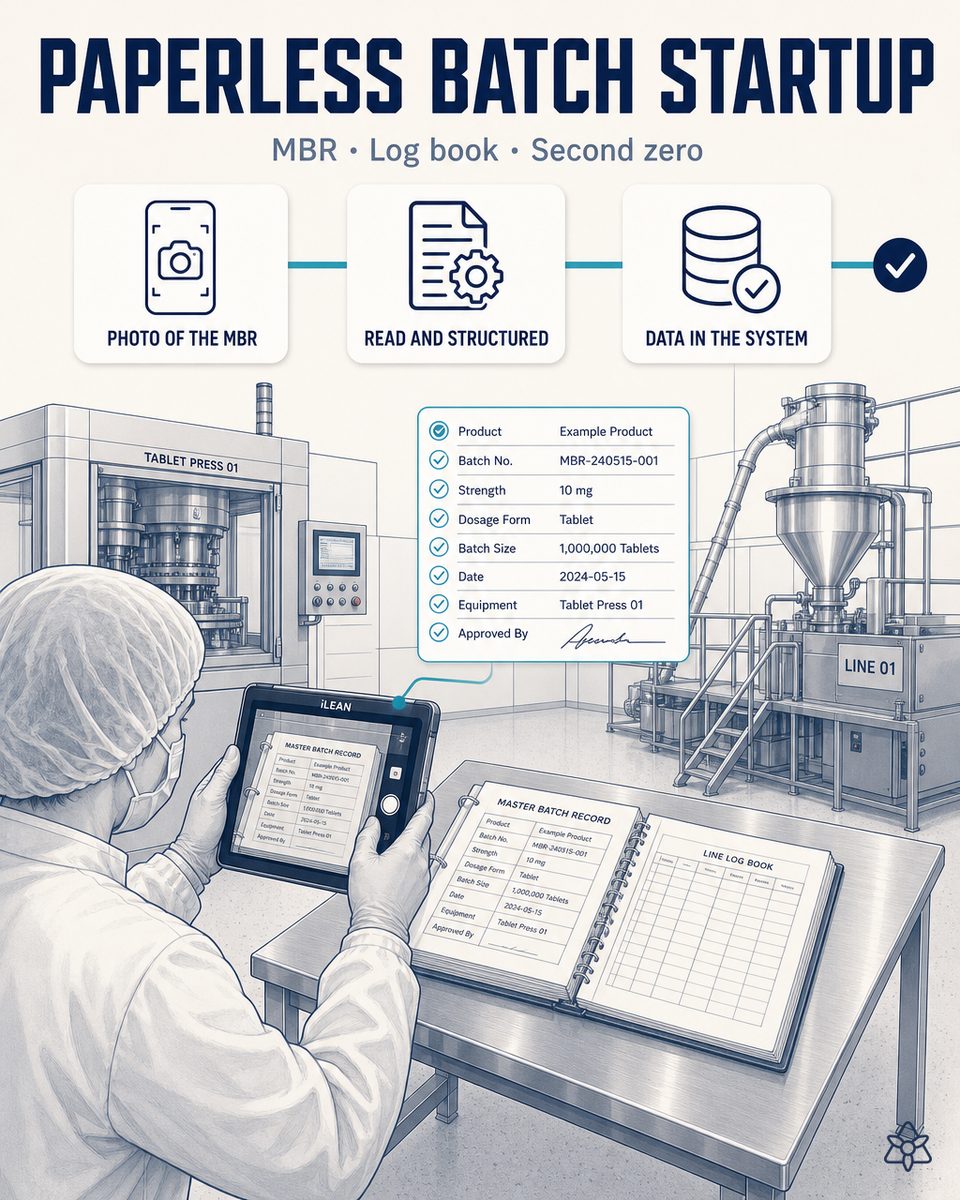
The MBR and the log book are the batch's legal truth — and live on paper until someone types them.
In a pharmaceutical factory producing hormonal oral solid forms and semi-solids, the Master Batch Record is the batch's legal truth: 40 to 60 pages on paper the qualified operator fills in step by step following the SOP, plus the line log book recording the qualification, the interventions and the shift's signatures. The process is validated and stable; the gap lies in what happens to those papers afterwards:
- Late transcription — in a multi-format plant, the transfer of the MBR and the log book into the electronic batch record happens hours or days after the real startup, typed by hand by production or QA.
- A latent documentary gap — during that window, what the paper says and what the system says do not match. Any hole in that transcription is a serious finding in an FDA or COFEPRIS audit: an untransferred field, illegible initials, a page that does not appear.
- Work that is not theirs — the qualified operator already has enough following the SOP to the letter; typing the MBR into the ERP is not their job. And every QA hour spent transcribing is an hour not spent on quality.
Nobody sees that gap until an inspector asks for a specific batch's file and it must be reconstructed from scattered scanned PDFs and archived paper. That is where a routine transcription turns into a data integrity observation.
Connect in photo mode — a photo of the MBR and the log book, and the electronic batch record exists at second zero.
The batch startup needs no new SOP and no MES forcing a process revalidation. It needs the information that already exists on paper — the MBR filled per procedure and the signed log book — to reach central memory at second zero, without production or QA transcribing it later. That is what Connect in photo mode is for.
The operator photographs the MBR and the log book at batch startup and continues with their SOP. Connect extracts the fields with an anchored LLM, signs them with a 21 CFR Part 11 timestamp in central memory and presents them on the industrial tablet for early human validation. The electronic batch record exists at second zero.
How Connect photo operates at batch startup in a hormonal oral solid plant:
- A photo over the usual paper — the qualified operator fills the MBR and the log book exactly as the current SOP dictates and photographs them with the line's tablet or phone. No field to type, no procedure to rewrite.
- Extraction anchored to the real templates — a language model anchored to the house's MBR and log book templates extracts the structured fields: batch, potency, format, excipients, line qualification and the operator's initials. It generates no free data; it recontextualizes what is already written.
- A 21 CFR Part 11 signature at second zero — each field enters central memory sealed with a timestamp and an electronic signature compliant with 21 CFR Part 11, linked to the page's original image. ALCOA+ data integrity from the first instant, not from the transcription.
- Early human validation on the tablet — the qualified person reviews the extracted fields on the line's industrial tablet and confirms. If something does not add up — a doubtful potency, initials that do not match the line qualification — the system flags it before accepting the data.
- An auditor's per-batch query — the auditor types the batch number into the web and finds the digitized MBR aligned with the log book, with the original images and the complete audit trail. Nobody reconstructs files after the fact.
Paper batch startup vs. startup digitized with Connect
| Aspect | Classic paper startup | With iLEAN Connect photo |
|---|---|---|
| MBR → electronic batch record latency | 4-8 h — and sometimes days, per QA's load | Second zero — a photo and central memory |
| The line log book | Signed paper, transcribed by hand later | Digitized and aligned with the batch's MBR instantly |
| An auditor's query on a batch | Scattered scanned PDFs, a file to reconstruct | An instant web query by batch number |
| The paper vs. system documentary gap | Latent for hours or days, until the inspection | Detected at startup, with early human validation |
| The record's signature | A transcription with no traceability of who typed what | A 21 CFR Part 11 timestamp and electronic signature, with an audit trail |
| Production's and QA's time | Hours per batch typing the MBR into the ERP | Recovered for producing and for quality |
Impact estimate for your plant — to be validated with your own numbers.
The block below is an estimate to be validated against your plant's actual data. We put it forward so the committee has an order of magnitude; we refine it during the assessment.
- Pharmaceutical factory of hormonal oral solid forms and semi-solids, multi-format, with a 40-60-page paper MBR and a per-shift line log book.
- Connect photo pilot on batch startup — the tablet or phone already on the line, without changing the SOP or touching the validated process. First value expected within a few weeks.
- Indicative payback between 4 and 9 months, depending on the plant's batches/day volume. Estimate to be validated.
- Freeing the time production and QA spend today transcribing the MBR and the log book into the electronic batch record — hours per batch returning to production and quality. Estimate to be validated with your data.
- The hard lever is the documentary gap detected at startup, not at the inspection: a complete, queryable batch file from second zero avoids the data integrity finding that conditions an entire FDA or COFEPRIS audit.
And the fair question from the QA manager
"What if the model misreads a potency or confuses some log book initials?" — hallucination is a problem of free generation, not of anchored tasks. In tasks where the AI limits itself to recontextualizing a specific data point from one medium to another (reading the filled MBR and log book and extracting their fields against the real template), the best models brought the error below 1.5% [1]. And even then, nothing critical is decided alone: the doubtful data point is held and the qualified person signs on the tablet before the record is accepted. The three safety rings are there precisely for this.
[1] OpenAI paper "Why Language Models Hallucinate", 2025 — on the reliability of AI in anchored tasks.
What people ask about batch startup in a hormonal oral solid plant
Why does batch startup fail today in a hormonal oral solid plant?
Because the batch's legal truth is born on paper: a 40-to-60-page Master Batch Record and the line log book, filled by hand by the qualified operator per the SOP. Transcription into the electronic batch record happens hours or days later, and in that hole lives a latent documentary gap: any field not adding up between the MBR, the log book and the system is a serious finding in an FDA or COFEPRIS audit. The operator already has enough following the SOP; typing the MBR into the ERP is not their job.
Does the SOP have to change to digitize the MBR with Connect?
No. The operator keeps filling the MBR and the log book on paper exactly as the current SOP dictates — same format, same fields, same initials. Connect in photo mode captures what is already written: a photo of the MBR and another of the log book, and the fields enter central memory. The approved procedure is not touched and nobody is forced to rewrite the process documentation: the photo capture is incorporated as an additional documentary step, managed through change control.
How is the record signed in compliance with 21 CFR Part 11?
Each field extracted from the MBR and the log book is sealed in central memory with a timestamp and an electronic signature compliant with 21 CFR Part 11, linked to the page's original image. Human validation is early: the qualified person reviews the fields on the industrial tablet and their confirmation is recorded as an electronic signature, with a complete audit trail. The result meets the ALCOA+ principles: attributable, legible, contemporaneous, original and accurate — from second zero, not from the late transcription.
What about MBRs of different formats and potencies?
The language model does not read "a generic MBR": it is anchored to the house's real templates, one per format and potency. For each batch it extracts batch, potency, format, excipients, line qualification and the operator's initials against the corresponding template. It generates no free data — it recontextualizes what is already printed or handwritten. If a page does not fit the expected template or a field arrives doubtful, the system flags it and the qualified person resolves it on the tablet before the data is accepted.
How does the auditor consult the digitized batch record?
By batch number, on the web. The auditor — or QA preparing an FDA or COFEPRIS inspection — types the batch and finds the digitized MBR aligned with the line log book: each field with its 21 CFR Part 11 timestamp, its electronic signature and the paper page's original image. No locating scattered scanned PDFs or reconstructing the file after the fact: the electronic batch record exists from second zero and is consulted in seconds.
More cases from this series
- iLEAN in regulated industry — five compliance pillars by design5 compliance pillars making iLEAN deployable in regulated pharma: audit trail, ALCOA+, non-invasive,…
- A pre-inspection evidence pack for FDA, COFEPRIS and ANVISA — zero documentary reconstructionZero hours of pre-audit reconstruction. iLEAN Agents organizes photo, log and signature by certifying…
- From the supplier’s email to the concrete action with no human latencyiLEAN Connect listens to the API supplier’s email and WhatsApp, crosses them with active orders and…
- From the delivery note and the CoA to the ERP with a single photo — 50-70% fewer receiving licensesAPI receiving in 5 min. iLEAN digitizes the delivery note, the Certificate of Analysis and the GS1…
- Coder and serializer stitched to the ERP — zero serial mix-upsBatch, serial and aggregation from the ERP to the coder with no typing. Zero serial mix-ups, eliminating…
- Giving the qualified granulator’s panel life without requalifying the assetAn external camera reads the qualified panel’s curve without touching the GMP asset. Zero…
See this case landed on your plant in 30 min — your hormonal oral solid factory's paperless batch startup, with your MBRs and your log book.
We work on your plant's real data, not ours. Assessment with no commitment.
See this case landed on your plant in 30 min ‹ See all 13 hormonal pharma cases See pharma