MV/LV transformer winding control with AI vision — a defect that gets buried is never recovered.
A winding defect in a distribution transformer is found today at the final test — when the core is already closed, the tank is already impregnated and stripping it down is close to throwing it away. iLEAN Vision reads the head of the winding machine while the coil is being wound: it counts turns, watches the interlayer insulation and the contact between turns, and stops the machine before the bad layer gets buried. The person signs — the winding machine does not restart on its own.
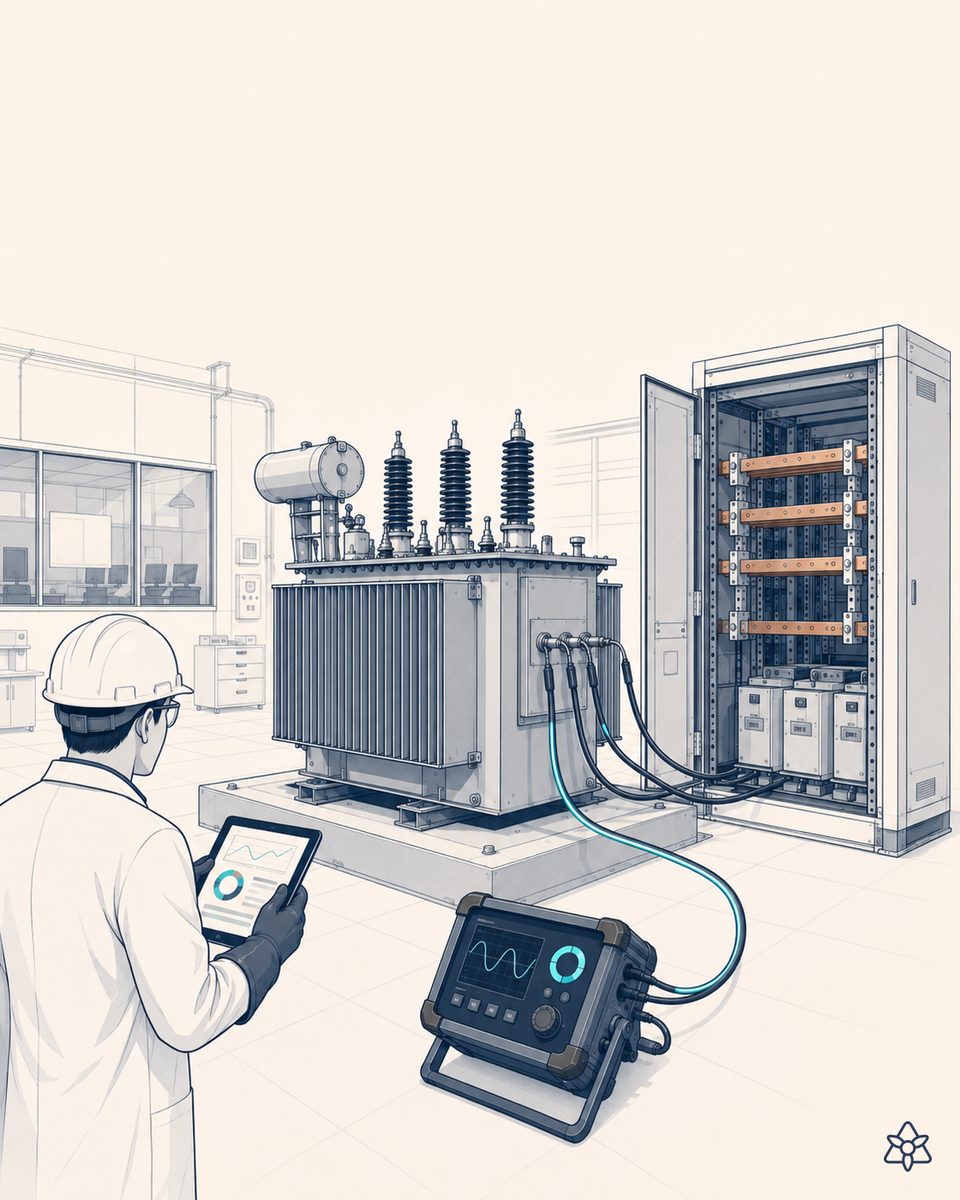
Three winding defects, all of them invisible once the core is closed.
Winding a distribution transformer is one of those operations where the failure is born in silence and turns catastrophic once there is no way back:
- Incorrect turn count — the turns ratio drifts. It is found at the final electrical test.
- Badly laid insulation layer — kraft paper or nomex with a wrinkle, a poorly made overlap or a gap. Risk of an interlayer short in service.
- Contact between adjacent turns — damaged enamel, turns riding over each other. A turn-to-turn short that shows up months later.
All three share the same pattern: they are born during winding and get buried at the next step — layer stacking, impregnation in oil or resin, closing the core. When the final test says “no”, stripping the transformer down to see what happened is close to throwing it away. And when the final test says “yes” but the turn-to-turn contact appears three years later in service, the cost is orders of magnitude higher: outages, replacement and a claim. The classic system (an attentive operator + the final test) works 99% of the time. That 1% is what the insurer or the brand pays for.
iLEAN Vision does not replace the winding operator — it seals the gap between the winding head and the final test.
The winding problem is not a lack of skill on the operator's part — good winders are still the gold of a transformer factory. The problem is that machine speed makes it impossible to watch every turn by eye, and between winding and the final test there are steps that bury the defect for good. iLEAN acts as the putty that fills that gap between the head of the winding machine and the test lab.
Vision watches the head while the coil is being wound. Connect reads the encoder and the machine's parameters. An agent cross-references it with the transformer's recipe and stops the machine if something does not add up. The person signs — never the other way round.
The iLEAN pieces applied to MV/LV transformer winding control:
- iLEAN Vision (Edge with CNN) — a terminal with high-speed cameras and calibrated lighting over the head of the winding machine. It counts turns in sync with the encoder, watches the interlayer insulation and the contact between turns. It sends a signal to the PLC to stop the machine before the defective layer gets buried. It works with no network.
- Connect — captures the encoder, the speed and the transformer's recipe (expected number of turns per layer, conductor, insulation type), whether that comes from a modern MES or from a spreadsheet kept by the winding lead. It also captures the batch certificate for the enameled wire and for the kraft paper / nomex at second zero.
- Agent — cross-references the image, the count, the recipe and the raw-material certificates. If there is a deviation, it does not send an email at 10 p.m.: it alerts the winder through whichever channel they use and, depending on the configured level of autonomy, stops the winding machine. The winder validates — and the machine only restarts with their sign-off.
Winding supervised by eye vs. winding with inline AI vision.
| Aspect | Classic winding | With inline iLEAN Vision |
|---|---|---|
| Moment of detection | Final electrical test, core already closed | During winding, before the next layer |
| Turn count | Trusted encoder + verification at the test | Encoder + Vision in parallel, a double net |
| Interlayer insulation | Operator's visual check at the layer change | Verified at winding speed, without a break |
| Turn-to-turn contact | Impossible to watch continuously by eye | The CNN detects damaged enamel and overlapping turns |
| Operation with no network | n/a | Edge keeps watching with its own lighting |
| Dossier per transformer | Rebuilt by hand for the end customer | Metrics per layer, automatic, tied to the serial number |
Impact estimate for your plant — to be validated with your numbers.
The block below is an estimate to be validated with the specific data of your plant. We put it forward so the committee has an order of magnitude; we refine it during the diagnostic.
- MV/LV distribution transformer factory (typically 25-2500 kVA) with enameled-wire and/or rectangular-conductor winding machines, and a final test covering turns ratio, resistance and partial discharge.
- iLEAN Vision pilot on one winding machine: Edge terminal + cameras + lighting + integration with the machine's encoder and PLC. First value expected within a few weeks, in assist mode first, with automatic stopping once the quality manager gives the go-ahead.
- Indicative payback between 4 and 9 months, depending on the rejection rate at the final test, the average cost of a rejected transformer and the cost of the winding hours thrown away.
- Expected reduction in transformer scrap at the final test of ≥ 30%, with a conservative floor. The hard lever is avoiding a single transformer that reaches the final test with a bad winding: the part is practically unrecoverable once impregnated and closed.
And the winding lead's reasonable doubt
“What if the AI gets it wrong and stops a winding machine on a false alarm?” — hallucination is a problem of free generation, not of anchored tasks like this one — comparing an image of the head against the pattern learned on that same machine with that same raw material. In anchored tasks, the best models brought error below 1.5%[1]. And even so, the system starts in assist mode (it alerts, it does not stop), and is only moved up to automatic stopping once the winder and the quality manager can see that the detections add up. IRIS's three safety rings are there for exactly that.
[1] OpenAI paper “Why Language Models Hallucinate”, 2025 — on the reliability of AI in anchored tasks.
What people ask about transformer winding control with AI vision
Which typical defects start in the winding of a distribution transformer?
The three classics: an incorrect turn count (turns ratio out of tolerance, picked up at the final test), a badly laid kraft paper / nomex layer (risk of an inter-turn short in service, invisible once impregnated), and contact between adjacent turns caused by damaged enameled wire or poor guidance at the head of the winding machine. All three share a very specific pattern: they are born during winding and get buried at the next step (layer stacking, impregnation in oil or resin, closing the core). When the final test says “no”, stripping the transformer down to see what happened is close to throwing it away.
Why is the operator's visual inspection not enough on a modern winding machine?
Because a modern winding machine runs at speeds the human eye physically cannot follow — several hundred turns per minute on LV, tens per minute on MV with rectangular conductor or foil, multiplied by hours of winding per transformer. The operator does their job very well at the critical moments (layer change, coil change) and checks the quality of the enameled wire as it comes in — but asking them to watch every single turn for a whole shift is not reasonable. A CNN camera does exactly that: it watches the head of the winding machine at line speed, counts turns and watches the contact between turns without ever tiring. The operator keeps the moments of decision, which is where they add value.
What exactly does iLEAN Vision see at the head of the winding machine?
iLEAN Vision reads three things in parallel from a single scene: (1) it counts turns synchronized with the winding machine's encoder — if the count drifts from what is expected for that layer, it alerts the operator; (2) it watches the interlayer insulation — kraft paper or nomex, detecting wrinkles, gaps or badly made overlaps; (3) it watches the contact between adjacent turns — damaged enamel, turns riding over each other or doubling up. All of it at winding speed, with the head passing in front of it. If something does not add up, it sends a signal to the PLC to stop the winding machine before that layer is buried under the next one.
Does this work with round, rectangular or foil conductor?
Yes, all three. The CNN is trained on the customer's specific conductor: round enameled magnet wire for LV, rectangular or continuously transposed conductor (CTC) for MV, aluminum or copper foil for foil windings. Training happens during the immersion phase, on real parts from the plant — we do not sell a “universal” model that then fails on your specific material. What changes from one winding to another is the trained model and the camera geometry, not the architecture.
What does an AI vision pilot on a winding machine cost, and what does it return?
The typical pilot is one winding machine with iLEAN Vision (Edge terminal + cameras + lighting) + integration with the machine's encoder + a stop actuator. The hard lever is the cost of a transformer rejected at the final test (the part is practically unrecoverable once it has been impregnated and the core closed), plus the cost of the winding hours thrown away. The payback presented to the committee is several months. Ask us for an estimated ROI with your plant's data — transformers per month, current rejection rate at the final test, average cost of a rejection — and we will send it to you within 48 hours.
More cases in other sectors
- Drum-to-site cable traceability with AI — the day a switchboard burns on site, you don't want to be digging through spreadsheets.How iLEAN Tracer ties copper batch, actual length, tests and destination site of each cable drum into…
- Laser marking verification on circuit breakers — one wrongly engraved digit is a different product, and another claim.iLEAN Vision validates the laser marking (In, Icu, curve) of miniature circuit breakers before packing.…
- CPR traceability for electrical cable — a meter without a class does not go on site.iLEAN Tracer links reaction-to-fire class, DoP and batch to every meter of CPR cable made and shipped to…
- EN 61439-2 audits of LV switchboards — the dossier is not stitched together the night before.A living EN 61439-2 file per LV switchboard: iLEAN Writer ties routine tests, the declaration of…
- EN 61439 applied-voltage test with an AI dossier — the bottleneck is no longer the test, it's the paperwork.How iLEAN Writer captures the EN 61439 applied-voltage test straight from the megohmmeter and delivers…
- GOES steel inspection for transformers — the burr you see afterwards is a loss the end customer pays for.How iLEAN Vision detects burr and cutting defects in grain-oriented electrical steel before the…
Tell us your case and in 48h we'll send you the estimated ROI of AI vision on your winding machine.
We work on the real data from your plant, not ours. Diagnostic with no commitment.
Request estimated ROI in 48h See electrical equipment