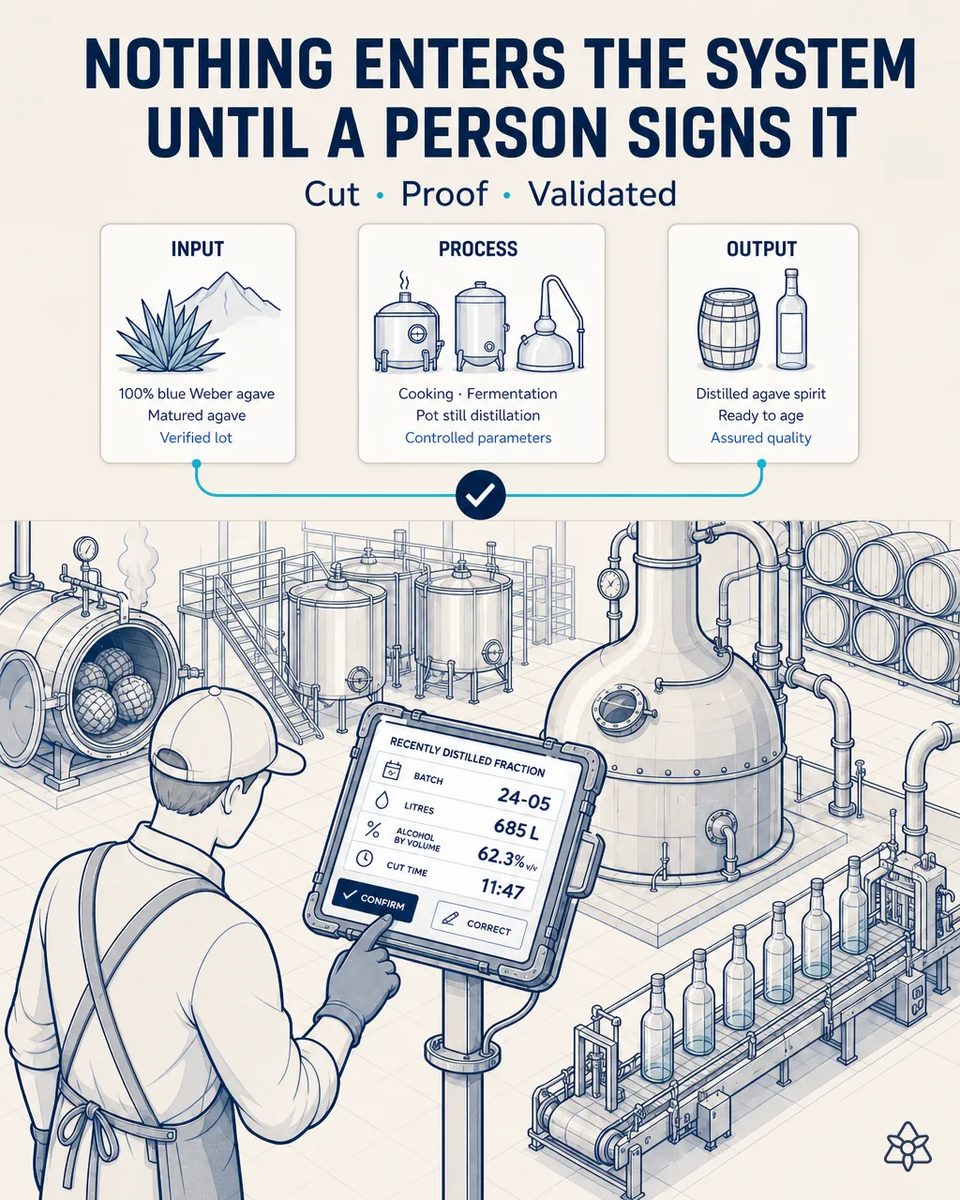
Nothing enters the system until a person signs it
This is what separates iLEAN from an autonomous AI agent that writes data nobody has signed. In a distillery, the data most likely to go in wrong is the distillation data: the proof of the ordinario, the volume and proof of each fraction, and the exact moment of the cut. An industrial tablet at the still shows the distiller what iLEAN has just read; he confirms with two taps, or corrects. Only then does the data cross into central memory.
The most sensitive data in the plant is typed by whoever was not at the still.
A distillery's process data is sparse but very sensitive. One misread degree or one mis-noted volume shifts the mass balance of the whole batch, and with it the yield calculation and the declared stock. Manual transcription introduces errors that surface weeks later, when there is no reconstructing what happened or who wrote it down. Work-in-progress inventory stops being reliable, and with it any conversation about losses. And there is a deeper problem with AI systems that write without a signature: if the AI posts data straight into the company master, the master gets contaminated and nobody can tell which record has human authorship and which does not. In front of a certifying body or a contract-production client, that does not hold up.
- A distillery's process data is sparse but very sensitive. One misread degree of proof or one mis-noted volume of heads shifts the mass balance of the whole batch, and with it the yield calculation and the declared stock.
- Manual transcription introduces errors that surface weeks later, when there is no reconstructing what happened or who wrote it down. Work-in-progress inventory stops being reliable, and with it any conversation about losses.
- If an AI posts data straight into the company master, the master gets contaminated: nobody can tell which record has human authorship and which does not. That is not a technical nuance; it is what an auditor asks about first.
- In front of the certifying body or a contract-production client, a record nobody signed does not hold up.
Connect with early human verification — two taps at the still.
Connect in early human verification mode. The flow:
It is the piece that guarantees the master is not contaminated and that every datum has a name attached. Without it, the other eleven cases on this page do not get approved, because nobody signs off on AI writing into the system the proof and the cut of a batch. The distiller confirms or corrects; iLEAN only assembles. It is also the piece the certifying body understands first, because it is the one that puts a name next to every number.
- An industrial tablet mounted at the still — resistant to humidity and wet hands — and a second one in the bottling area.
- It shows a visual summary, not a form: batch, fraction, liters, proof, cut time, with uncertain fields highlighted.
- Two taps: ✓ or correct the field that is wrong.
- Only after that signature does the data cross into central memory and from there into the ERP.
Every process record carries authorship: signed by whoever was standing at the still, with its timestamp. That turns the history into defensible evidence, and it is the requirement that makes every other case on this page defensible too.
Today's record versus the signed record
| Aspect | Today | With iLEAN |
|---|---|---|
| When the cut data enters | Days later | Seconds, at the still |
| Who appears as the author | Whoever typed it | Whoever stood at the still |
| A transcription error | Surfaces weeks later | Corrected on the spot |
| Uncertain fields | Invisible | Highlighted before signing |
| Work-in-progress inventory | Unreliable | Signed batch by batch |
| Who writes to the master | A person, typing | A person, confirming |
From transcription errors surfacing weeks later to validation in seconds, right at the point where the data happens. From a process master with no authorship to every record signed by a person.
Impact estimate — to be validated with your numbers.
The block below is an estimate to be validated against your plant's actual data. We put it forward so the committee has an order of magnitude; we refine it during the assessment.
- Estimated payback 4-9 months.
- Fewer administrative reworks: the error is corrected at the still, not chased weeks later by someone who was not there.
- A more reliable work-in-progress inventory, which is what every loss conversation depends on.
- And a process history that is defensible evidence in front of the certifying body, because every record carries who signed it and when.
Estimated payback 4-9 months from fewer administrative reworks and more reliable work-in-progress inventory. *Estimate to be validated.*
And the fair question from the production manager
"If a person signs in the end, what is the AI saving?" — the work is not in deciding, it is in assembling. Today somebody would walk to a terminal, find the batch and type fraction, liters, proof and time. Extracting those from the sheet or the still's readings is an anchored task, where the best models drop below 1.5% error [1], so the summary arrives assembled and the distiller only confirms or corrects. Every correction is stored and feeds back into the extraction, so the fields corrected most often become the ones flagged before asking.
[1] OpenAI paper "Why Language Models Hallucinate", 2025 — on the reliability of AI in anchored tasks.
What people ask about signing the cut on the tablet
How long does it take the distiller?
Seconds. The summary arrives with batch, fraction, liters, proof and cut time already assembled, and it is resolved with two taps at the still, with wet hands. The screen is a visual summary, not a form: what iLEAN is unsure about is highlighted, the rest is a glance.
Can the AI post the cut data on its own?
No, and it is not configurable: it is the architecture. Nothing crosses into central memory or the ERP without a human signature. If the distiller does not sign, the data stays pending and the batch is flagged as incomplete, which is a visible state rather than a silent one.
What exactly gets recorded?
What summary was shown, who confirmed it, when, and what was corrected if anything. That is what serves later in front of the certifying body or a brand client. The record also keeps which source the summary came from — the photographed sheet, the still's readings or a voice note — so every number can be traced back.
Does the tablet survive the still area?
It is an industrial tablet rated for humidity and wet hands, mounted at the still. A second one goes in the bottling area for the same purpose. Both work with gloves and both show the same summary, so the signature happens where the data happens.
Is it mandatory before the rest?
In practice yes. It is the requirement that makes every other case on this page defensible, because it guarantees every record has an author. Deployed first, it also gives the plant a working habit: nothing is real until somebody at the still has said so.
More cases from this series
- Every kilo of agave, accounted for in the bottleFour rings reconciling kilos of agave, liters of must, liters at 40% and stamped bottles, batch by…
- Every batch writes its own evidence packEvery batch generates its own file: agave origin, cooking curve, analysis, cuts, bottling and stamps,…
- Agave intake traced by photoPhotograph the weigh ticket and the field folios: kilos, field and folio post to the ERP with one tap,…
- The agave truck alert, read at second zeroiLEAN reads the delay or tonnage-change alert from the agave truck, cross-references the cooking…
- The autoclave panel, digitized without touching the machineAn external camera reads the pressure, temperature and time curve of the agave cooking autoclave. No PLC…
- The coder prints what the ERP says, with no typingBrand, batch, category and market travel from the ERP to the coder through the API, and tax stamp…
Tell us who appears as the author of last week's cut data in your system.
We work on your plant's real data, not ours. Assessment with no commitment.
Request estimated ROI within 48h ‹ See all cases of tequila distilleries See food industry