The master distiller talks while he walks
The master distiller spends the day walking between the cooking area, the fermentation tanks, the stills and the barrel cellar, with a hydrometer in one hand and a torch in the other. Everything he notices on that round is the finest information the plant has, and today it dies at the end of the shift. With iLEAN Connect in voice mode he talks while he walks: the system listens, structures, stores and hands support back in seconds, without him stopping or pulling out a phone.
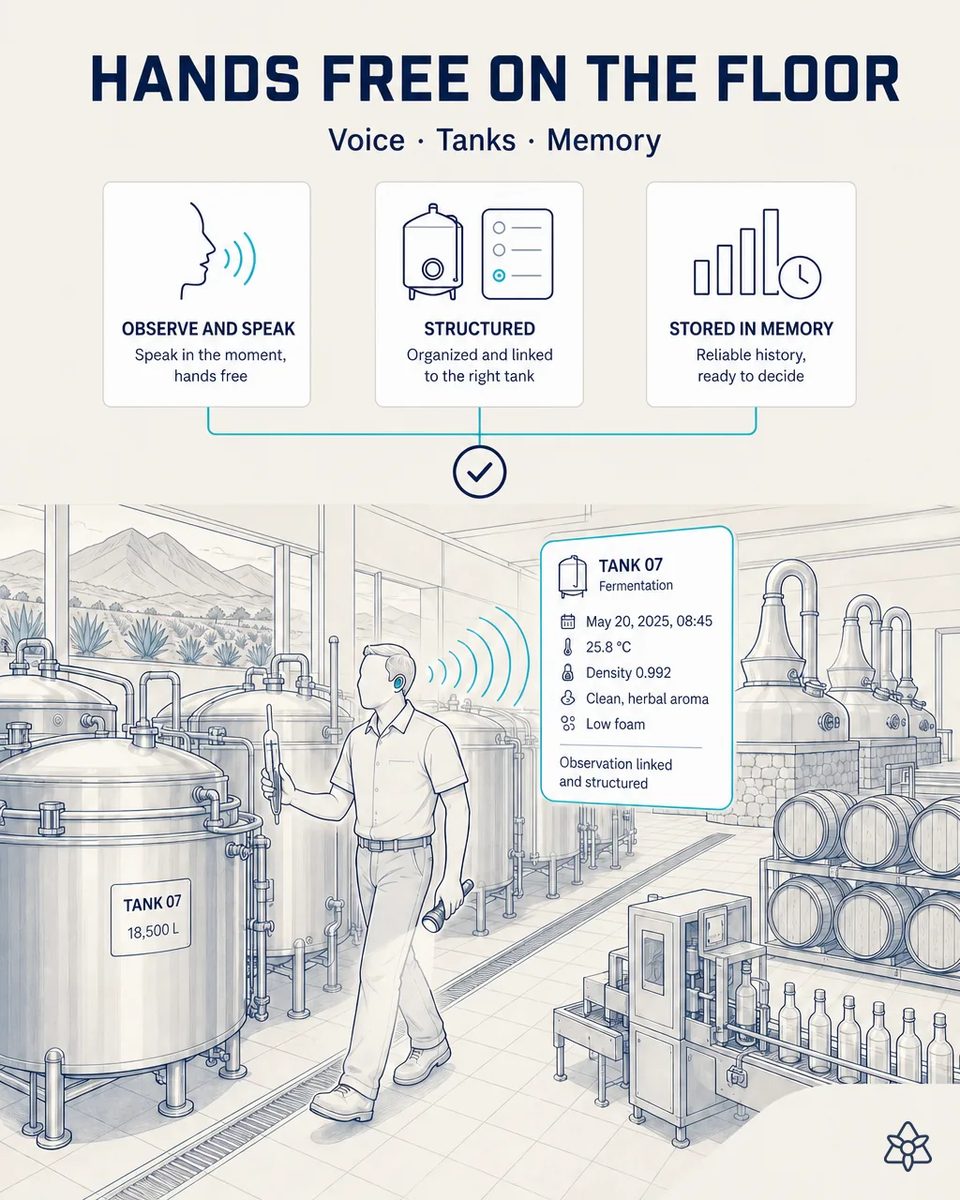
The finest information in the plant dies at the end of the shift.
In a premium distillery the critical knowledge is sensory and contextual. No sensor holds it: it depends on a person who has spent decades smelling, tasting and looking. That tank six started slow, that the coil is running tight on temperature, that a barrel in row three is sweating more than usual. That person cannot type: their hands are full and they are moving. And asking them to fill in a form at the end of the shift is asking them to reconstruct from memory what they noticed eight hours earlier. What gets lost is precisely the observations that anticipate a problem — the ones that arrive as instinct rather than as an alarm. What survives today are stray comments in a chat group, unstructured, tied to no tank and no batch, impossible to look up when the same pattern repeats three months later.
- In a premium distillery the critical knowledge is sensory and contextual. No sensor holds it: that tank six started slow, that the coil on the copper still is running tight on temperature, that a barrel in row three is sweating more than usual.
- The person who holds it cannot type: he has a hydrometer in one hand and a flashlight in the other and he is moving between cooking, tanks, stills and the barrel cellar.
- Asking him to fill in a form at the end of the shift is asking him to reconstruct from memory what he noticed eight hours earlier. What gets lost is precisely the observation that anticipates a problem.
- What survives today are stray comments in a chat group, tied to no tank and no batch, impossible to look up when the same pattern repeats three months later.
Connect in voice mode — iLEAN listens to the master distiller, not to the plant.
Connect in voice mode. The flow:
The microphone activates when he wants it to, and only for what he chooses to say. That distinction is not cosmetic: it is what keeps the case alive in month six instead of being perceived as monitoring. And the answer that comes back in seconds — that tank also started slow in the two previous batches with the same yeast lot — is support, not a decision. He can also ask — which tanks started slow this year? — and get the list, with the batches beside it.
- A light Bluetooth earpiece, of the kind already used on the floor.
- The master distiller activates the microphone when he wants and dictates in plain language: "note that tank six has been running two days slow since the yeast lot changed".
- iLEAN structures the observation, ties it to the active tank and batch, and stores it in central memory.
- And it answers in seconds with what it already knows: "that tank also started slow in the two previous batches with that same yeast lot — shall I flag it to the lab?"
One design point matters here: the AI listens to the conversation the master distiller directs at it, not to the plant and not to the operators. The microphone activates when he wants it to. Humans in command, without exceptions.
Today's round versus the captured round
| Aspect | Today | With iLEAN Connect |
|---|---|---|
| A qualitative observation | Lost at the end of the shift | Tied to tank, batch and yeast lot |
| The master distiller's hands | Full: hydrometer and flashlight | Still full: he just talks |
| A slow tank | "I think this happened before" | "It happened in these three batches" |
| Where the notes live | A chat group | Searchable central memory |
| What comes back | Nothing | What the house already knows, in seconds |
| Operators' conversations | — | Not recorded |
From no record of qualitative observation at all to a history searchable by tank, by batch and by yeast lot. From "I think this happened before" to "it happened in these three batches, with this common factor".
Impact estimate — to be validated with your numbers.
The block below is an estimate to be validated against your plant's actual data. We put it forward so the committee has an order of magnitude; we refine it during the assessment.
- Estimated payback 5-10 months, hard to isolate on its own because its main value is preserving the master distiller's knowledge as an asset of the house.
- A history searchable by tank, by batch and by yeast lot where today there is no record at all.
- Problems anticipated from an observation instead of discovered from an alarm — a slow tank flagged on day two rather than at the still.
- And the sensory criteria of the person who decides the cut, available to the house the day that person is no longer there.
Estimated payback 5-10 months, hard to isolate because its main value is preserving the master distiller's knowledge as an asset of the house. *Estimate to be validated.*
And the fair question from the production manager
"Will it understand him with the pumps running and trade words nobody outside the plant uses?" — recognition is prepared for industrial noise and for the vocabulary of the house: piña, ordinario, heads, tails, the names of the tanks. Structuring a dictated observation into tank, batch, symptom and severity is an anchored task, where the best models drop below 1.5% error [1], and what was understood is shown back to him so he can correct it with one word.
[1] OpenAI paper "Why Language Models Hallucinate", 2025 — on the reliability of AI in anchored tasks.
What people ask about voice capture on the distillery floor
Does it listen all the time?
No. The microphone activates when the master distiller wants it to and records only what he directs at it. There is no continuous listening and no tracking of where anyone is. What operators say to each other on the floor is never captured.
Does he have to speak in a particular way?
No. He speaks the way he would tell a colleague. iLEAN structures it afterwards into tank, batch, symptom and severity. A half sentence between two tanks is enough; he does not have to finish a form.
How does it know which tank he means?
From what he says, and from the active batches in central memory. If there is doubt, it asks back rather than guessing. The tank name and the batch number are the two anchors it always resolves first.
Does it replace the batch log?
No. The batch log carries the numbers; the voice notes carry the context around them. Both end up on the same batch, which is what makes them useful together: the photo carries what was measured, the voice carries what was noticed.
What does the plant keep if the master distiller leaves?
The history of his observations, tied to the batches they concern. Not his instinct, which cannot be copied, but the record of how that instinct read each batch. That record is what the next master distiller reads to understand why the house cuts where it cuts.
More cases from this series
- Every kilo of agave, accounted for in the bottleFour rings reconciling kilos of agave, liters of must, liters at 40% and stamped bottles, batch by…
- Every batch writes its own evidence packEvery batch generates its own file: agave origin, cooking curve, analysis, cuts, bottling and stamps,…
- Agave intake traced by photoPhotograph the weigh ticket and the field folios: kilos, field and folio post to the ERP with one tap,…
- The agave truck alert, read at second zeroiLEAN reads the delay or tonnage-change alert from the agave truck, cross-references the cooking…
- The autoclave panel, digitized without touching the machineAn external camera reads the pressure, temperature and time curve of the agave cooking autoclave. No PLC…
- The coder prints what the ERP says, with no typingBrand, batch, category and market travel from the ERP to the coder through the API, and tax stamp…
Tell us how many of the master distiller's observations from last month you could find today.
We work on your plant's real data, not ours. Assessment with no commitment.
Request estimated ROI within 48h ‹ See all cases of tequila distilleries See food industry