Format change verified
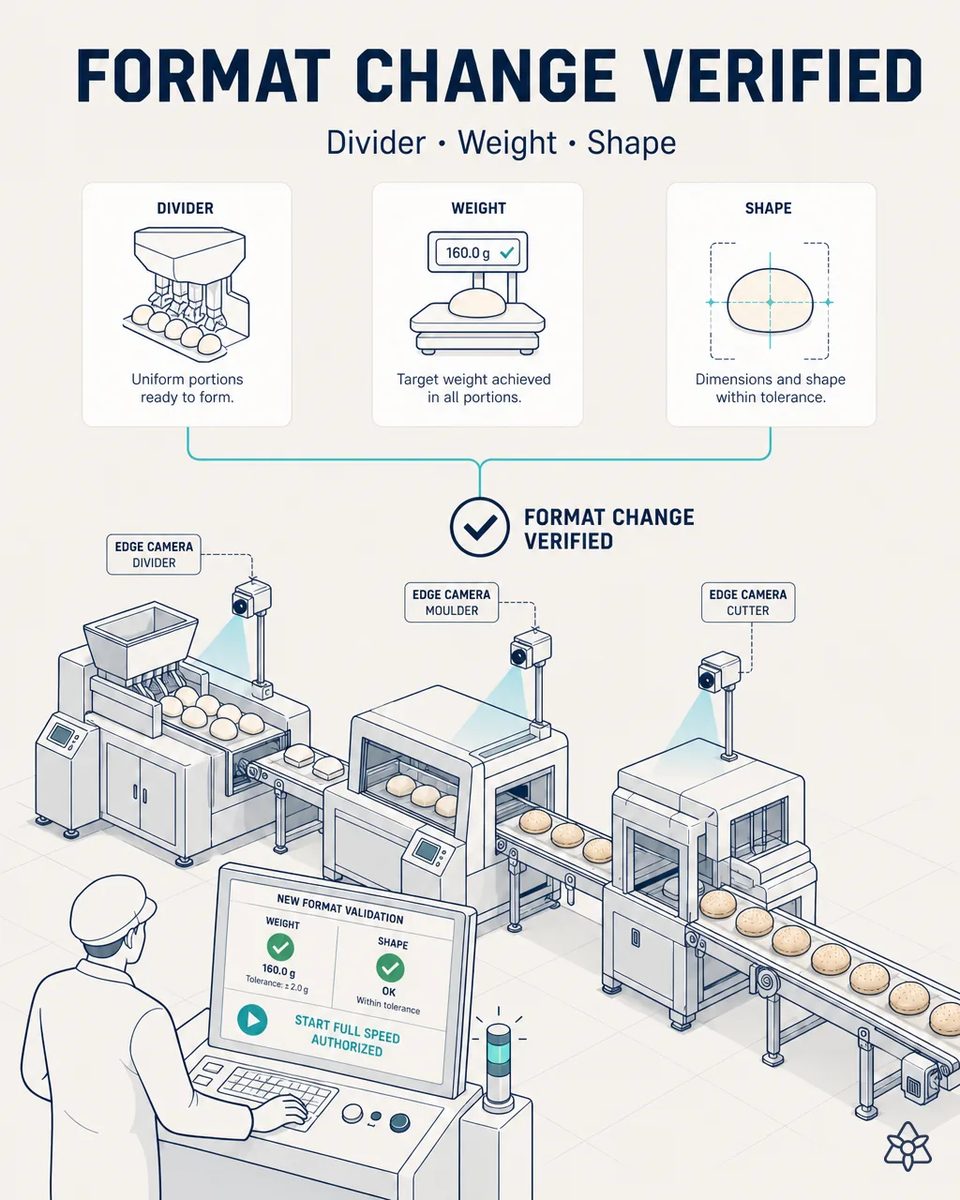
Switching from large sliced bread to burger buns means recalibrating the divider, molder and cutter. With iLEAN Edge, fixed cameras at every critical point compare the current state against the new format's reference, and JIDOKA AI won't allow full-speed startup until all of them check out.
After a format change, the first minutes are baked on trust.
If a format changeover isn't perfectly set, the first minutes of production come out off-weight or off-shape. Today it depends on an operator eyeballing it and signing off "ready", with no objective evidence.
- Switching from large sliced pan bread to burger buns means recalibrating the divider, the molder and the cutter: piece weight, dough shape and cut all change at once.
- If one of them is not perfectly set, the first minutes of production come out off-weight or off-shape and are already proofing before anyone notices. By the time they reach the oven exit, the dough and the oven time are both spent.
- Today the decision depends on an operator eyeballing it and signing off as ready, with no objective evidence behind the signature. It is not carelessness: the changeover sits on the critical path and the shift clock is running.
- And multi-SKU lines change format several times a week, so the exposure repeats with every switch, on every shift that runs a changeover.
Edge with JIDOKA AI — no full-speed startup until every critical point checks out.
Edge + JIDOKA AI. Industrial cameras with vision models trained to recognize "correct format vs. weight or shape deviation" at each critical point. Startup blocked until visual OK + supervisor sign-off.
The camera does not replace the operator's judgment: it gives it evidence. Each critical point is compared with the new format's reference, and the supervisor signs on what the cameras saw instead of on a feeling. What changes is not who decides, but what the decision rests on.
Blind format startup versus format startup verified by camera
| Aspect | Today | With iLEAN Edge |
|---|---|---|
| Divider piece weight | Checked on a few pieces | Confirmed against target and tolerance |
| Molded dough shape | Judged by eye | Compared with the format reference |
| Cutter setting | Found wrong at the slicer | Verified before full speed |
| Ready-to-run signature | A tick with nothing behind it | Visual OK plus supervisor sign-off |
| Minutes of off-spec product | Baked and then scrapped | Held before they reach the oven |
| Evidence of the changeover | None | Images stored per change |
Impact estimate — to be validated against your changeover log.
The block below is an estimate to be validated against your plant's actual data. We put it forward so the committee has an order of magnitude; we refine it during the assessment.
- Payback depends on changeover frequency: we do not fix a month range because a line that switches once a month and one that switches daily are different cases.
- On multi-SKU lines that change format several times a week, startup scrap after each change is where the return accumulates: dough that was divided, molded and proofed wrong is lost along with the oven time it used.
- The blind startup with off-spec minutes becomes a startup verified with objective visual evidence at every critical point, signed by the supervisor on what the cameras saw.
- And every changeover leaves its own images, which the audit dossier (case 11) uses without anyone rebuilding it. The evidence that authorized the start is the same evidence the auditor later reads.
Reduced startup scrap after format changes; payback depends on changeover frequency (multi-SKU lines change several times a week). Estimate to validate.
And the fair question from the production manager
“What if the cameras hold the line for nothing while the shift clock runs?” — that is the right objection, because a changeover sits on the critical path. Comparing a piece's weight and shape with a known format reference is an anchored task, where the best models drop below 1.5% error [1]. When the doubt is the model's, it does not block silently: it escalates to the supervisor, who decides on the images.
[1] OpenAI paper "Why Language Models Hallucinate", 2025 — on the reliability of AI in anchored tasks.
What people ask about verifying format changeovers
Which points does the system check?
Divider, molder and cutter as a rule, each with its own fixed camera and reference for the new format. The exact points are set at commissioning with your line team, who know where changeovers usually go wrong.
How is piece weight confirmed after the change?
Against the new format's target and tolerance, using the line's own weighing where it exists and piece size against the reference image, always with the supervisor confirming before full speed.
Does the camera check add minutes to the changeover?
The check takes seconds. What lengthens a changeover today is the cautious slow ramp-up that exists precisely because there is no evidence that the settings are right.
Can the supervisor override a hold?
Yes, with a signature that is stored as an exception. What cannot happen is a full-speed start with no record of who decided it. The exception appears in the changeover's own record.
Does SMED work fit with this?
It does. The verification removes the uncertainty at the end of the change, which is often the slowest part, so it adds to a SMED effort rather than competing with it. Fast changes and verified changes stop being a trade-off.
More cases from this series
- Coder without typingiLEAN stitches the date/batch coder to the ERP via API: a batch change is a tap in the ERP, not typing…
- Supplier alert in secondsiLEAN reads the flour supplier's email at zero latency, cross-references active ERP orders, and suggests…
- Voice that keeps walkingThe shift leader dictates issues while walking the floor with a headset; iLEAN structures them and…
- Lab Excel, into the ERPiLEAN Connect absorbs the lab's quality Excel and pushes it to the ERP after verification, with up to…
- Camera reads vintage panelAn external camera reads a 15-20-year-old proofing-chamber panel and digitizes its curve without…
- Paperless line startupHow Connect digitizes the Production Order and oven startup log with two phone photos, at zero latency,…
Tell us how many format changes your bread lines run per week.
We work on your plant's real data, not ours. Assessment with no commitment.
Request estimated ROI within 48h ‹ See all cases of industrial bakery See food industry