Zero Allergen Mix-Ups Across the Range
The capital pain of a gourmet croquette plant with 18 SKUs selling into large retail is always the same: zero allergen or labeling mix-ups across the range. The work order and the store order define the SKU and its allergens from the start, already validated by Connect.
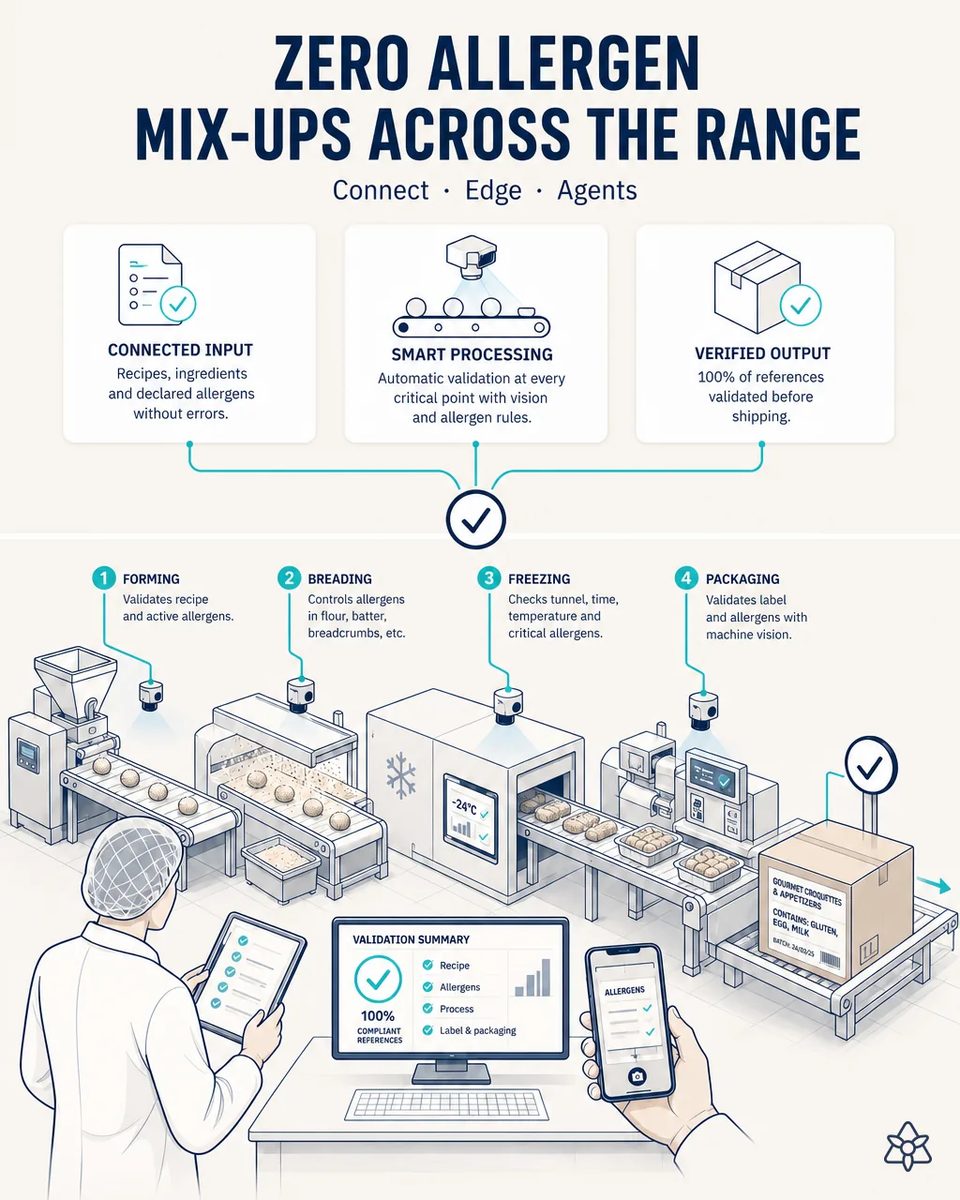
An allergen mix-up is never one failure: it is a chain of small ones.
The capital pain of a gourmet croquette plant with 18 SKUs selling into large retail is always the same: zero allergen or labeling mix-ups across the range.
- A sheet from the previous run left on the forming table, a changeover signed in a hurry, a reel of film loaded from the wrong SKU and a label nobody read before boxing.
- Each link looks acceptable on its own and passes its own control. Together they produce the pack that declares the wrong allergens.
- With a range mixing milk, gluten, egg, shellfish and a deliberately vegan SKU, every changeover is an exposure — and short runs multiply the number of changeovers.
- And the cost is not a reject: it is a withdrawal, a retail distributor who stops trusting the brand, and a consumer who bought it directly from you.
Connect, Edge and Agents coordinated — JIDOKA AI stops the line on a discrepancy.
The work order and the store order define the SKU and its allergens from the start, already validated by Connect. Batch start-up validates that the recipe matches the planned SKU; the Edge camera over packaging reads what's being boxed and cross-checks it against the active SKU. If it doesn't match, JIDOKA AI stops the line.
No single check solves it: each one already exists today in some form and the pack still gets through. The strength is in the cross-reference, because what gives the chain away is two independent sources ceasing to agree — the label being boxed against the SKU the order planned, the batter made against the recipe the work order called for.
The six checks, and what each one closes
| Check | Which cases it draws on | What it closes |
|---|---|---|
| 1 · The order | Batch start-up (1) + online store (8) | Which SKU and which allergens were planned |
| 2 · The recipe | Batch start-up (1) + quality spreadsheet (6) | That the batter made matches the SKU planned |
| 3 · The ingredients | Delivery note (7) + supplier delay (3) | Which lots actually entered the batch |
| 4 · The changeover | Clean validation (10) | That the line was clean for this allergen |
| 5 · The pack | Breading inspection (9) + packaging camera | That what is being boxed is the active SKU |
| 6 · The evidence | IFS dossier (11) + two-tap validation (5) | Who validated each step, and when |
Latent risk of allergen mix-up at every SKU changeover → Discrepancy caught on the line, before it ships to retail.
Impact estimate — to be validated with your numbers.
The block below is an estimate to be validated against your plant's actual data. We put it forward so the committee has an order of magnitude; we refine it during the assessment.
- Estimated payback 6-12 months, measured against the first avoided withdrawal and to be validated with management and quality together.
- Protection of the relationship with the large-retail distributor, which is what the IFS Plus certification opened in the first place and what a single incident closes.
- A discrepancy caught on the line rather than on a shelf: the scope goes from a market withdrawal to a run held in the cold store.
- And, in direct sales, a wrong pack that never reaches a consumer's home with your own name on it.
Payback 6-12 months · protection against a product recall. Estimated payback is 6 to 12 months against the first avoided recall, while also protecting the relationship with the large-retail distributor. Estimate to validate with management and quality.
And the fair question from the production manager
"Do we have to deploy all twelve cases to get this?" — no, and framing it that way is how a project never starts. The checks are built in layers and each case pays on its own from the first month. With batch start-up and the clean validation you already have checks 1, 2 and 4, which is where most of the current exposure sits. Where a model is involved the tasks are anchored, with the best models below 1.5% error [1], and JIDOKA AI stops only on a verifiable discrepancy between sources.
[1] OpenAI paper "Why Language Models Hallucinate", 2025 — on the reliability of AI in anchored tasks.
What people ask about the complete system
Where do you start?
With the case that has fewest dependencies, which here is batch start-up, followed by the two-tap validation that makes everything else acceptable on the floor.
What does the cross-reference add that each control does not?
The chain. A changeover signed in a hurry passes its own control and a film reel loaded from the wrong SKU passes its own; the pack that adds the two together is the one that ships wrong.
What if two checks disagree wrongly?
JIDOKA AI stops on a verifiable discrepancy between two sources, not on a model's uncertainty. When the doubt belongs to the model, the case is escalated to a person.
Does it replace our ERP or our recipe master?
No. Check 1 rests precisely on the order being the truth. iLEAN cross-references your systems against each other and against what is actually happening on the line.
Can the return be estimated before committing?
Yes: with your changeover count, your reject history and what a withdrawal would cost in your channel, the return of each layer is estimated before deciding the order of deployment.
More cases from this series
- Paperless Batch Start for Gourmet Croquette PlantsiLEAN Connect digitizes the work order and recipe sheet the moment a gourmet croquette batch starts,…
- The Production Lead Reports Without StoppingThe production lead logs incidents by voice while walking the line, hands-free, without ever stopping…
- The IQF Freezing Tunnel Starts TalkingAn external camera reads the IQF freezing tunnel's panel and digitizes its temperature curve without…
- Online Orders Stop Being Re-TypedOnline store and HORECA orders flow automatically into the production system, with no manual re-entry.
- The Quality Spreadsheet Stops Living on Its OwniLEAN reads the lab's quality control spreadsheet and pushes it into the ERP after validation, cutting…
- Catching a Supplier Delay Before It Costs the ShiftiLEAN reads the seafood or ham supplier's delay email instantly and proposes how to replan production…
Tell us what an allergen withdrawal would cost your brand, in retail and in your own online store.
We work on your plant's real data, not ours. Assessment with no commitment.
Request estimated ROI within 48h ‹ See all cases of gourmet croquettes and appetizers See food industry