The Burst Croquette Never Reaches the Bag
At real line speed, 100% human visual control is impossible. With 18 different SKUs, the 'correct shape' pattern also changes from product to product. A camera above the line infers per piece in milliseconds, using a model trained on the specific SKU, with no image ever sent to the cloud.
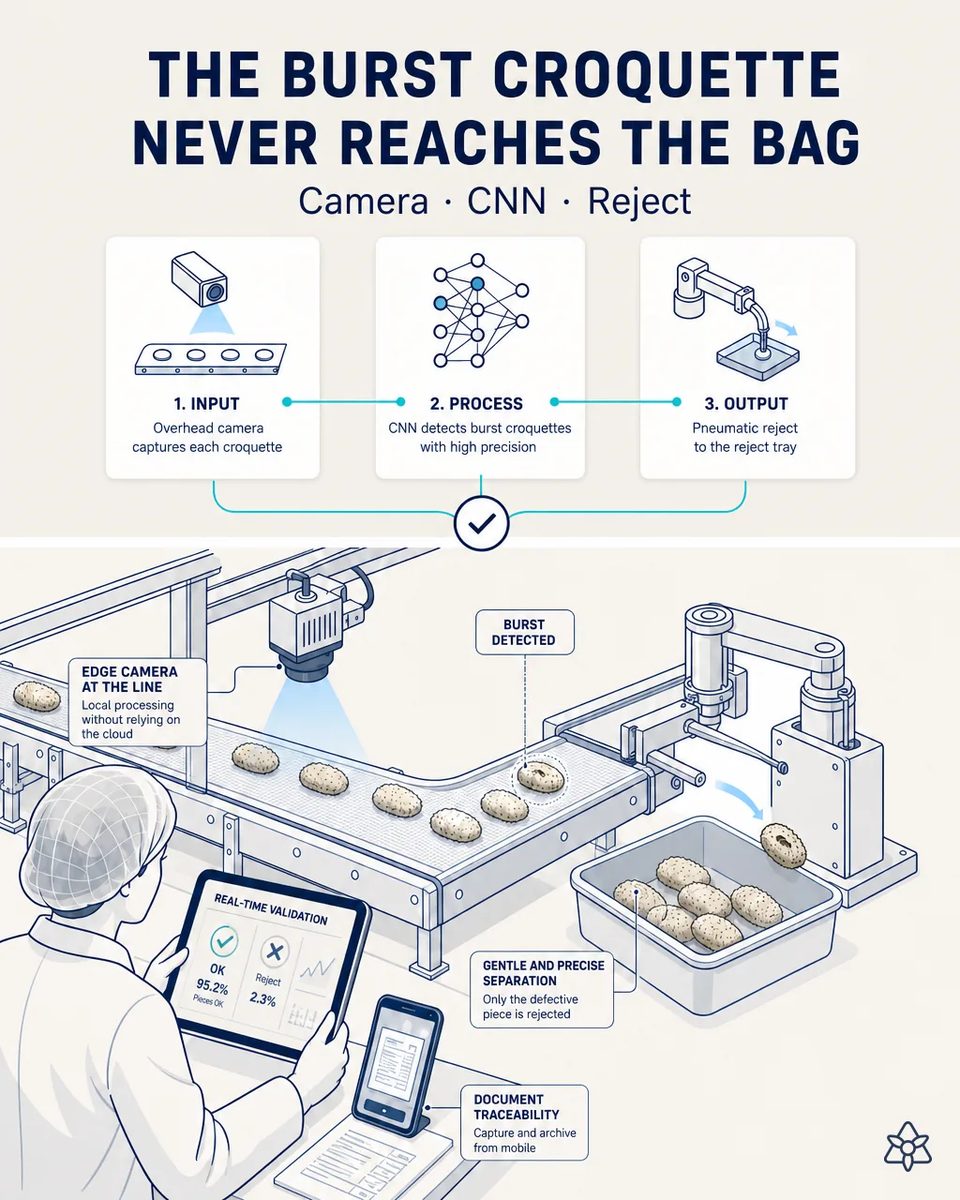
At line speed, a human eye covers one or two percent of what goes into the bag.
At real line speed, 100% human visual control is impossible. With 18 different SKUs, the 'correct shape' pattern also changes from product to product.
- A burst croquette, one with the filling showing through, one with a bare patch where the breadcrumb never took: all of them are obvious on a tray, sitting still, and none of them is reliably caught at cadence on a moving belt.
- With 18 SKUs the 'correct shape' itself changes from product to product: a bite-size appetizer, a 20 g cylinder and a hand-formed artisan piece are not the same reference.
- So visual control ends up being a sample of one or two percent, checked by whoever is free, against a pattern that changed with the last SKU changeover.
- And the defect that gets through does not stop at the bag: in direct sales it arrives at a consumer's home under your own brand, with a photo attached to the review.
Edge — inference per piece in milliseconds, with the model of the active SKU.
A camera above the line infers per piece in milliseconds, using a model trained on the specific SKU, with no image ever sent to the cloud. A burst, malformed or incompletely breaded piece is automatically diverted before packaging, without slowing the line's pace.
The image never leaves the line: inference runs locally, so cadence does not depend on the plant network and no picture of your product ever reaches a cloud. Rejecting before packaging also means the film, the tray and the freezing were not spent on a piece that was never going to ship — and that saving is almost always left out of the business case.
Today's visual control versus Edge inspection
| Aspect | Visual sampling | With iLEAN Edge |
|---|---|---|
| Coverage | 1-2% sampled | 100%, piece by piece |
| Speed | Slows down to look | Milliseconds, at line pace |
| A burst or bare piece | Gets through between samples | Diverted before packaging |
| Pattern per SKU | Changes with each changeover | The model of the active SKU |
| Defect history | A count on a sheet | Per SKU, shift and run |
| Images sent to the cloud | — | None: inference is local |
1-2% human visual sampling, defects slip through → 100% visual control, in milliseconds per piece.
Impact estimate — to be validated with your numbers.
The block below is an estimate to be validated against your plant's actual data. We put it forward so the committee has an order of magnitude; we refine it during the assessment.
- Estimated payback 5-12 months, depending on your current reject ratio and on how much of it is caught today.
- From 1-2% sampling to 100% inspection, without slowing the line's pace by a single piece per minute.
- Fewer visual-defect complaints, which in direct-to-consumer sales arrive as a public review with a photograph attached rather than as a quiet claim from a distributor.
- And a defect history per SKU, shift and run that shows which format, which batter and which filling are actually generating the rejects, instead of a single number argued about in the morning meeting.
Payback 5-12 months · 1-2% sampling → 100% inspection. Estimated payback is 5 to 12 months depending on the current reject ratio, with fewer visual-defect complaints as an added benefit. Estimate to validate.
And the fair question from the production manager
"What if it rejects good pieces?" — the false positive is the real risk of any vision system, which is why the model is trained on good and bad pieces of your own SKUs, under the lighting of that station, and never on a generic model. Borderline pieces are not simply dropped: they are escalated to the operator, and every decision feeds back into training. On the classification itself the task is anchored, with the best models below 1.5% error [1].
[1] OpenAI paper "Why Language Models Hallucinate", 2025 — on the reliability of AI in anchored tasks.
What people ask about inspecting the breading line
Does it keep up with the breading line's speed?
Yes: inference is local and resolves in milliseconds per piece, so it depends neither on the plant network nor on an internet connection.
How many pieces are needed to train it?
Fewer than people expect, because a croquette's defect catalog is short and repetitive: burst, malformed, bare patch, double breading. What matters is that they are real pieces from your own SKUs.
Does it handle several SKUs on the same camera?
Yes, switching the model with the active SKU, which Connect already knows from batch start-up. With 18 references that is not an optional extra: it is the requirement, because a bite-size appetizer and a hand-formed piece have nothing in common visually.
What happens to the rejected piece?
It is diverted into a reject tray before packaging, with a separation gentle enough not to burst the pieces around it, and it is counted against its own run and its own defect type.
Does it replace the quality technician?
No. It replaces the sample. The technician stops counting defects on a tray and starts working on why one particular SKU produces them, which is the part of the job that actually reduces rejects.
More cases from this series
- Paperless Batch Start for Gourmet Croquette PlantsiLEAN Connect digitizes the work order and recipe sheet the moment a gourmet croquette batch starts,…
- The Production Lead Reports Without StoppingThe production lead logs incidents by voice while walking the line, hands-free, without ever stopping…
- The IQF Freezing Tunnel Starts TalkingAn external camera reads the IQF freezing tunnel's panel and digitizes its temperature curve without…
- Online Orders Stop Being Re-TypedOnline store and HORECA orders flow automatically into the production system, with no manual re-entry.
- The Quality Spreadsheet Stops Living on Its OwniLEAN reads the lab's quality control spreadsheet and pushes it into the ERP after validation, cutting…
- Catching a Supplier Delay Before It Costs the ShiftiLEAN reads the seafood or ham supplier's delay email instantly and proposes how to replan production…
Tell us what percentage of the croquettes you pack is actually looked at, piece by piece, today.
We work on your plant's real data, not ours. Assessment with no commitment.
Request estimated ROI within 48h ‹ See all cases of gourmet croquettes and appetizers See food industry