Two Taps Before It Enters the System
The main cultural brake on digitizing is the fear that AI enters data on its own and someone has to clean up the ERP afterward. But there's no time to type on the line either. When iLEAN parses the work order, when the production lead dictates an incident, or a supplier email arrives, it all shows up on the tablet as a 2-second visual summary.
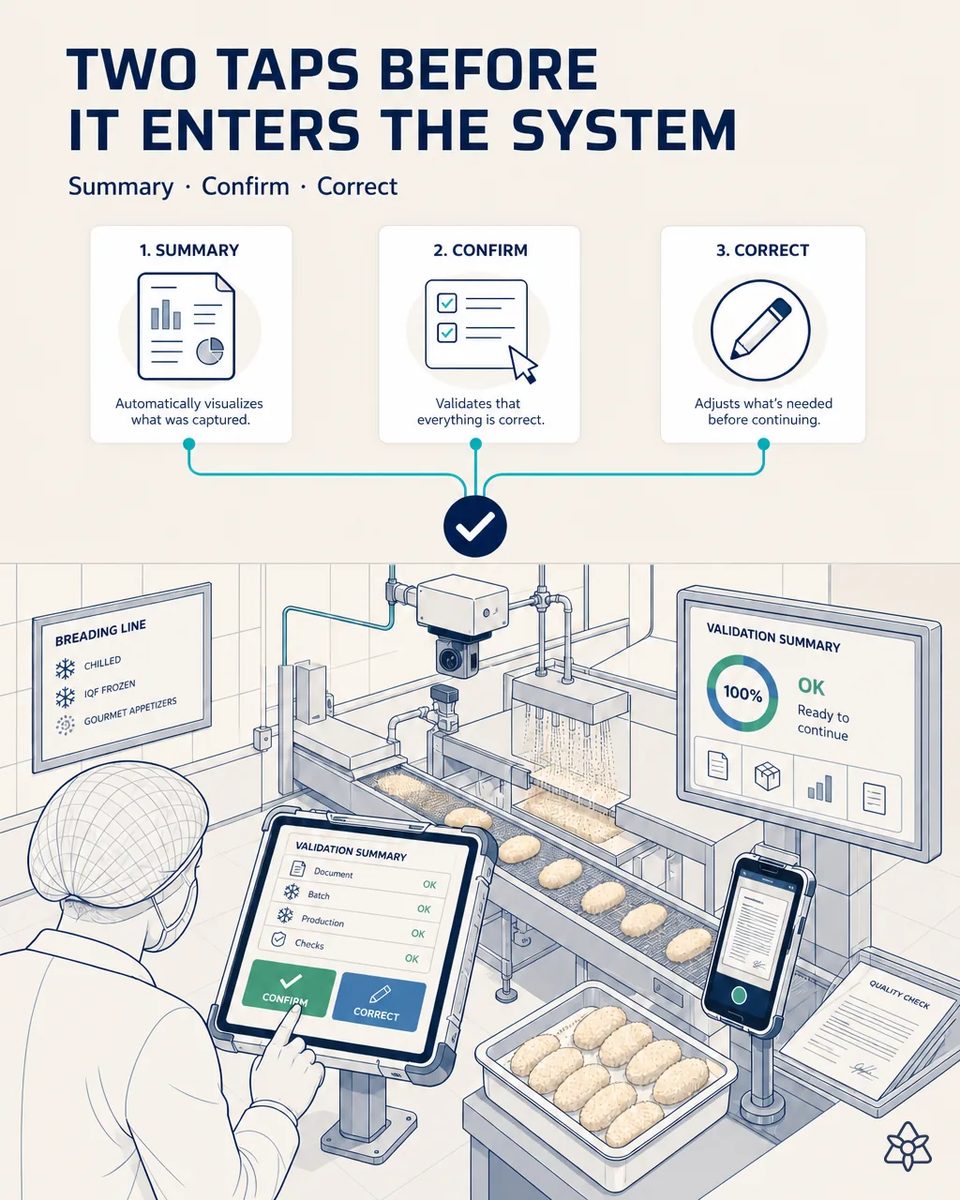
The cultural brake is not the technology: it is who answers for what is in the system.
The main cultural brake on digitizing is the fear that AI enters data on its own and someone has to clean up the ERP afterward. But there's no time to type on the line either.
- The fear is concrete and reasonable, and it is the main cultural brake on digitizing anything here: that an AI enters data on its own and somebody spends the following month cleaning up the master behind it.
- The opposite fear is just as real: there is no time to type on a breading line, and any system that asks for it gets abandoned in the second week.
- Caught between the two, most plants stay on paper — and paper is exactly what leaves the batch invisible until the evening, or until the following Monday.
- In an own-brand gourmet range the master is not an internal matter: what is in it ends up printed on a pack that carries your own name, and read by a customer who bought it from you directly.
Connect with early human verification — two taps on the line tablet.
When iLEAN parses the work order, when the production lead dictates an incident, or a supplier email arrives, it all shows up on the tablet as a 2-second visual summary. The supervisor confirms with one tap or corrects with another. Only then does the data cross into the central system. No training, no habit change.
It is the piece that makes the other eleven acceptable in this plant. Every datum has a person's name behind it and the master is never written by a machine alone — and it costs the line two seconds, not two minutes. Whatever iLEAN parses, dictates or receives surfaces here first, as a summary built to be confirmed with one tap or corrected with another.
Today's data entry versus two-tap validation
| Aspect | Today | With iLEAN Connect |
|---|---|---|
| When data enters the system | When somebody finds time to type | The moment it is confirmed |
| Who answers for it | Unclear | The person who tapped, by name |
| What the line has to do | Type, or not bother | Read a 2-second summary |
| A capture that looks wrong | Discovered later in the ERP | Corrected with one tap |
| Training needed | A new screen to learn | None: confirm or correct |
| Who writes to the master | Whoever holds a seat | Only validated data |
Fear of AI entering unvalidated data into the ERP → Human-validated data in seconds, a clean master.
Impact estimate — to be validated with your numbers.
The block below is an estimate to be validated against your plant's actual data. We put it forward so the committee has an order of magnitude; we refine it during the assessment.
- No standalone payback: this is an enabling piece. Its value is that the rest of the matrix gets signed off at all.
- The master stays clean, which is what makes the data usable by the store, the ERP and the audit dossier alike — none of which tolerates a field somebody has to go back and fix.
- Two seconds per capture on the line, against the minutes a manual entry costs today and the hours of cleanup a bad one costs later.
- And the cultural objection — that AI enters data on its own — stops being an objection, because it does not.
Strategic value · the piece that unlocks the whole iLEAN matrix. Without this early human verification, none of the other pieces of the iLEAN matrix would get signed off in this plant. It's the step that earns trust for everything else.
And the fair question from the production manager
"If the tablet is just a rubber stamp, what have we gained?" — the summary is designed to be read in two seconds and shows exactly what will be written, field by field, so confirming is a decision rather than a reflex. Underneath, each capture is an anchored task where the best models drop below 1.5% error [1], so the person on the line is correcting the occasional exception, not re-entering the whole batch by hand.
[1] OpenAI paper "Why Language Models Hallucinate", 2025 — on the reliability of AI in anchored tasks.
What people ask about validating on the line tablet
How long does it take the person on the line?
About two seconds: the summary is built to be read at a glance, with the fields that matter highlighted and everything else collapsed. It is one screen, not a form.
Can iLEAN write into the ERP without that confirmation?
No. That is the rule the whole matrix rests on here: no capture becomes data until somebody on the line has looked at it and confirmed it, and that rule is not configurable away.
Where does the tablet live?
At the point where the capture happens: batter room, breading line, dock. It is a wash-down industrial tablet that works with gloves on, not an office device brought down for the demo.
What is recorded when somebody corrects a capture?
The original value, the corrected one, who corrected it and when. That trail is both the traceability an auditor asks for and what improves the extraction over time.
Does it have to be deployed before the other cases?
In practice yes, and the brief says as much: without this early human verification none of the other pieces of the matrix would get signed off in this plant. It is the step that earns the trust for everything else.
More cases from this series
- Paperless Batch Start for Gourmet Croquette PlantsiLEAN Connect digitizes the work order and recipe sheet the moment a gourmet croquette batch starts,…
- The Production Lead Reports Without StoppingThe production lead logs incidents by voice while walking the line, hands-free, without ever stopping…
- The IQF Freezing Tunnel Starts TalkingAn external camera reads the IQF freezing tunnel's panel and digitizes its temperature curve without…
- Online Orders Stop Being Re-TypedOnline store and HORECA orders flow automatically into the production system, with no manual re-entry.
- The Quality Spreadsheet Stops Living on Its OwniLEAN reads the lab's quality control spreadsheet and pushes it into the ERP after validation, cutting…
- Catching a Supplier Delay Before It Costs the ShiftiLEAN reads the seafood or ham supplier's delay email instantly and proposes how to replan production…
Tell us who answers today, by name, for what is written in your master data.
We work on your plant's real data, not ours. Assessment with no commitment.
Request estimated ROI within 48h ‹ See all cases of gourmet croquettes and appetizers See food industry